
If your child is sitting the 11+ in England in 2026, the odds are high their test is set by GL Assessment — the provider behind grammar-school entrance tests across most selective areas, including Birmingham, the Trafford (Manchester) consortium, Bradford and Gloucestershire. Since the rival CEM paper-based format was discontinued, GL has become the dominant standard, which is good news for parents: it is a known, learnable format. Here is exactly what it contains and how to prepare for it — without wasting months on the wrong things.
The GL Assessment 11+ in brief
- GL draws from four subject banks — verbal reasoning, non-verbal reasoning, maths and English. Your region decides which of them are used and how they are weighted.
- Papers are almost always multiple-choice with a separate machine-read answer sheet, sat under tight timing.
- There is no negative marking, so an unanswered question is the only guaranteed zero. Teach elimination, then a decisive guess.
- Raw marks are converted to age-standardised scores, so a summer-born child is not penalised against their older classmates.
- The format is learnable. That is the whole reason preparation works — and the reason skills-first preparation beats paper-drilling.
What does the GL 11+ test?
GL tests draw from four subject banks. How your region combines them varies — some areas test all four, others weight two or three — which is why checking your local arrangement matters (our city guides list each region's exact setup).
Verbal Reasoning (VR)
- What it tests
- Logic with words, letters and codes across many distinct question types — synonyms, analogies, letter sequences, hidden words, word codes.
- Why children find it hard
- Almost never taught in primary school; vocabulary breadth decides marks; the format itself must be learned.
Non-Verbal Reasoning (NVR)
- What it tests
- Pattern logic with shapes: sequences, rotations, reflections, matrices, cube nets — plus spatial reasoning in many regions.
- Why children find it hard
- Untaught at school and unfamiliar at first sight, but the most coachable paper once the pattern families are learned.
Maths (Quantitative)
- What it tests
- KS2 curriculum to end of Year 5 plus problem-solving under time pressure: number, fractions, ratio, measures, data.
- Why children find it hard
- Content is familiar; the speed is not. Many bright children simply run out of time on first attempts.
English
- What it tests
- Reading comprehension (often classic or challenging texts), spelling, punctuation and grammar.
- Why children find it hard
- Inference questions — reading between the lines — separate the top scorers, and inference grows from wide reading, not drilling.
| Paper | What it tests | Why children find it hard |
|---|---|---|
| Verbal Reasoning (VR) | Logic with words, letters and codes across many distinct question types — synonyms, analogies, letter sequences, hidden words, word codes. | Almost never taught in primary school; vocabulary breadth decides marks; the format itself must be learned. |
| Non-Verbal Reasoning (NVR) | Pattern logic with shapes: sequences, rotations, reflections, matrices, cube nets — plus spatial reasoning in many regions. | Untaught at school and unfamiliar at first sight, but the most coachable paper once the pattern families are learned. |
| Maths (Quantitative) | KS2 curriculum to end of Year 5 plus problem-solving under time pressure: number, fractions, ratio, measures, data. | Content is familiar; the speed is not. Many bright children simply run out of time on first attempts. |
| English | Reading comprehension (often classic or challenging texts), spelling, punctuation and grammar. | Inference questions — reading between the lines — separate the top scorers, and inference grows from wide reading, not drilling. |
Verbal reasoning is the paper that surprises families most, because it is not a school subject at all. GL's verbal reasoning bank spans a wide set of distinct question types — synonyms and antonyms, analogies, letter and number sequences, word codes, hidden words, odd-one-out, and several more — and each has its own method. A child who has met all of them is not cleverer than one who has not; they are simply not spending exam minutes working out what is being asked. We break every type down with worked examples in Verbal Reasoning: Every 11+ Question Type Explained.
Non-verbal reasoning behaves differently. It looks the most alien on first sight and is the most coachable paper on the test, because the underlying pattern families are finite: sequences, rotations, reflections, matrices, analogies between shapes, odd-one-out, and cube nets or folding in regions that include spatial reasoning. Children who plateau on NVR are almost always guessing at what the pattern is rather than working through a fixed checklist of what it could be. Teaching that checklist is usually worth more marks per hour than any other 11+ intervention.
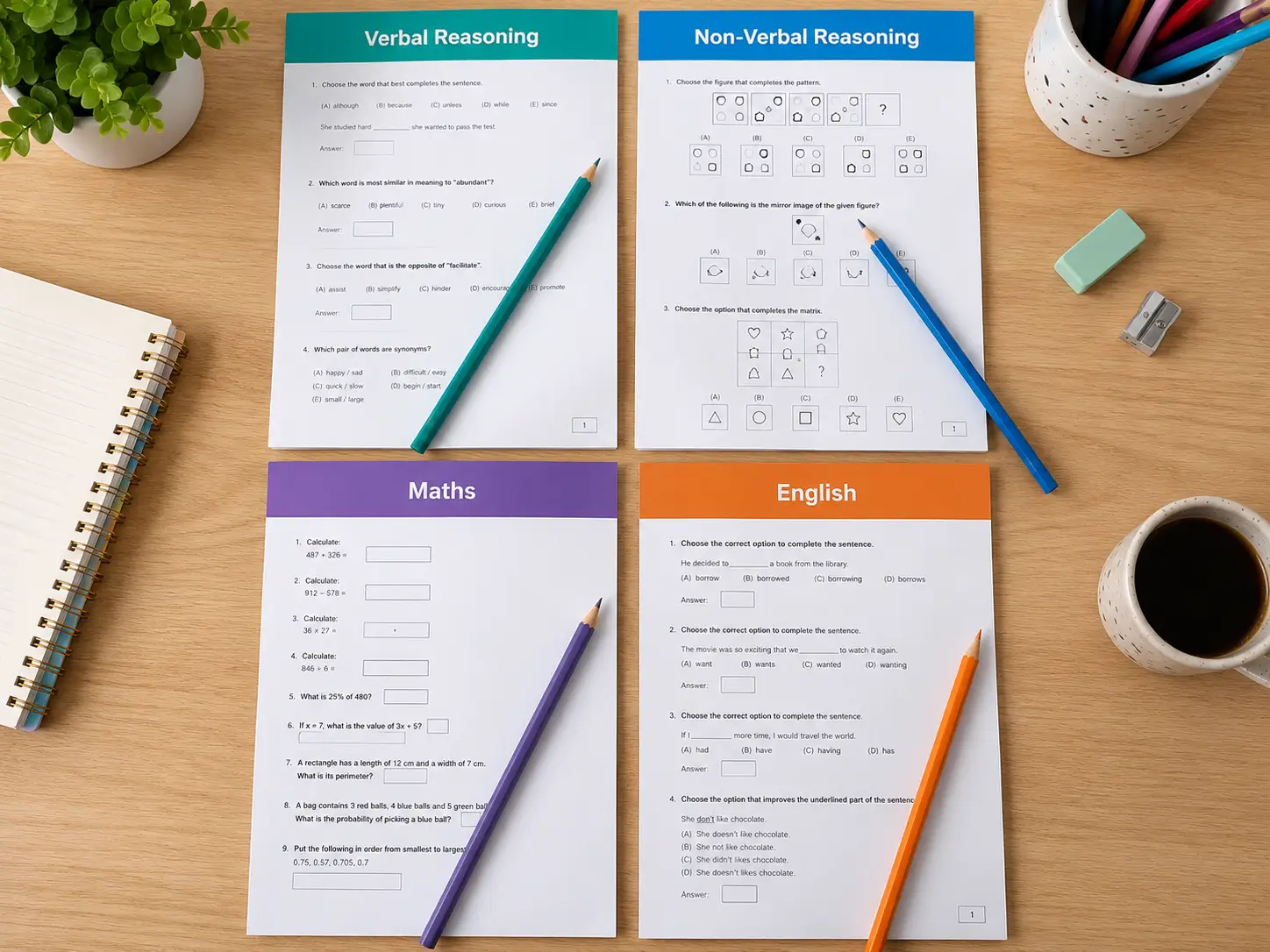
Format and timing essentials
GL papers are typically multiple-choice with a separate answer sheet, run under strict timing that most children find tight, and are frequently taken as two sittings of roughly an hour with a short break (Gloucestershire's consortium test, for example, runs exactly this way). Answer-sheet discipline is its own skill — a right answer marked on the wrong line scores zero — and there is no penalty for guessing, so a blank is the only wrong strategy. GL also publishes free familiarisation materials, which every family should download; several consortium schools link to them directly.
How GL tests are scored
Raw marks are converted to age-standardised scores, so an August-born child is not penalised against September-born classmates. Regions then use the standardised score differently — some set qualifying scores, others (like Gloucestershire) rank all qualifying children with no fixed pass mark. What this means for preparation: aim for consistent strength across papers, because ranking systems reward the child with no weak paper.
The practical consequence is that a raw mark on a practice paper tells you very little on its own, and comparing your child's raw score with another family's is close to meaningless when the children are months apart in age. What matters is the standardised score and how your region uses it. We explain how standardisation works, and what counts as a good score, in What Is a Good 11+ Score? Standardised Scores Explained.
Regions apply the same standardised scores in very different ways. Birmingham's King Edward VI Foundation has historically published both a qualifying score and a higher priority score; the Trafford consortium sets its own consortium threshold; Gloucestershire ranks qualifying children rather than setting a pass mark. Thresholds move year to year with the cohort, so use published figures to understand the system, not as a target to aim at — and always confirm the current year's arrangements on the school's own admissions page.
Which regions use GL?
GL or GL-style papers are used across most selective areas in England, but the combination of papers differs, and that difference should shape your preparation. Some consortia test all four banks; others use two or three. Checking this before you buy a single practice book is the cheapest hour of preparation you will ever do — families routinely spend months on a paper their region does not even sit. In London the variable is which authority you apply through rather than which consortium sets the paper, and the selective route open to you can differ from one borough to the next — we set that out district by district in our guide to tutoring by London district.
Areas we cover, and where to find the local detail:
How to prepare for a GL test, in order
Follow this order — inverting it (papers first, skills later) leads to an early plateau and a late panic:
- 1Vocabulary and reading first — from Year 4, wide reading is the highest-yield GL preparation that exists.
- 2Learn the question families — through Year 5, work systematically through VR and NVR types so nothing in the exam is a stranger.
- 3Curriculum-solid maths — speed comes from fluency, not tricks.
- 4Timed technique last — final summer: full papers, the 2-pass method, answer-sheet discipline.
One caution for younger children's families: providers do change — Gloucestershire moves to a new provider (FSCE) from 2028 entry — so build transferable skills, not format tricks.
- 1
Months 1–3 — vocabulary, reading and the question families
Wide reading continues throughout, but the active work is meeting every verbal and non-verbal reasoning type at least once, untimed. The goal for this phase is simple: nothing in the exam should be unfamiliar. Speed is explicitly not the target yet.
- 2
Months 4–6 — method and accuracy
Work each question family until the method is automatic rather than reconstructed each time. Keep maths fluency ticking alongside. Still largely untimed: a child who is fast and wrong has learned the wrong lesson, and unpicking that costs longer than teaching it properly first.
- 3
Months 7–9 — first full papers, then diagnosis
Introduce full papers, initially untimed, then loosely timed. Use them diagnostically: the point of an early paper is to produce a shortlist of two weak question families, not a score to worry about. Keep several clean papers back for later.
- 4
Months 10–12 — timing, technique and taper
Full papers under real conditions, the two-pass method, and answer-sheet discipline drilled until it is automatic. Target the two weak families identified earlier. In the final fortnight stop teaching new content, and in the final few days stop almost entirely.
The mistakes that cost the most marks
Most lost marks on a GL paper are not knowledge failures. They are timing failures, transcription failures and strategy failures — which is good news, because all three are fixable in weeks rather than years.
What good GL technique looks like
- Two passes: answer everything straightforward first, then return to the hard ones
- Never leaving a blank — eliminate, then guess decisively
- Marking the answer sheet in a fixed rhythm, checking the question number every few answers
- Skipping a stuck question within seconds rather than sinking two minutes into it
- Keeping a few unseen papers back for genuine timed mocks
What quietly loses marks
- Working through strictly in order and running out of time before the easy questions at the end
- Leaving blanks — there is no negative marking, so a blank is a guaranteed zero
- Losing a line on the answer sheet and shifting every subsequent answer
- Drilling papers before the question types are known, which teaches speed at guessing
- Using every practice paper early, leaving nothing clean for a real mock
Where TutorMint fits
Our 11+ programme is built around the GL format used across our regions: 1-hour lessons from £15, sequenced skills-first exactly as above, with honest progress reporting — including telling you when your child is already on track without us.
Ready to find out where your child stands?
Sources
- TutorMint founder — 10+ years preparing children for UK entrance exams
Written by TutorMint Founder
10+ years of classroom and one-to-one teaching experience. Facts checked 19 September 2026.
Found this useful?
Add Tutormint as a preferred source and our guides show up higher when you search Google.