One-to-One Online Chemistry Tutor for GCSE and A-Level Students
Chemistry is where science meets maths — and where marks quietly disappear. As your child's online Chemistry tutor, we build the method behind moles, equations and mechanisms, not just the rules.
Chemistry Topics We Cover
Atomic Structure & Bonding
Atoms, the periodic table, and ionic, covalent and metallic bonding — the model everything else in chemistry stands on.
Quantitative Chemistry
Moles, concentrations, yields and titration calculations — the maths-heavy strand where most Chemistry marks are lost.
Reactions & Energy
Rates, equilibrium, electrolysis and energy changes — understanding why reactions happen, not just what they produce.
Organic & Analysis
Hydrocarbons, polymers and analytical techniques at GCSE; mechanisms and spectra at A-Level.
GCSE Triple Science and A-Level Chemistry
At GCSE Triple Science, Chemistry is a standalone GCSE with deeper quantitative work than Combined Science. At A-Level, it is famously demanding — organic mechanisms, equilibria calculations and synoptic papers that connect the entire course. Our Chemistry specialists teach both levels to your child's exact board, building the calculation methods and exam technique the subject punishes students for lacking.
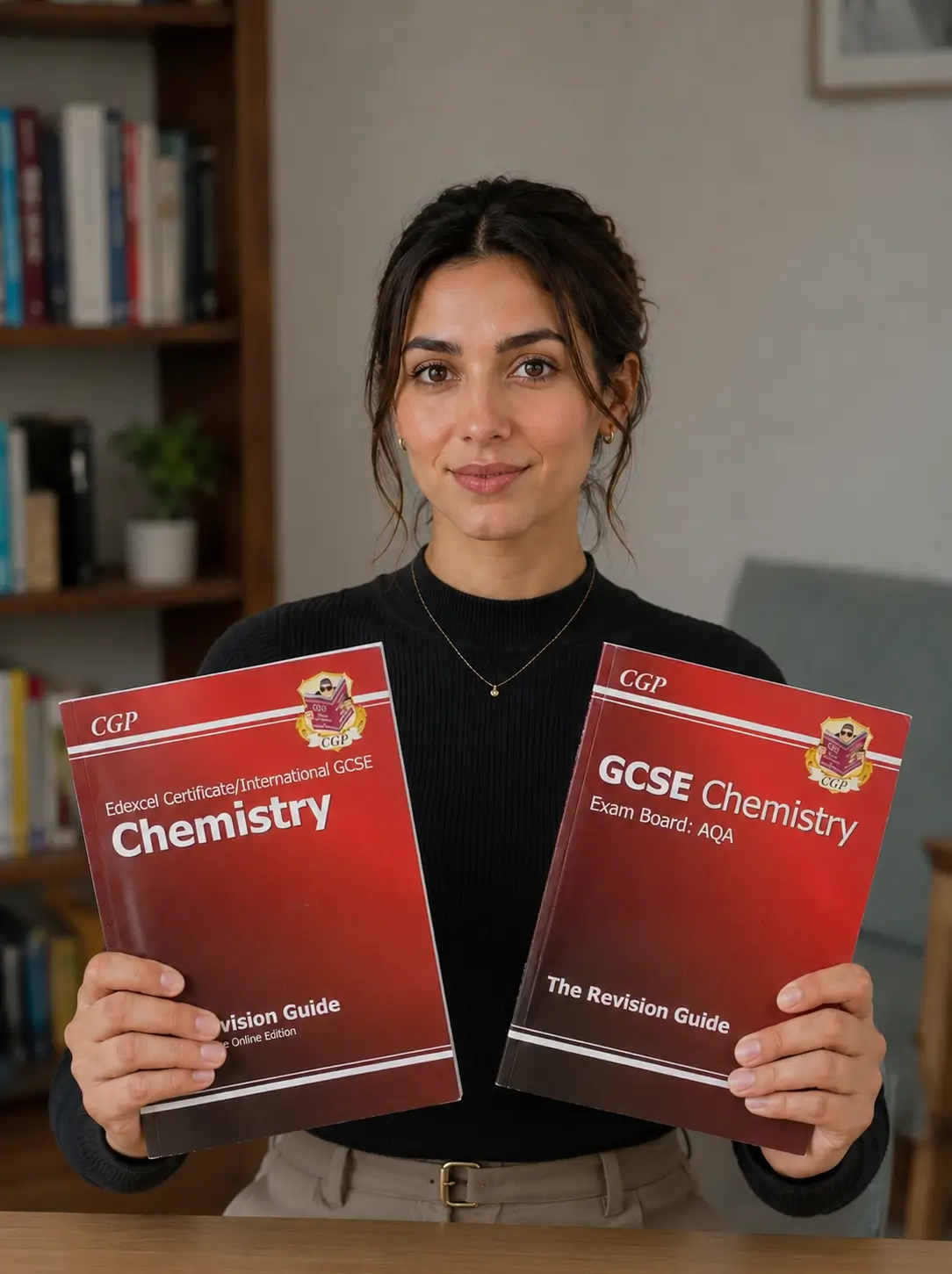
Chemistry Exam Boards We Teach To
Every Chemistry specification covers similar science, but they do not examine it the same way. Papers are structured differently, required practicals differ, and each board has its own habits in how it words questions and awards marks. A tutor teaching generic Chemistry to a student sitting a specific paper is leaving marks on the table. Your child's tutor works from their exact specification and that board's past papers from the first lesson.
AQA
The most widely taught Chemistry specification in England, at both GCSE and A-Level. A-Level Chemistry is assessed across three papers — two worth 35% each and a synoptic third paper worth 30% that includes 30 marks of multiple choice. Twelve required practicals run through the course and are examined in the written papers.
Edexcel (Pearson)
Common in independent schools and widely used for International GCSE. The content overlaps heavily with AQA, but paper structure and the balance between recall and application differ enough that practising the wrong board's papers gives a false read on readiness.
OCR
OCR runs two distinct routes at each level, which parents are often unaware of. At GCSE, Gateway and Twenty First Century present the same chemistry in different orders and contexts. At A-Level, Chemistry A is the conventional route while Chemistry B (Salters) teaches through applied contexts. We confirm which route a student is on before planning any lessons.
≥20%
of marks assess maths skills
≥15%
of marks assess practical skills
12
required practicals (AQA)
A-Level Chemistry Tuition: What the Course Actually Demands
A-Level Chemistry has a reputation for being one of the hardest A-Levels, and the reputation is earned. The course is built on three strands — physical, inorganic and organic — that are taught in parallel and then examined together, with a fifth of the marks assessing maths rather than chemistry.
What that demands week to week — the calculation chain, mechanisms as a notation, the practical endorsement and the synoptic paper — is covered in full on our A-Level Chemistry tutoring page.
GCSE Chemistry Tuition: Combined, Triple and Tier Choices
Two decisions shape a GCSE Chemistry result before a student sits a single paper — Combined versus triple science, and Foundation versus Higher tier — and parents are rarely walked through either.
Both, along with the calculation content that sits behind them and how the required practicals are examined, are covered on our GCSE Chemistry tutoring page. Chemistry consistently appears among the hardest GCSE subjects, and this is a large part of why.
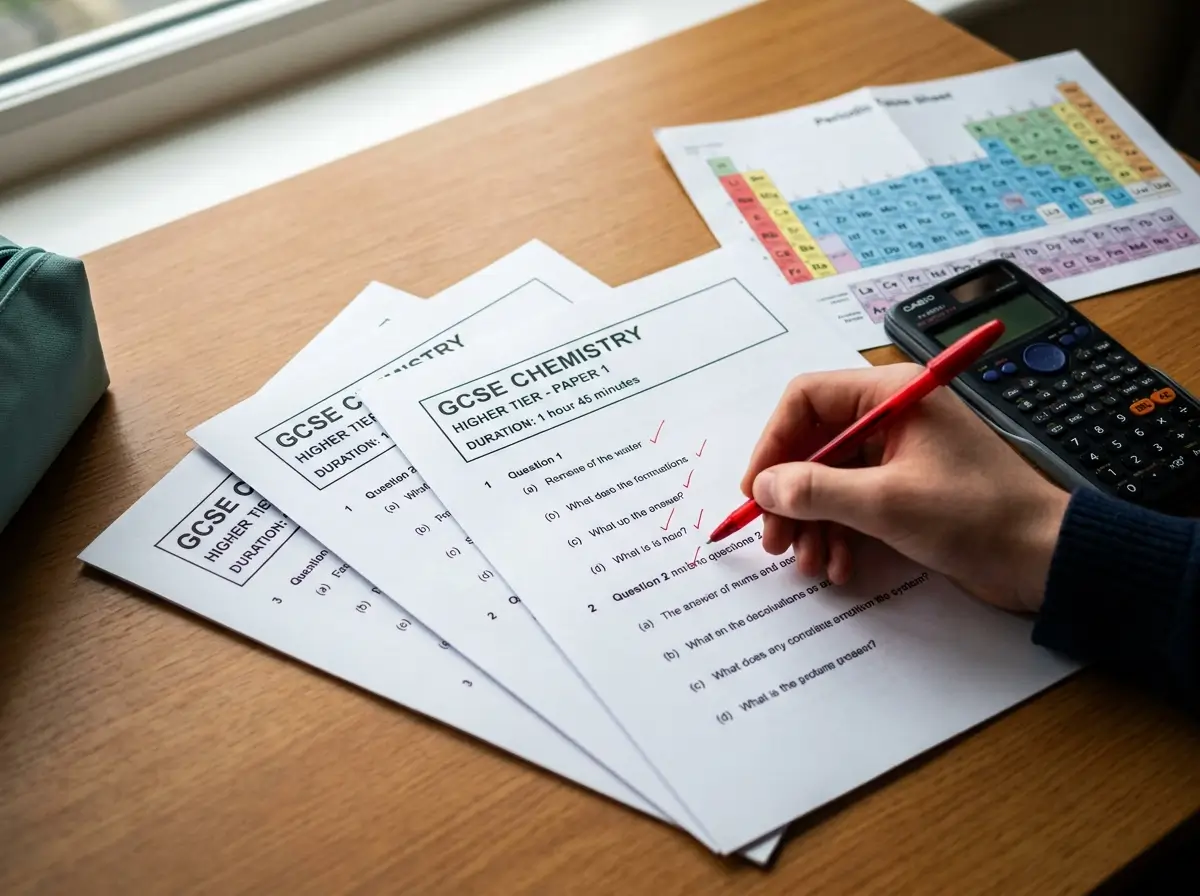
Foundation papers are graded 1–5 and Higher papers 4–9. Tier is decided before the exam, so we give an honest read on it from actual past-paper performance.
Where Chemistry Marks Are Actually Lost
After enough papers, the same handful of gaps account for most of the missing marks. These are the ones we look for first — and they shape how we plan exam preparation for every Chemistry student.
Moles and quantitative chemistry
The single biggest source of lost marks at GCSE and a persistent one at A-Level. The failure is almost never the concept of a mole — it is one insecure earlier step, usually relative formula mass or a unit conversion, that quietly corrupts every calculation built on top of it.
Balancing and ionic equations
Students who cannot balance quickly and confidently lose marks twice: once on the equation itself, and again on every calculation that depends on the ratio it gives.
Required practical questions
Method, variables, error and analysis. Theory-only revision leaves these questions feeling unfamiliar even when the underlying chemistry is well understood.
Extended response answers
Six-mark questions are marked on structure and linked reasoning, not on how much is written. Students who know the chemistry frequently under-score here purely on how the answer is organised.
Organic mechanisms (A-Level)
Curly arrows have rules. Students who memorise mechanisms rather than learning the rules cannot handle an unfamiliar molecule, which is exactly what the synoptic paper asks them to do.
Significant figures and units
Marks lost here are the most frustrating kind, because the chemistry was right. They are also the fastest to fix.
See How Online Chemistry Tutoring Works
One free demo class with an experienced Chemistry tutor — no payment, no obligation, and a clear picture of where the marks are being lost.
Online Chemistry Tutor FAQs
Answers to questions parents ask before booking a free Chemistry demo class.