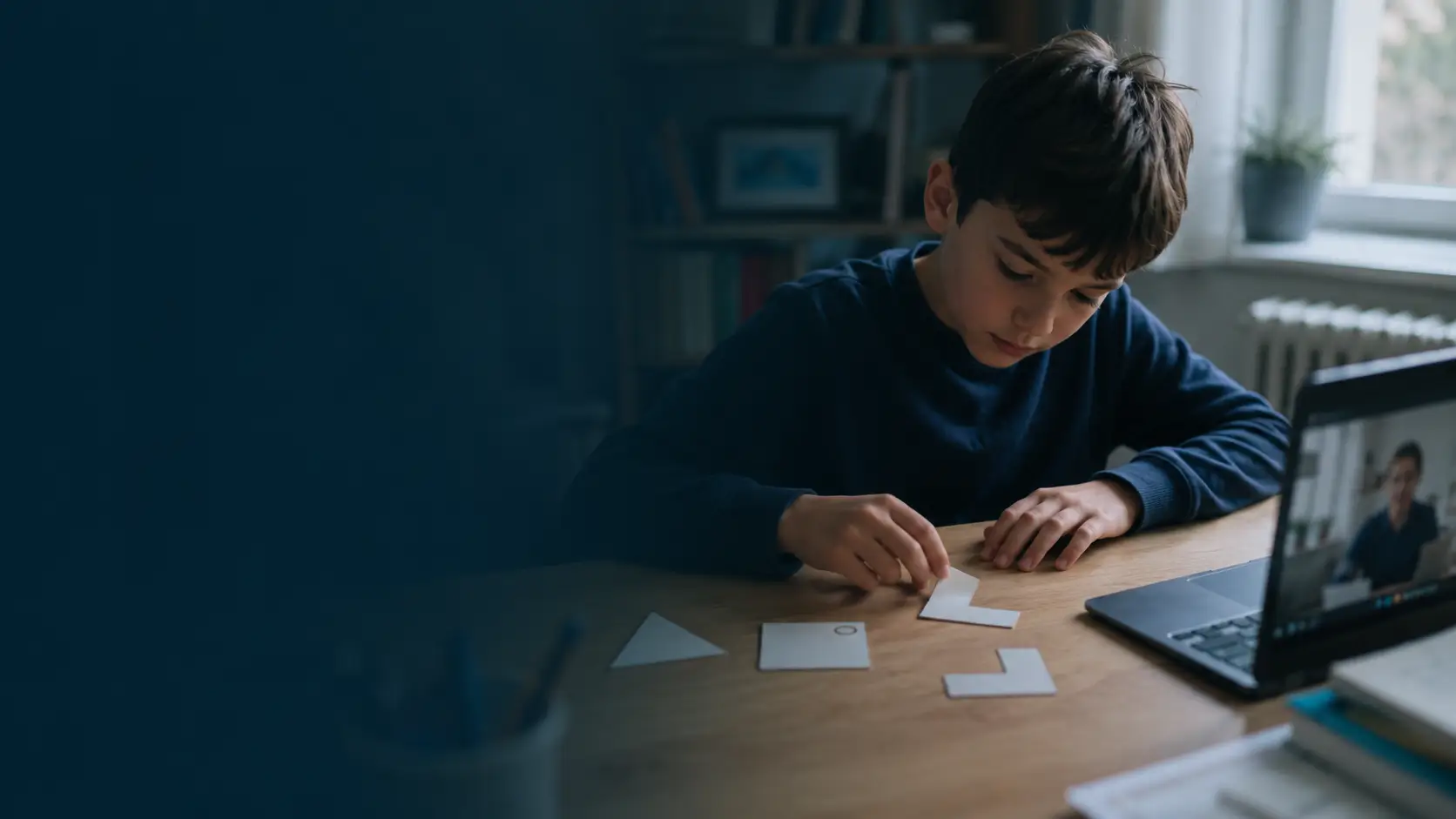
One-to-One Non-Verbal Reasoning Tutor for the 11+
Non-verbal reasoning looks like an IQ test, which is why parents assume it cannot be taught. It is a closed set of pattern families — and once a child can name the family, the puzzle stops being a puzzle. This is the most coachable paper on the 11+.
The Pattern Families Behind Every NVR Question
There is no infinite supply of NVR questions. There is a finite set of families, and every paper is built from them.
Similarities, Odd One Out & Analogies
“Which shape belongs with these?” and “A is to B as C is to?” One rule is hiding among four decoys — shading, rotation, line count, symmetry. We teach children to check the features in a fixed order instead of staring and hoping.
Series & Sequences
A row of shapes that changes by a rule, and one blank. Most errors come from spotting one change and stopping. The method is to track every element separately — position, count, shading, direction — and only then choose.
Matrices & Grids
A 2×2 or 3×3 grid with a missing cell, where the pattern runs across and down at the same time. Reliably the hardest family, because two rules must be held at once — and the family that improves most visibly with practice.
Rotation, Reflection & Cube Nets
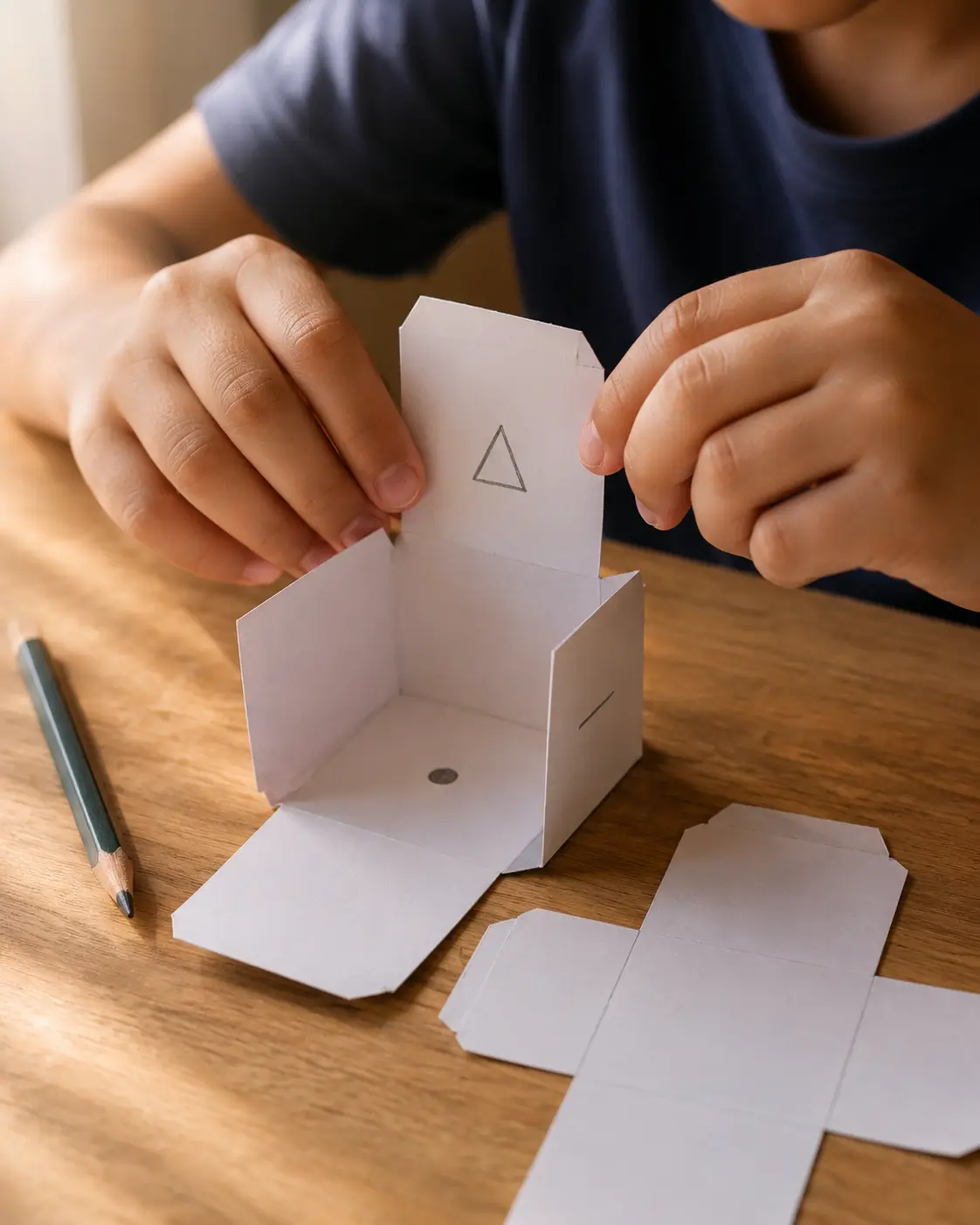
Turn it 90°, 180°, 270°. Mirror it left-right or top-bottom. Fold the net into a cube and say which faces touch. This is where spatial reasoning sits, and where a physical prop in the first few lessons beats any worksheet.
The Question Is Never “Which Looks Right?”
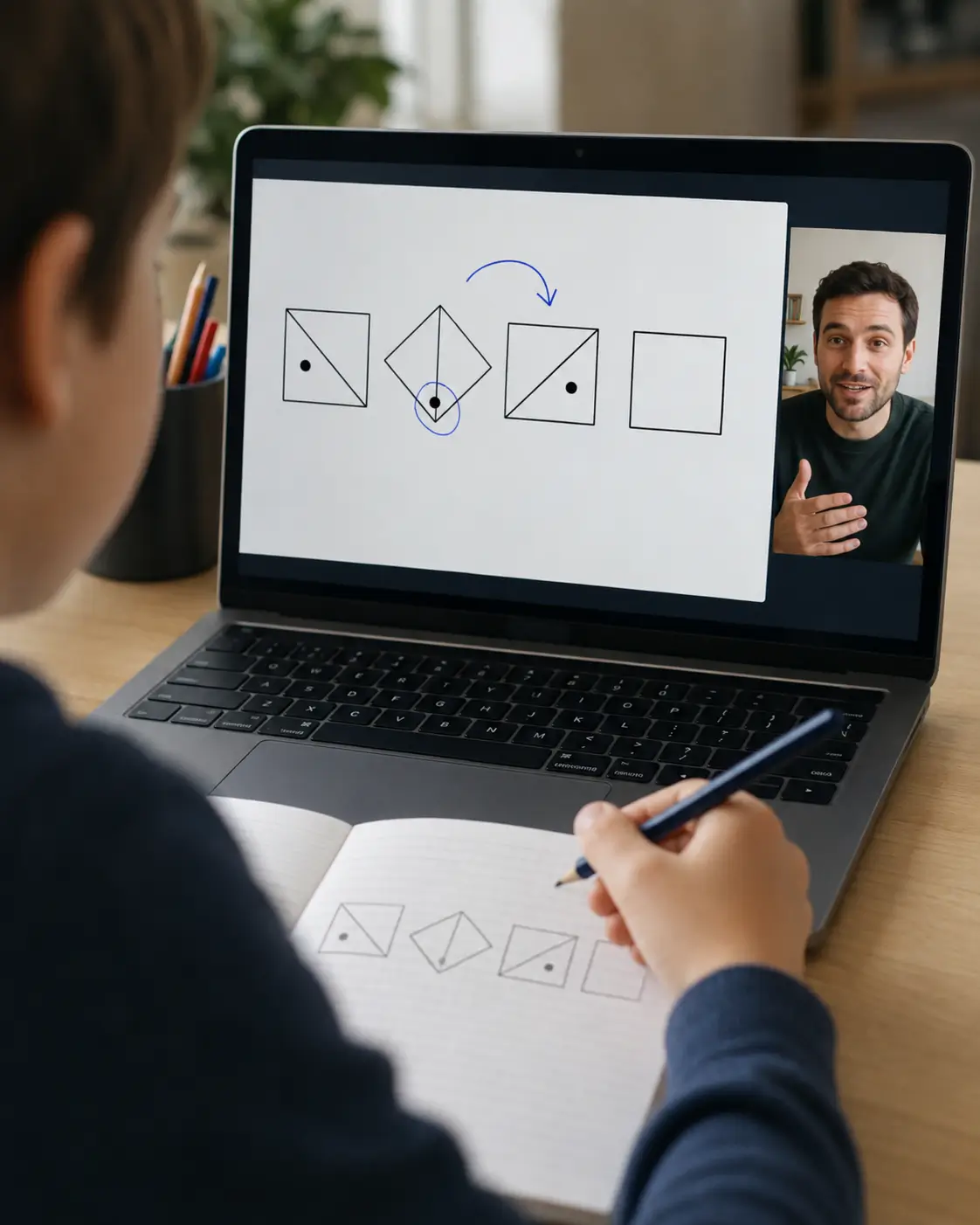
It is “which single answer keeps every feature consistent?” The triangle below turns, and the yellow dot turns with it. A child who tracks only the triangle picks a plausible wrong answer every time — the dot is what the question is actually testing.
Distractors in a real paper are built exactly this way: right shape, wrong dot. Teaching a child to check features in a fixed order is what removes the guesswork, and it is the first thing we do.
In a live lesson this happens on a shared screen, so your child watches the shape move instead of imagining it. Word-based puzzles are handled on our verbal reasoning tutor page.
Why NVR and Spatial Reasoning Respond Fastest to 11+ Tutoring
Non-verbal reasoning is untaught at school and unfamiliar at first sight, which is exactly why it improves fastest once the pattern families are learned. Nothing about it depends on six years of prior curriculum. A child who has never seen a matrix question is not behind — they are simply unstarted, and the distance from unstarted to competent is measured in weeks.
Compare that with 11+ Maths, where progress is built on years of arithmetic already in place. NVR has no such dependency. It is the single largest block of easily won marks on the test, which is why our 11+ programme treats it as an early priority rather than a summer top-up.
There is a second reason it repays teaching. Because NVR looks like an aptitude test, plenty of families skip it, assuming it measures something fixed. It does not. It measures whether a child has learned to look at a shape systematically. Skipping it is the mistake — and it is a common enough one that preparing properly is a genuine competitive edge in ranked admissions areas.
Spatial reasoning — nets, 3D rotation, views from above — is set as its own component in several regions and folded into NVR in others. We cover both, and we start by finding out which your target school actually sets.
How Our Non-Verbal Reasoning Tuition Is Sequenced
01
Name the family
Before solving anything, the child learns to say which family a question belongs to. Naming it selects the method. Guessing at unnamed questions is what produces a random score that swings twenty marks between mocks.
02
Check features in a fixed order
Shape, number, position, shading, size, direction — always the same order, every question. A fixed checklist is what turns “I can't see it” into a finite search. Nearly every NVR error we see in lessons is a child spotting the first change and stopping.
03
Build it before you imagine it
Rotation, reflection and cube nets are physical before they are mental. Early lessons use a real folded net or a turned page on camera; the mental version comes once the physical one is secure. Children taught to visualise straight away memorise instead, and memorising does not transfer to a new question.
04
Add the clock last
Timing and answer-sheet discipline come once accuracy holds. GL papers are multiple-choice with a separate answer sheet — a right answer on the wrong line scores zero — and there is no penalty for guessing, so no box should ever be left blank.
See Which Pattern Families Your Child Is Guessing On — Free
One free demo class with an experienced 11+ tutor, including a short diagnostic across the NVR families. You will find out whether the problem is one family or the whole paper — those need very different plans. No payment, no obligation.
New to the exam? Start with the full 11+ programme or read what counts as a good 11+ score.
Non-Verbal Reasoning Tutoring FAQs
Answers to the questions parents ask before booking a free non-verbal reasoning demo class.