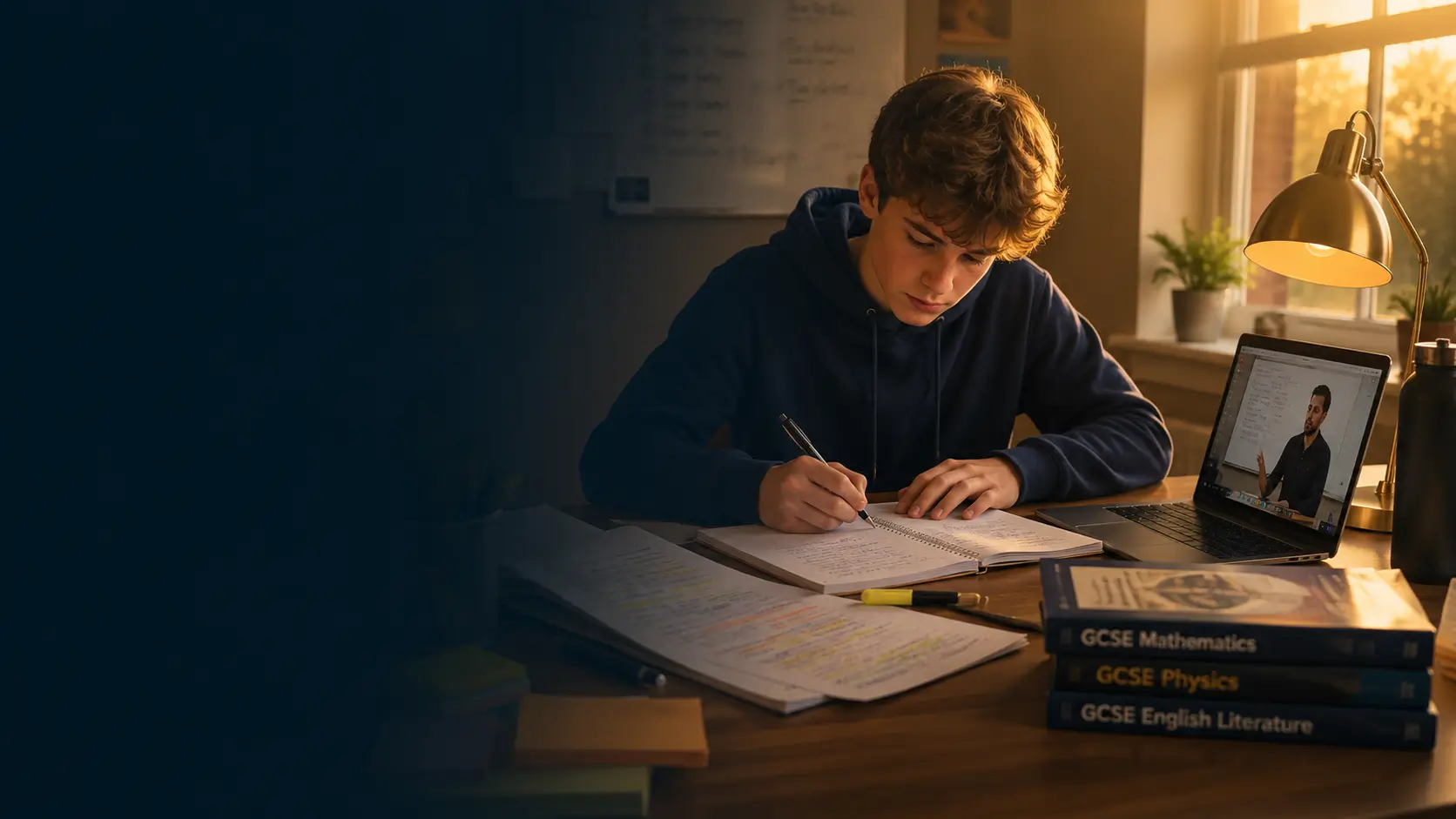
One-to-One Online GCSE Tutoring for UK Students
GCSEs decide sixth form places, apprenticeships and confidence for years afterwards. Our online GCSE tutoring turns predicted grades into achieved grades — one exam board, one specification, one student at a time.
- AQA
- Edexcel
- OCR
- Foundation & Higher Tier
- Years 10–11
GCSE Subjects We Cover
Maths, English and Science — taught to your child's exact exam board and tier.
GCSE Maths
Number, algebra, geometry and statistics across both calculator and non-calculator papers. Foundation students secure the marks that guarantee a strong pass; Higher students master the problem-solving questions where grades 7–9 are won. See our online Maths tutor page.
GCSE English
Language and Literature: analysing unseen texts, structuring essay answers, and using quotations the way examiners reward. We build the writing technique that turns ‘knows the text’ into marks on the paper. See our online English tutor page.
Built Around the 9–1 GCSE System
Every GCSE course is defined by its exam board specification — and that is exactly where our tutoring starts. Your child's tutor teaches to their board (AQA, Edexcel, OCR or WJEC) and their tier, using real past papers and mark schemes from the exams they will sit. Lessons begin with a gap analysis to find the topics costing marks, then work topic by topic: reteaching weak concepts, practising exam-style questions, and reviewing answers against the official mark scheme so your child learns to write what examiners are looking for — the same targeted approach behind all of our exam preparation, delivered as one-to-one online tutoring rather than in a group.
- Topic-by-topic gap analysis mapped to the specification
- Past paper practice with mark scheme review
- Exam technique: command words, timing and mark allocation
- Foundation and Higher tier strategies, including tier decisions
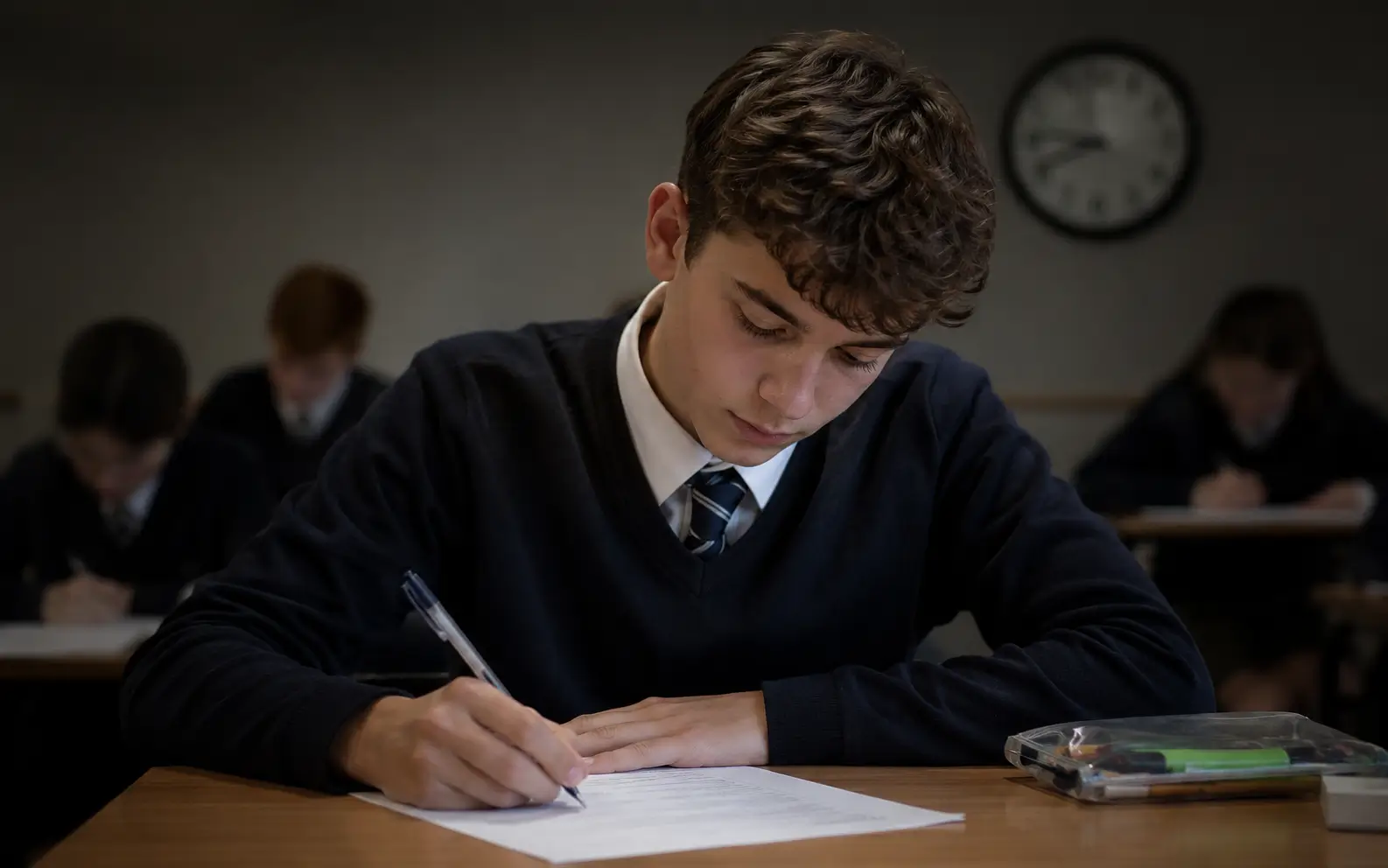
Year 10 or Year 11 — It's Not Too Late, But Earlier Is Easier
In Year 10, tutoring builds strong foundations while the content is still being taught, so nothing needs re-learning later. In Year 11, the focus shifts to targeted revision, mock exam preparation and closing the gap between predicted and target grades. Even students starting after the mocks can make meaningful progress — one-to-one lessons mean every session works on exactly what your child needs, not a general revision plan. If Year 10 has only just started and it has gone badly, a first half-term is weak evidence about a child, and we have written about which bad starts are worth acting on and which are simply the course settling in. Many students continue straight into A-Level tutoring once their GCSEs are behind them.
See How Online GCSE Tutoring Works
One free demo class with an experienced GCSE tutor. No payment, no commitment — see the gap analysis in action.
GCSE Tutoring Starts From £20 Per Lesson
Lessons are 1 hour. Your first demo class is completely free, there are no sign-up fees, and there's no contract — you can pause or stop at any time.
GCSE
from £20/lesson
1-hour lesson
What a GCSE Grade Actually Means Now
GCSEs in England are graded 9 to 1 rather than A* to G, and the two scales do not map onto each other neatly — which is why parents who sat lettered GCSEs often cannot read their child's report with any confidence. Grade 9 is deliberately set above the old A*, and is awarded to a small proportion of entries.
The line that matters most is between 3 and 5. A grade 4 is a standard pass and a grade 5 a strong pass. Sixth forms, colleges and employers set their own entry requirements against those, and the difference between a 4 and a 5 in Maths or English can decide which courses are open. Our grade 4 versus grade 5 explainer sets out where that line usually bites, and if the grade already sitting in front of you is a 3, we have written separately about what a grade 3 actually means and what the realistic routes forward are.
Two structural decisions are made before any paper is sat. Combined versus Triple Science, and tier. Both are settled before a student sits anything, both can quietly cap a grade, and neither is usually explained to parents at the time. Both are made in Year 9, alongside the rest of the GCSE options decision, which is the last point at which either is cheap to change. The detail sits with the subjects they affect — Maths, Biology and Chemistry each set out how the decision works in that subject. Mock results are a large part of the evidence a school uses to settle tier, which is why a bad set of mocks is worth reading properly rather than taken as a verdict — the mark breakdown decides more than the grade on the front does. Bring your child's current entry to the demo and we will give you an honest read on it, including when the honest read is not the comfortable one. Combined Science is also the lowest-passing GCSE in the country on the published 2025 figures, which our ranking of the hardest GCSE subjects sets out subject by subject.
Where GCSE Marks Are Actually Lost
Across every subject, the same handful of habits account for most of the marks that go missing — and almost none of them is a gap in subject knowledge. They are also the fastest things to change, which is why exam technique often moves a grade quicker than more content does.
Command words
Describe, explain, evaluate and compare ask for four different answers, and a confident answer to the wrong one scores nothing. This is the cheapest grade improvement available in most subjects.
Extended response marks
Six- and nine-mark questions are marked on structure and linked reasoning rather than volume. Students who know the material routinely under-score purely on how the answer is organised.
Timing across the paper
Marks are allocated per minute for a reason. Running long on early questions to make them perfect leaves the last page — often the highest-tariff page — unanswered.
Answering the adjacent question
The one that was revised rather than the one that was asked. It feels like an easy mark at the time and is invisible until the paper comes back.
Abandoned working
Crossed-out work cannot be credited. In any subject with method marks, a wrong final answer with visible working keeps most of the marks; a blank space keeps none.
Units, significant figures and precision
Lost after the thinking was already done, which makes these the most frustrating marks on the paper and the fastest to recover.