
One-to-One Online 11+ Tutoring for Grammar School Entrance
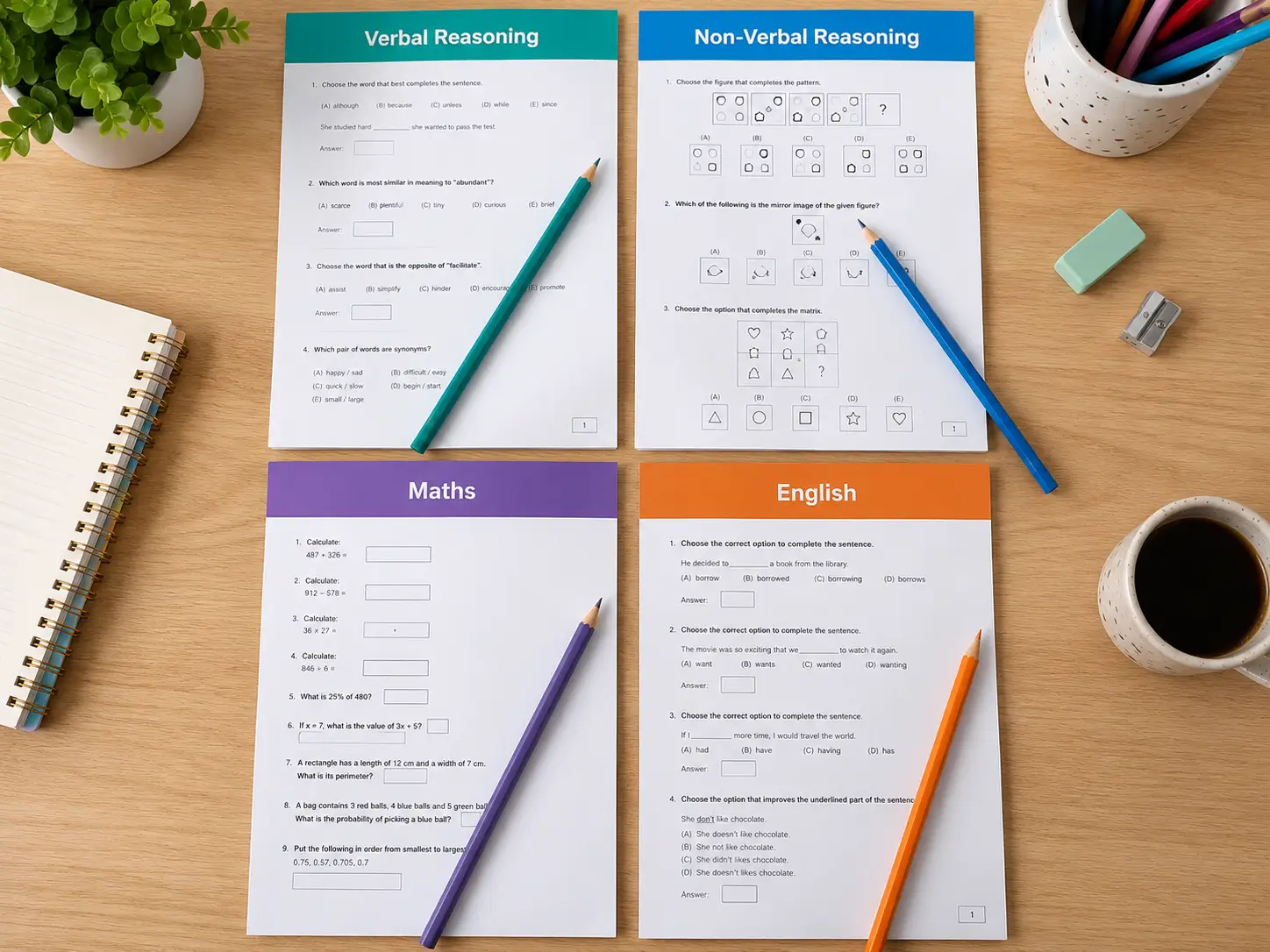
The 11+ rewards preparation, not just ability, which is why 11+ online tutoring works. We build the four skills the exam actually tests — Maths, English, verbal and non-verbal reasoning — with the speed and exam technique grammar school papers demand.
- GL Assessment
- School's Own Papers
- Verbal Reasoning
- Non-Verbal Reasoning
- Years 4–6
The Four Parts of the 11+ — and How We Prepare Each One
11+ Maths
Mental arithmetic, worded problems and multi-step reasoning at speed. We build accuracy first, then the pace the timed papers demand. If your child needs support beyond the entrance exam, our online Maths tutor page covers KS3 and GCSE too.
11+ English
Comprehension, vocabulary, spelling and grammar — plus creative writing for the schools that assess it. Wide vocabulary is the single biggest 11+ English advantage, and we build it week by week. For broader support once the exam is behind them, see our online English tutor page.
Verbal Reasoning
Word patterns, codes, logic and sequences. These question types are rarely taught in school — which is exactly why practice moves scores so quickly. See how our verbal reasoning tutor teaches all 21 question types.
Non-Verbal Reasoning
Shapes, rotations, mirror images and spatial patterns. We teach the recognition strategies that turn unfamiliar puzzles into familiar question types — our non-verbal reasoning tutor page shows the method.
What a GL Assessment 11+ Paper Actually Looks Like
Most selective areas in England now set their entrance test through GL Assessment, which draws from four question banks: verbal reasoning, non-verbal reasoning, maths and English. Your region decides which of the four are used and how they are weighted, so the cheapest hour of preparation you will ever spend is finding out which papers your child will actually sit.
There is no negative marking, which changes the strategy entirely: a blank is the only guaranteed zero, so we teach elimination first and then a decisive guess. Our full walk-through sits in GL Assessment 11+ explained.
What to expect on the day
- Multiple choice, marked on a separate answer sheet
- Often two sittings of roughly an hour, tightly timed
- No negative marking, so a blank is the only certain zero
- Raw marks converted to age-standardised scores
- Free familiarisation papers published by GL
Arrangements differ by school. Tell us what your target school's admissions page says and we prepare for that test.
We Prepare for the Exam Your Target School Actually Sets
Different grammar schools and regions use different 11+ arrangements. Most selective areas now use GL Assessment or GL-style papers, and a number of independent schools set their own entrance exams. The formats differ in question style, timing and how answers are recorded, so practising the wrong style wastes precious months. Tell us your target schools, and your child's tutor prepares them for the exact format they will face, using realistic practice papers and strict timing from the start.
Parents still ask about GL versus CEM. The comparison is now largely historical: the familiar CEM paper format was discontinued, and most areas that used it run GL or GL-style tests today. Advice written before that change is out of date on format, so check the school's current admissions page.

How the 11+ Is Scored, and What a Good Score Means
The raw mark is not the score that counts. Raw marks are converted into age-standardised scores, which adjust for how many months old a child is within the year group, so a summer-born child is not measured against a September-born classmate on raw marks alone. Regions then apply that score differently: some publish a qualifying score, others rank every qualifying child with no fixed pass mark, which is why a score by itself is never an offer.
Cut-offs also move each year with the cohort. A ranking system rewards the child with no weak paper over the child with one outstanding one, so we work across every strand the region sets rather than polishing the strongest. What is a good 11+ score works through it in full, and what happens when the result is a no covers the fortnight between results in October and the council's preference form on the 31st.

When Should 11+ Preparation Start?
Most 11+ exams are sat in September of Year 6, with results arriving in October before secondary school applications close. That makes the ideal preparation window Year 5 — a full year of steady, low-pressure practice. Starting later still works, but the plan changes: over the summer before the exam, lessons focus on timed papers, exam technique and the highest-value question types — the same targeted approach behind all of our exam preparation. If your child is sitting the exam this autumn, book the free demo now so we can assess where they stand and make every remaining week count.
A year of 11+ preparation, in order
Papers first and skills later is what produces an early plateau and a late panic. When to start 11+ preparation sets out the year-by-year version.
- 1Year 4
Reading, not practice papers
Wide reading builds the vocabulary that decides English and verbal reasoning marks two years later. It is the one thing that cannot be caught up in a term.
- 2Year 5
Meet every question family
Structured preparation starts here, untimed, until no question type in the exam is unfamiliar. Speed is deliberately not the target yet.
- 3Spring
Method and accuracy
Each question family is practised until the method is automatic, with maths fluency kept ticking alongside. A child who is fast and wrong has learned the wrong lesson.
- 4Summer
Timing and technique
Full papers under real conditions, the two-pass method, and answer-sheet discipline drilled until it is habit.
- 5September
The exam, then results
The test is sat, results arrive in October, and in the final fortnight before it we stop teaching new content.
Where 11+ Marks Are Actually Lost
Most marks that go missing on an 11+ paper are not knowledge failures. They are timing, transcription and strategy failures, which is good news, because all three are fixable in weeks rather than years.
Running out of time
Working strictly in order means the easy questions at the end are never reached. We teach two passes: everything straightforward first, then back to the hard ones with the clock understood rather than feared.
Leaving blanks
There is no negative marking on these papers, so an unanswered question is the only guaranteed zero. Eliminate what is clearly wrong, guess decisively, move on.
Losing a line on the answer sheet
One slipped line shifts every answer after it, and a child who knew the content can lose most of a paper to it. Answer-sheet rhythm is a skill, and we practise it deliberately.
Vocabulary left to the end
Inference and synonym questions rest on reading breadth, built over years rather than weeks. Our guide to verbal reasoning question types shows where it shows up in the paper.
11+ Tutoring Wherever You Are in the UK
Selective arrangements are local: which papers are set, how places are allocated and when children register all vary by area. We keep a guide for the areas families ask about most.
Lessons are online, so we cover the whole UK, including areas without a local guide. Every area we cover is listed on the UK tutoring hub, and 11+ lessons are 1 hour from £15 at our published rates. London families sitting the 11+ often want the borough picture rather than the city one, because the selective route open to you is decided by which authority you apply through — that is set out district by district in our guide to tutoring by London district.
Find Out Where Your Child Stands — Free
One free demo class with an experienced 11+ tutor, including a short assessment across the exam's question types. No payment, no obligation — just a clear picture of what to work on.
11+ Tutoring Starts From £15 Per Lesson
Lessons are 1 hour. Your first demo class is completely free, there are no sign-up fees, and there's no contract — you can pause or stop at any time.
11+
from £15/lesson
1-hour lesson