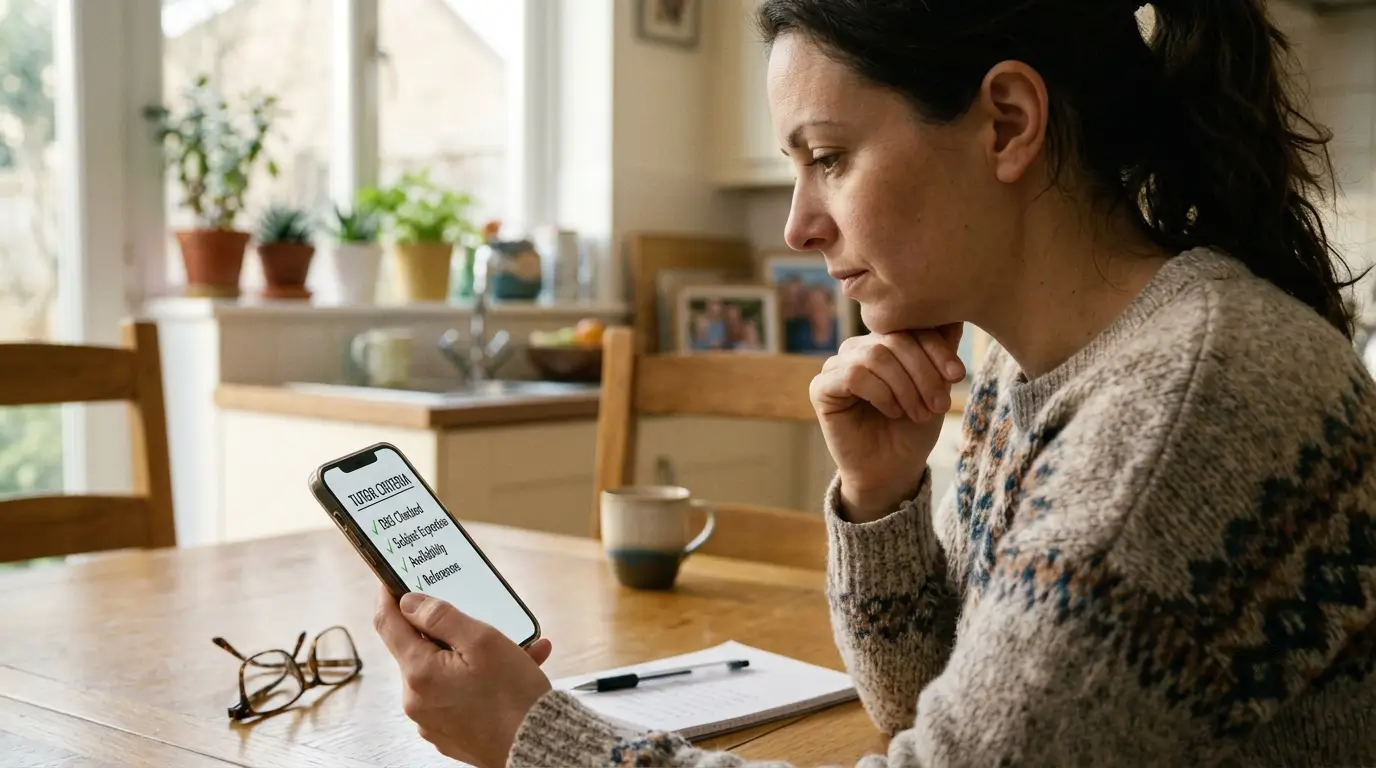
Choosing a tutor in the UK comes down to ten questions asked before any money changes hands: three about safety, five about teaching and contact, two about money. Most parents ask about price and availability, book, then meet the cancellation policy the first time their child is ill. Below are the ten questions verbatim, with what a good and a bad answer sound like, so you can tell them apart on the call.
The good and bad answers come from more than ten years on the tutor's side of these calls, not from a survey. Run it on us too: near the end are the two questions we would rather you did not ask, because our answer is not the best available.
How do you choose a tutor in the UK who is genuinely safe to hire?
Safety comes before price, subject and personality: a charming tutor with nothing verifiable behind them is no bargain. Three questions cover it, and the first has changed recently enough that most articles on the topic are out of date.
Question 1: “Do you hold an enhanced DBS check with a children's barred list check, and can I see the original certificate?”
A DBS check is a criminal record check run by the Disclosure and Barring Service. There are four levels, and 'DBS checked' on a profile tells you nothing until you know which one.
Basic
- What it shows
- Unspent convictions and conditional cautions
- Who it is for
- Anyone, any role
Standard
- What it shows
- Spent and unspent convictions and cautions
- Who it is for
- Certain specified roles
Enhanced
- What it shows
- The standard check plus any information held by local police that is considered relevant to the role
- Who it is for
- Roles needing greater scrutiny
Enhanced with barred lists
- What it shows
- The enhanced check plus whether the person is on the list of people barred from that role
- Who it is for
- The highest safeguarding requirements
| Level | What it shows | Who it is for |
|---|---|---|
| Basic | Unspent convictions and conditional cautions | Anyone, any role |
| Standard | Spent and unspent convictions and cautions | Certain specified roles |
| Enhanced | The standard check plus any information held by local police that is considered relevant to the role | Roles needing greater scrutiny |
| Enhanced with barred lists | The enhanced check plus whether the person is on the list of people barred from that role | The highest safeguarding requirements |
The barred list matters most for tutoring: it is the only level that tells you whether the person in front of your child has been formally barred from working with children.
Here is the nuance the marketplace articles skip: a private tutor is not in the same position as a school employee. Until 21 January 2026 a self-employed person could only apply for a basic check on themselves, and an enhanced check had to come through an employing organisation. From that date the Disclosure and Barring Service let self-employed workers apply for enhanced and enhanced-with-barred-list checks themselves, through a registered DBS umbrella body, where the role is eligible. Its announcement names private tutors teaching children directly as an example.
21 January 2026
the date self-employed tutors could first apply for their own enhanced DBS check
Disclosure and Barring Service, GOV.UK
Eligibility is not automatic. It depends on the work counting as regulated activity, which for teaching or instructing children means face-to-face contact on more than three days in any 30-day period, or once overnight between 2am and 6am. A tutor teaching several children weekly clears that comfortably. Someone who tutors one child once a fortnight may not, which means they may not be eligible for the barred list check at all. That is a fact about the rules, not a mark against the tutor, and a good one explains it rather than bluffs.
A good answer names the level without prompting, gives the date of issue, and offers to show you the original certificate, on a video call or in person. A bad answer is 'yes, I'm fully DBS checked' with no level attached, a scanned copy or photo sent by message, or 'the agency has it, you don't need to see it.'
GOV.UK is specific about what a parent should accept: you must see an original DBS certificate, and copies or digital photographs are not acceptable and should be rejected. Check the name matches photo ID, check the certificate is for the child workforce, and if it shows the person is barred from working with children, do not employ them. You cannot apply for a check on a tutor's behalf, so the certificate is your only route.
Question 2: “What date was it issued, and is it registered on the Update Service?”
DBS certificates carry no expiry date. A certificate is accurate on the day it is printed and says nothing about the years since. The DBS Update Service closes that gap: the tutor pays £16 a year to keep it live, and anyone with their permission and a legal entitlement can run a free online status check.
A good answer is a date and a yes, with the certificate number offered so you can check the status yourself. A bad answer is 'it's a few years old, but nothing's changed since.'
Question 3: “Do you have a written safeguarding policy, and who exactly do I report a concern to?”
Not a feeling about safety: a document, with a named person or role attached, and a stated response time.
Ours is published rather than emailed on request; read our safeguarding policy and the privacy policy covering your child's data before you speak to anyone.
A good answer points you to a document you can read now, names who handles concerns, and says what happens if a child may be at risk of harm. A bad answer is a reassuring sentence about being great with children, or a policy that turns out to be one line on a profile page.
What should you ask about lessons and communication?
Question 4: “Can I join or watch any lesson, without arranging it first?”
The answer should be an immediate yes. Online tutoring takes the parent out of the room by default; the fix is an open door. Our lessons run on Google Meet in the browser, and parents can join any lesson without notice.
A good answer is yes, any lesson, no notice needed. A bad answer is 'you can sit in on the first one,' or that a parent in the room would distract the student. The second is occasionally true for teenagers and always convenient for a tutor with something to hide.
Question 5: “How will you contact my child between lessons?”
A good answer is that they will not. Messages route through an official channel the parent can see, and progress updates go to the parent rather than the student. A bad answer is any version of adding your child on a personal messaging app so they can ask questions during the week. It sounds generous. It is the clearest safeguarding red flag on this list, and worth ending the conversation over.
Question 6: “What have you taught at this exact level and exam board, and for how long?”
Subject knowledge is not the same as teaching a specification. A tutor who has taught AQA GCSE Maths for five years knows which topics the paper punishes.
A good answer is specific: the board, the level, how long, and what they would do with a student sitting on a Grade 4 aiming at a 6. A bad answer is a personal grade quoted as a credential, or a claim to cover every subject and every board up to A-Level.
Question 7: “What will actually happen in the first lesson?”
A good answer is an assessment: find the gaps, then tell you honestly what they found, including the possibility that your child needs less help than you feared. A bad answer is a shortened lesson wrapped around a pricing conversation. A trial that spends longer on packages than on teaching has told you what the business is for.
Question 8: “How will I know it's working, and what will you tell me if it isn't?”
A good answer describes checkpoints and commits to delivering bad news. A bad answer is confidence as the only metric: real enough, and the easiest thing to report when the marks have not moved.
What should you ask about money before you pay anyone?
Question 9: “If my child is ill on lesson day, do I still get charged?”
Ask for it in writing, not spoken reassurance. Ours is in the terms and conditions: free rescheduling with 24 hours' notice, illness reschedules free even inside that window, and no charge if we ever cancel.
A good answer is a written policy with a notice period, a stated goodwill allowance, and a clause covering what happens when the tutor cancels. A bad answer is 'we'll sort it out nearer the time,' which becomes a full fee the first time it is tested.
Question 10: “What is the total cost, and can I stop after one lesson?”
Registration fees, matching fees and compulsory ten-lesson blocks do not appear in an advertised hourly rate. Our pricing starts from £15 for the 11+ and KS3, from £20 at GCSE and from £25 at A-Level, per one-hour lesson, with no sign-up fee and no contract.
A good answer is a single per-lesson figure, no compulsory block, and the freedom to stop. A bad answer is a headline rate that grows a matching fee and a minimum commitment on the call.
Which of these questions would we rather you didn't ask?
Two, honestly. Question 6 is the first. Our tutors are experienced at the level they teach. We do not claim qualified teacher status or examiner experience, and we do not currently claim enhanced DBS certification — when that changes, this page will say so plainly. If your non-negotiable is a serving teacher who marks for your child's board, someone else answers that question better than we do, and you should hire them.
The second is our track record with families like yours. We are early, and we would rather say so than manufacture a wall of reviews. What we offer instead is a real lesson before you decide, which is why the demo is free and unconditional.
What is the fastest way to run this checklist?
- 1Enhanced DBS with a children's barred list check, and can I see the original?
- 2What date was it issued, and is it on the Update Service?
- 3Written safeguarding policy, and who do I report a concern to?
- 4Can I join any lesson without arranging it first?
- 5How will you contact my child between lessons?
- 6What have you taught at this level and exam board, and for how long?
- 7What actually happens in the first lesson?
- 8How will I know it's working, and what will you say if it isn't?
- 9If my child is ill, do I still get charged?
- 10Total cost, and can I stop after one lesson?
Answers that should end the conversation: refusing to show an original DBS certificate; asking to message your child privately; guaranteeing a specific grade, which no honest tutor can do; a compulsory upfront block with no per-lesson option.
Ready to find out where your child stands?
Sources
- GOV.UK — Check someone's criminal record as an employer
- GOV.UK — Self-employed workers and personal employees can now apply for enhanced DBS checks
- GOV.UK — Private individuals employing self-employed workers or personal employees
- GOV.UK — Regulated activity with children
- GOV.UK — DBS Update Service
- TutorMint founder — 10+ years of classroom and one-to-one teaching experience
Written by TutorMint Founder
10+ years of classroom and one-to-one teaching experience. Facts checked 7 August 2026.
Found this useful?
Add Tutormint as a preferred source and our guides show up higher when you search Google.