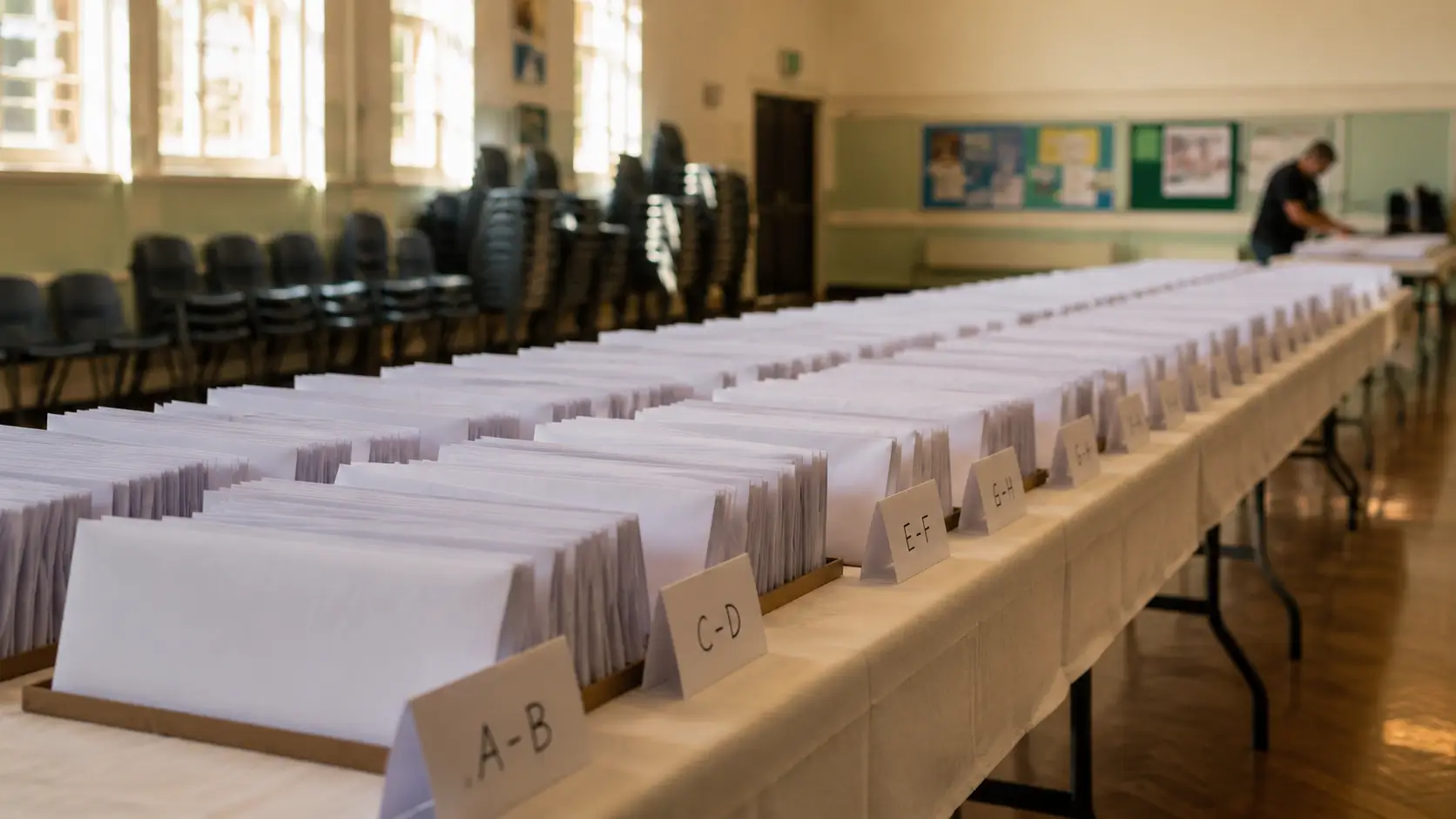
GCSE results day in England, Wales and Northern Ireland is Thursday 20 August 2026. Results reach schools and colleges from 8am, and most schools open their doors to students between 8am and 10am. This guide covers the day itself: what time results appear, what every line on the statement of results means, what counts as a pass in 2026, and what each outcome actually commits you to over the following weeks.
GCSE results day 2026 at a glance
- Thursday 20 August 2026 in England, Wales and Northern Ireland. Scotland's SQA results are issued separately, earlier in August.
- Results are released to schools from 8am. Your school sets its own collection window, so check the time it gave you rather than assuming 8am.
- Grade boundaries are published by the exam boards at 8am on the same morning. They tell you how many marks a grade was worth, which is the number that matters if a grade looks close.
- Grade 4 is a standard pass and grade 5 is a strong pass. Both are passes. Sixth forms and colleges set their own entry requirements on top of that.
- There is no Clearing at GCSE. Sixth form and college places are settled directly with the institution, usually on the day or the day after.
- If maths or English came in below grade 4 and you are continuing in post-16 education in England, you will be studying that subject again. The November series exists for exactly this, and entries close on 4 October 2026.
When is GCSE results day 2026?
Summer 2026 results days
A-Level, AS and level 3 vocational
- Date
- Thursday 13 August 2026
- Nations
- England, Wales, Northern Ireland
GCSE and level 2 vocational
- Date
- Thursday 20 August 2026
- Nations
- England, Wales, Northern Ireland
Summer 2026 results days
| Qualification | Date | Nations |
|---|---|---|
| A-Level, AS and level 3 vocational | Thursday 13 August 2026 | England, Wales, Northern Ireland |
| GCSE and level 2 vocational | Thursday 20 August 2026 | England, Wales, Northern Ireland |
The two dates are a week apart every year for a practical reason: sixth forms and colleges need the A-Level week to settle their own intake before the GCSE cohort arrives to confirm places.
What time do GCSE results come out?
Three different times get muddled together every August. They are not the same thing:
- 8am: results reach the school. Exam boards release results to centres from 8am on results day. This is a transfer to the school's system, not to students.
- 8am: grade boundaries go public. The boards publish boundary tables on their own websites at the same time. Anyone can look them up, including you, before you have seen a single grade.
- Whenever your school says: results reach students. Each school decides its own window. Many open at 8am, plenty open at 9am or 10am, and some post or email results instead. The time on your school's letter is the only one that applies to you.
If your child is collecting results without you, agree in advance that they will send a photo of the whole slip rather than typing out the grades. Half the panicked phone calls on results day come from a misread line or a missing subject that turns out to be on the second page.
How to read the statement of results
The slip carries more information than the grades, and the extra lines are the ones that change what you should do next.
- X and Q are not grades. X means no result was issued because the student was absent for all parts of an exam. Q means pending: marks for one or more components are missing. Both are administrative, both can be queried by the school's exams officer with the board immediately, and neither should be treated as a fail.
- Check which tier was sat. Foundation-tier GCSE maths is capped at grade 5. If your child sat Foundation, a grade 5 is the ceiling of that paper, not a shortfall.
- Look up the boundaries before you react. A grade 3 that sat two marks below the grade 4 boundary and a grade 3 that sat thirty marks below are entirely different situations, and they lead to different decisions about reviews of marking and about November.
- Write the gap in marks, not grades. For every subject that disappointed, note the number of marks between the mark achieved and the next boundary up. That single column is the most useful thing you will produce on Thursday.
What counts as a pass at GCSE in 2026?
The 9 to 1 scale in plain terms
9, 8, 7
- What it is called
- Top grades
- What it generally means in practice
- Broadly the old A* and A. Usually the entry range for A-Level study in that subject
6, 5
- What it is called
- Grade 5 is a strong pass
- What it generally means in practice
- Comfortably a pass. Many sixth forms set 5s as the bar for related A-Levels
4
- What it is called
- Standard pass
- What it generally means in practice
- A pass. Meets the post-16 requirement for maths and English in England
3, 2, 1
- What it is called
- Below a standard pass
- What it generally means in practice
- In England, maths and English at grade 3 or below trigger continued study post-16
U
- What it is called
- Ungraded
- What it generally means in practice
- No grade awarded
The 9 to 1 scale in plain terms
| Grade | What it is called | What it generally means in practice |
|---|---|---|
| 9, 8, 7 | Top grades | Broadly the old A* and A. Usually the entry range for A-Level study in that subject |
| 6, 5 | Grade 5 is a strong pass | Comfortably a pass. Many sixth forms set 5s as the bar for related A-Levels |
| 4 | Standard pass | A pass. Meets the post-16 requirement for maths and English in England |
| 3, 2, 1 | Below a standard pass | In England, maths and English at grade 3 or below trigger continued study post-16 |
| U | Ungraded | No grade awarded |
The grade 4 and grade 5 distinction causes more confusion on results day than anything else on the slip, largely because school league tables and government funding rules use them differently. We have written the full explanation separately: GCSE Grade 4 vs Grade 5: What Counts as a Pass.
Your sixth form or college place
Most post-16 offers are conditional on specific GCSE grades, and most institutions confirm or discuss places on results day itself or the morning after. There is no national clearing system at this level. It is a direct conversation with the school or college that made the offer.
If the grades meet the offer
- Confirm the place in whatever way the college asked, on the day if possible
- Check the subject-specific requirements, not just the overall total, because A-Level entry bars are often set per subject
- Enrolment dates are usually within a fortnight, so put the date in the calendar before you celebrate
- If a subject came in higher than expected, ask whether the A-Level choice can still be changed
If the grades fall short of the offer
- Phone the college the same morning. Places are frequently held for near misses, and the conversation goes better before the day fills up
- Ask specifically what they will accept: a different subject combination, a BTEC route, or a resit alongside the course
- Ask what they will enter your child for in November, and get the answer in writing
- If the answer is no, ask which local colleges still have places. Admissions staff know, and they will usually tell you
The three routes out of Thursday
What each outcome leads to
Grades met the offer
- The route
- Enrol and start
- The first move
- Confirm the place, note the enrolment date
One subject looks wrong against the boundary
- The route
- Post-results services
- The first move
- Ask the school for a free copy of the marked paper before deciding anything
Maths or English below grade 4
- The route
- November resit series
- The first move
- Agree the entry with the college well before 4 October 2026
Several subjects well below target
- The route
- A conversation about the route, not the grades
- The first move
- A vocational or BTEC path may fit better than repeating the same year
What each outcome leads to
| Situation | The route | The first move |
|---|---|---|
| Grades met the offer | Enrol and start | Confirm the place, note the enrolment date |
| One subject looks wrong against the boundary | Post-results services | Ask the school for a free copy of the marked paper before deciding anything |
| Maths or English below grade 4 | November resit series | Agree the entry with the college well before 4 October 2026 |
| Several subjects well below target | A conversation about the route, not the grades | A vocational or BTEC path may fit better than repeating the same year |
If the grades came in below what you were hoping for, the full guide to remarks, appeals and the retake decision is here: What to Do If the Grades Aren't What You Hoped. If November is now the plan, the dates, entry process and an eight-week study plan are in GCSE Resits 2026. And if one subject accounts for most of the disappointment, our ranking of the hardest GCSE subjects sets out how that subject performs nationally and what usually goes wrong in it.
Deadlines to write down before the week is out
Dates that follow GCSE results day 2026
3 September 2026
- What closes
- Priority copy of the marked GCSE paper
- Who acts
- The school requests it, with the student's consent
24 September 2026
- What closes
- Clerical re-check and standard review of marking
- Who acts
- The school, or the board directly for private candidates
4 October 2026
- What closes
- Entries for the November 2026 series
- Who acts
- The school or college enters the student
2 to 11 November 2026
- What closes
- The November exams are sat
- Who acts
- English Language and maths only
14 January 2027
- What closes
- November results released to candidates
- Who acts
- Direct to candidates
Dates that follow GCSE results day 2026
| Date | What closes | Who acts |
|---|---|---|
| 3 September 2026 | Priority copy of the marked GCSE paper | The school requests it, with the student's consent |
| 24 September 2026 | Clerical re-check and standard review of marking | The school, or the board directly for private candidates |
| 4 October 2026 | Entries for the November 2026 series | The school or college enters the student |
| 2 to 11 November 2026 | The November exams are sat | English Language and maths only |
| 14 January 2027 | November results released to candidates | Direct to candidates |
Two things about reviews of marking catch families out. Priority review of marking is not available at GCSE: it exists for AS, A-Level and other level 3 qualifications where a university place depends on the outcome. And there is no grade protection at any level. A review can lower a mark as easily as raise it, which is why looking at the free marked paper first is the sensible order.
What to say at home on Thursday
Worth saying plainly, because it costs nothing and it is the part most guides skip: nobody in your house will make a good decision before lunchtime. The exam boards' deadlines are weeks away. There is no route on this page that requires an answer in the first hour.
Helps
- Reading the whole slip together, calmly, including the subjects that went well
- Looking up the boundaries and working out the gap in marks
- Saying out loud that the decision does not have to be made today
- Letting them go and see their friends before any conversation about next steps
Does not help
- Comparing with a sibling's or a friend's results
- Deciding on a retake year on the doorstep
- Phoning round colleges while your child is standing there listening
- Treating a grade 4 as a failure because a 5 was expected. It is a pass
Where a tutor changes the outcome
Not on Thursday. In the ten weeks between results day and the November exams, and only if the work is aimed at something specific.
The marked paper is the reason to bother. It shows which questions lost marks and why: method marks not shown, one topic misread across three questions, a final section left blank because the clock ran out rather than because the content was unknown. Those are four different problems with four different fixes, and a student who resits without knowing which one applies to them tends to sit the same exam again and get something close to the same result.
Tutormint lessons are one-to-one and one hour, on Google Meet in the browser, with a shared whiteboard so tutor and student work the same question at the same time. Every student starts with a free demo class of around 40 minutes, including a short assessment, and you get honest feedback afterwards on where the marks actually went, including being told if tutoring is not what this needs. GCSE tutoring starts from £20 a lesson and A-Level tutoring from £25. Full rates are on our pricing page, and there is no contract.
If the gap is in maths or English going into sixth form or college, a short assessment with a maths tutor or an English tutor in the first fortnight is worth far more than the same work started in October. If the issue is exam technique rather than subject knowledge, start with exam preparation instead.
Ready to find out where your child stands?
Sources
- JCQ — Post-Results Services, Summer 2026 (who can request, consent, deadlines, appeals)
- AQA — Post-results services, summary guide summer 2026 (deadlines, no grade protection, X and Q codes)
- JCQ — Key dates in the examination cycle, GCSE November 2026 series
- GOV.UK — 16 to 19 funding: maths and English condition of funding
- Ofqual — Grading GCSEs: a guide for parents and students (9 to 1 scale, standard and strong pass)
Written by TutorMint Founder
10+ years of classroom and one-to-one teaching experience. Facts checked 31 August 2026.
Found this useful?
Add Tutormint as a preferred source and our guides show up higher when you search Google.