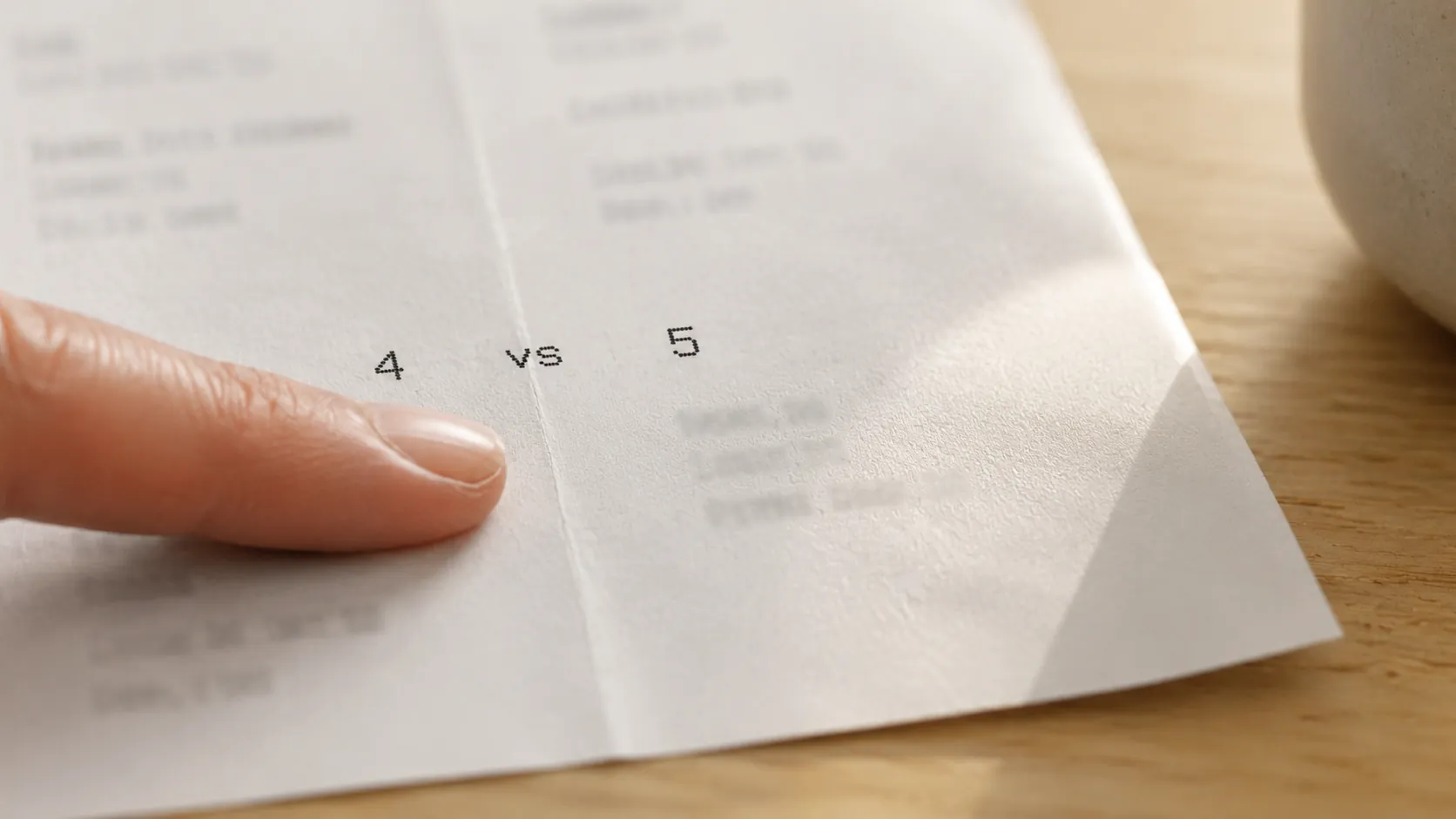
Short answer: a grade 4 is a pass — the Department for Education calls it a 'standard pass' — and a grade 5 is a 'strong pass'. Both terms are official. Neither is a rule about your child's future. The reason parents find this confusing is that the two numbers were designed for two different audiences, and almost nobody explains which is which.
The 9 to 1 scale in plain terms
GCSEs in England are graded 9 to 1, with 9 the highest. The scale replaced A*–G rather than translating from it, so there is no clean letter-for-number swap. The DfE gives three official anchor points, and everything between them is a redistribution rather than a translation.
The three official comparison points between the old and new GCSE grades
Bottom of grade 7
- Old grade
- Bottom of grade A
- What it anchors
- Top-end achievement
Bottom of grade 4
- Old grade
- Bottom of grade C
- What it anchors
- The standard pass line
Bottom of grade 1
- Old grade
- Bottom of grade G
- What it anchors
- The bottom of the scale
The three official comparison points between the old and new GCSE grades
| New grade | Old grade | What it anchors |
|---|---|---|
| Bottom of grade 7 | Bottom of grade A | Top-end achievement |
| Bottom of grade 4 | Bottom of grade C | The standard pass line |
| Bottom of grade 1 | Bottom of grade G | The bottom of the scale |
Grade 9 was deliberately set above the old A*, and is awarded to fewer students than A* was. And the old grade C was split in two — which is exactly why the old C-grade certainty disappeared. Both halves were then given jobs.
Standard pass (4) vs strong pass (5)
Grade 4 is the 'standard pass'. In the DfE's own wording, it "recognises grade 4 and above as a 'standard pass' in all subjects", calls it "a credible achievement for a young person that should be valued as a passport to future study and employment", and tells employers that if they previously asked for a grade C, the nearest equivalent is a grade 4.
Grade 5 is the 'strong pass'. Again in the DfE's wording, it "recognises a grade 5 and above in English or maths as a 'strong pass' in its headline school performance measure for English and maths attainment" — "a benchmark comparable with high performing education systems".
“Grade 4 is the pass the student needs. Grade 5 is the pass the school is judged on.”
Read those two definitions together and the whole thing clicks. That is why your child's school talks about 5s while the official post-16 rules talk about 4s. Both are behaving rationally. One of them is being measured.
67.1%
of UK GCSE entries were awarded grade 4 or above in summer 2025
Ofqual, all ages. Among 16-year-olds in England the figure was 70.5%
Why the difference matters more in maths and English
For most subjects, the 4/5 distinction is a matter of pride and of what a sixth form will accept. In maths and English it is written into national funding rules. If a student does not hold a grade 9 to 4 in maths and/or English, they must keep studying that subject as part of their post-16 education. It is a condition of the funding their college or sixth form receives, which is why it is not negotiable at the school's end.
16 to 19 condition of funding, 2026/27 academic year
Grade 4 or above
- What has to happen post-16
- Condition met. No requirement to continue that subject.
Grade 3
- What has to happen post-16
- Full-time students must study towards a GCSE in that subject — they are closest to a grade 4.
Grade 2 or below
- What has to happen post-16
- Study towards a GCSE grade 9–4, or a pass in Functional Skills level 2.
16 to 19 condition of funding, 2026/27 academic year
| GCSE grade in maths/English | What has to happen post-16 |
|---|---|
| Grade 4 or above | Condition met. No requirement to continue that subject. |
| Grade 3 | Full-time students must study towards a GCSE in that subject — they are closest to a grade 4. |
| Grade 2 or below | Study towards a GCSE grade 9–4, or a pass in Functional Skills level 2. |
Note what the rules do not say: a grade 3 does not mean an automatic November resit. It means the student must be studying towards the qualification. The route and the sitting are decisions for the college — so ask which series your child is being entered for rather than assuming.
Worth knowing before you plan a resit: in the November 2025 series, 37.5% of English Language resit entries and 23.2% of maths resit entries achieved grade 4 or above. A resit is winnable, but it is not a formality — and the students who pass are generally the ones who changed something about how they prepared, rather than simply sitting the same paper again.
Sixth form and college entry thresholds
Here is the honest answer, and it is the one most articles dodge: there is no national entry threshold. Every sixth form, college and training provider sets its own, and they vary by institution and by course. Many ask for grade 5s in English and maths for A-Level programmes; many ask for a 6 or 7 in the specific subject a student wants to take at A-Level; plenty of colleges accept 4s onto level 3 courses.
So don't guess the standard — get the actual numbers early:
- 1Look up entry requirements on the prospectus of every institution your child might apply to, in Year 10, not after results.
- 2Check the subject requirement, not just the general one — A-Level maths and the sciences usually ask for more in that subject.
- 3Ask what happens if they miss it by one grade: some places take a student on results day, some run a foundation route, some won't budge.
- 4Write the three numbers that matter on the fridge. A target beats a vague sense of 'doing well'.
If your child is aiming at a subject where the jump is steep — A-Level Maths is the classic — the grade they need is often a 7, not a 5, and that changes how Year 11 should be spent.
How to move a 3 or 4 up a grade
Moving between adjacent grades is usually not about learning more content. It is about converting marks that are already nearly there.
How near is worth knowing precisely. On the published boundaries a grade 3 sits about 40 marks below a 4 in maths and 19 in English — roughly thirteen and ten marks a paper. What a grade 3 actually means in marks breaks the gap down by paper and covers the tier decision that changes it most.
Find where the marks actually go. Get the mock paper, not the mock grade, and count the lost marks by cause: topic not known, method known but slipped, ran out of time, question misread. Grade-changing amounts of marks usually sit in the last three.
Bank the method marks. In maths especially, working shown is marks earned even when the final answer is wrong. Students chasing a 4 or a 5 lose a striking number of marks by writing nothing.
Target what appears every year. In maths, that means ratio, proportion, percentages and algebra fluency long before the exotic topics. In English, it means the assessment-objective wording the marks are actually awarded against.
Use the two techniques with the strongest evidence. Testing yourself rather than re-reading, and spacing practice out over time: the detail is in active recall and spaced repetition, and it matters more than the number of hours — on which, how many hours to revise is the wrong first question, and it is worth reading why.
Change the diagnosis, not the effort. A student who has already worked hard and got a 3 does not need to be told to work harder. They need someone to find the specific marks they are leaving behind. That is the part a class of thirty cannot do. If the grades have just landed and they were not what you hoped, the results-day guide covers remarks, appeals and the resit timetable.
At Tutormint that starts with a free demo class — about 40 minutes including a short assessment, so the first thing you get is a diagnosis rather than a sales pitch. Lessons run one hour on Google Meet in the browser with a shared whiteboard, and GCSE tutoring starts from £20 per lesson, with no sign-up fee and no contract. Rates for every level are on the pricing page.
Ready to find out where your child stands?
Sources
- DfE — GCSE factsheet for parents (May 2019): grade 4 recognised as a 'standard pass'; the grade 7 / 4 / 1 anchor points
- DfE — GCSE factsheet for employers, FE and HE providers (May 2019): grade 5 recognised as a 'strong pass' in the headline school performance measure
- GOV.UK — 2026 to 2027 academic year: 16 to 19 funding, maths and English condition of funding
- DfE — Secondary accountability measures: 2025 guidance (headline measure is grade 5 and above in English and maths)
- Ofqual blog — GCSE and level 1 and 2 results 2025 at a glance (67.1% grade 4+, 21.8% grade 7+)
- Schools Week — GCSE results 2025: 8 key trends in England's data (16-year-olds: 70.5% grade 4+; maths 71.9%; English language 70.6%)
- FE Week, 8 January 2026 — November 2025 resit outcomes from JCQ data
Written by TutorMint Founder
10+ years of classroom and one-to-one teaching experience. Facts checked 25 August 2026.
Found this useful?
Add Tutormint as a preferred source and our guides show up higher when you search Google.