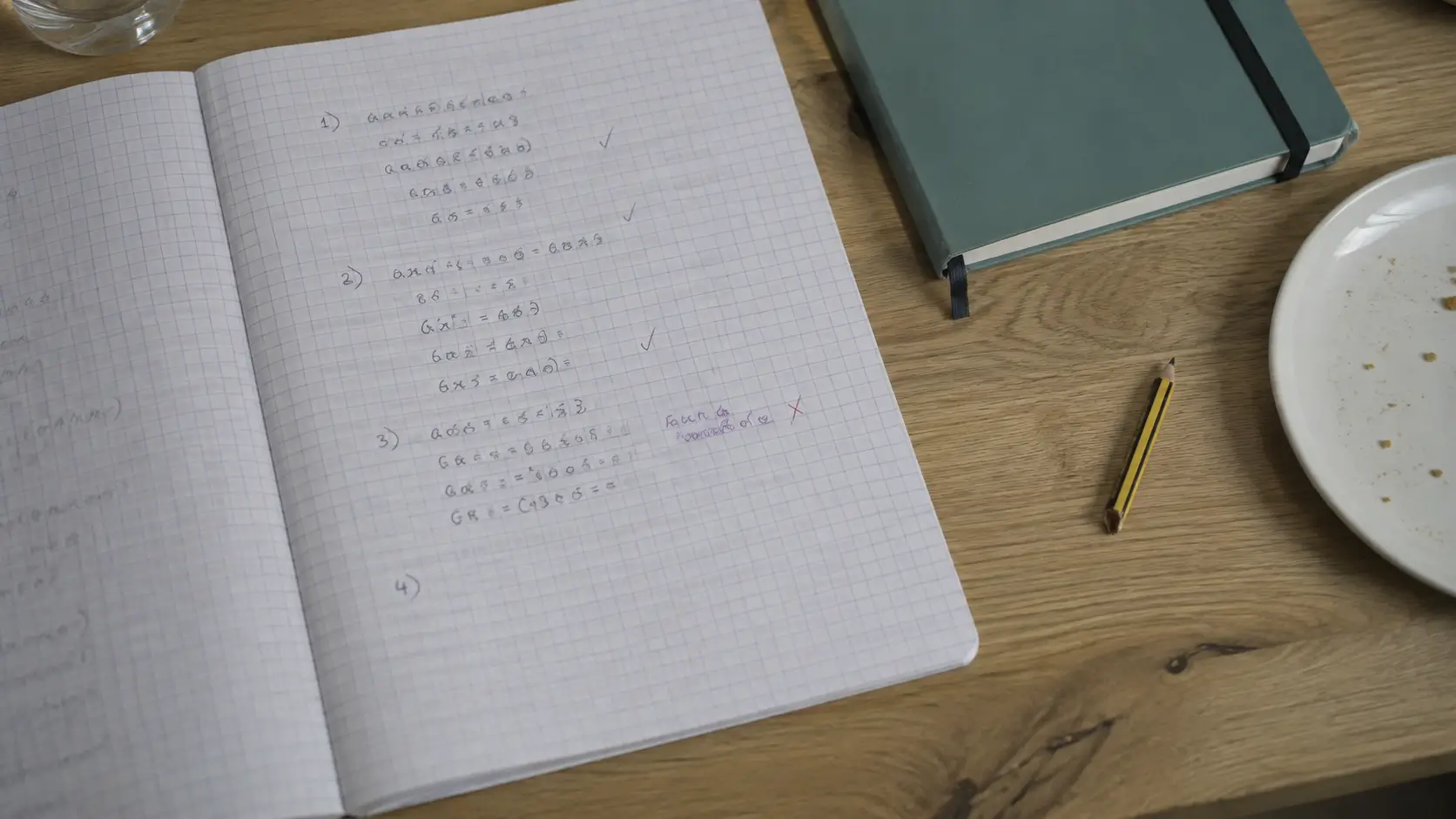
Most children at Key Stage 3 need no extra help at all. But KS3 is the cheapest time to fix anything that is wrong, and the easiest time to miss that anything needs fixing — because there is no exam, no league table and no report that tells you much. This is how to tell the difference, and what the smallest useful intervention looks like.
The myth that KS3 doesn't count
Key Stage 3 covers Years 7, 8 and 9 — the three years of the statutory national curriculum between primary school and GCSE courses. There is no national exam at the end of it. For most families that means there is no moment where anyone says "here is where your child is".
Schools feel that gap too. When Ofsted ran a dedicated survey of Key Stage 3 and published it in September 2015, drawing on the findings of around 1,600 routine inspections, it reported that inspectors raised concerns about Key Stage 3 in one in five of the routine inspection reports between September 2014 and March 2015. It also found that the majority of leaders it spoke to said they staffed Key Stages 4 and 5 before Key Stage 3, and that "too often, the transition from primary to secondary school was poorly handled".
That report is now more than a decade old, and much has changed since — but its central point is structural, not temporary: attention follows accountability, and nothing at KS3 is accountable. If a school's best maths teachers are timetabled to Year 11 first, that is a rational response to how schools are judged. It also means Year 8 is the year nobody is watching.
Why gaps at KS3 behave differently
This is an argument about how subjects are built, not a research claim.
Maths is hierarchical. Almost everything from Year 9 onwards assumes fluency with fractions, negatives, and rearranging an expression. A student who is shaky on those does not fail one topic — they lose marks in ratio, in algebra, in trigonometry, in probability, in every question where those operations appear as a step inside something else. The gap is invisible because it never appears as a topic on a report, which is why maths foundations are the first thing worth checking.
Science is cumulative in the same way, with the added problem that GCSE science assumes a working grasp of proportion, unit conversion and rearranging formulae — all of which are maths, taught elsewhere, and quietly assumed.
English is less hierarchical but more habitual. Reading volume at 12 shapes vocabulary at 16, and vocabulary at 16 shapes marks on every paper in every subject, because every exam is a reading test before it is anything else.
None of that means a struggling Year 8 is destined for a bad GCSE. It means the work needed to fix a gap grows over time, while the time available shrinks.
What actually changes between KS3 and GCSE
Families are often surprised by how abrupt Year 10 feels. Four things change at once:
- Everything is assessed. Coursework has largely gone from GCSEs; what remains is exams at the end, so knowledge has to be retained for two years rather than until the end of a unit.
- The volume of content rises sharply per subject, while the number of lessons stays the same.
- Depth of explanation replaces recall. A Year 8 answer that states the right fact often gets full marks. The GCSE version of the same question wants a mechanism, a comparison or an evaluation.
- Sets and tiers become consequential. Foundation-tier GCSE maths is capped at grade 5. Which tier a student ends up on is influenced by their Year 9 performance, in a decision often made without much ceremony.
That last point is the honest reason Year 9 matters more than Year 8. Some doors narrow at the end of it — GCSE option choices, science routes, and maths sets that are hard to move up from later.
Five signs your Year 8 or 9 is drifting
Not "getting lower grades" — drift is quieter than that.
- Homework is always finished, and always fast. Completed homework with no evidence of difficulty usually means it was copied, answered by an app, or set at a level that asks nothing.
- Test marks don't match classwork. The tell of a student who follows a lesson but cannot retrieve it a week later — a revision-method problem, easy to fix now, expensive to fix in Year 11.
- They can't tell you what they did. "Maths" is not an answer. A student who cannot name the topic has been passively present.
- A subject has become a personality trait. "I'm just not a maths person" at 13 is almost always a confidence account of two or three specific missing skills.
- The report says "working at expected standard" and nothing else. That phrase covers an enormous range. Ask the subject teacher one question instead: what is the single thing my child would most benefit from getting better at? Teachers answer that question well, and it is far more useful than a grade.
A second, blunter check: half of the pupils Ofsted surveyed for that same 2015 report said their homework never, or only some of the time, helped them make progress — inspectors found that too often homework "did not consolidate or extend pupils' learning". If homework is the only picture you have of your child's learning, it may be a poor one. If it is also the nightly battleground, homework help is a separate problem worth separating.
Light-touch support that works at this age
Year 8 does not need a revision programme. It needs small, specific, low-drama intervention — and, for most children, none at all.
What tends to work:
- One subject at a time. Fix maths foundations or reading, not both plus science.
- A fixed weekly hour, treated as normal rather than remedial. Twelve-year-olds are acutely sensitive to being singled out.
- Actual diagnosis before any teaching. Which specific skills are missing? A tutor who starts with the school's current topic without checking foundations is repeating the classroom, only more expensively.
- Reading, for anyone. Twenty minutes of anything they will genuinely read beats a vocabulary worksheet.
- Stopping when it's done. A gap closed is a gap closed. Support at KS3 should be able to end.
What tends not to work: starting GCSE content early "to get ahead" (it thins understanding, and they'll meet it again anyway), covering four subjects at once, and any arrangement the child experiences as punishment.
+5 months
additional progress from one-to-one tuition, on the EEF's average estimate
An average across studies, not a promise for any individual child — and the EEF notes it is considerably more expensive than most alternatives
That figure informs a decision rather than settling it. If you are still weighing whether any of this is worth paying for, is private tutoring worth it goes through the honest version of that question.
What good looks like by the end of Year 9
A short, checkable list. If most of these are true, your child is in good shape for Year 10 and needs nothing from anyone:
- 1Fractions, decimals, percentages and negatives are automatic, not worked out
- 2They can rearrange a simple formula and substitute into it without help
- 3They read something by choice, in any format, most weeks
- 4They can write a paragraph with a point, evidence and an explanation without being prompted for the structure
- 5They can say what they got wrong in a test and why
- 6They know which GCSE options they've chosen and roughly why
- 7Homework happens without a nightly negotiation
- 8There is no subject they describe as impossible
Anything unticked is a specific, nameable, fixable thing — which is exactly the advantage of asking the question in Year 9 rather than Year 11. It also helps to know which subjects get hardest: the hardest GCSE subjects is ranked on the actual 2025 outcome data. And if Year 10 has already started and it has not gone well, the same question a year on is a different one — is it too early for a tutor in Year 10 sets out which bad starts are settling in and which are worth acting on.
How Tutormint works at KS3
KS3 tutoring lessons are one-to-one and one hour, live on Google Meet in the browser with a shared screen or whiteboard, so the tutor and your child work the same problem at the same time. Lessons follow the national curriculum and your child's school scheme of work, and each ends with short practice for the week. Same tutor every week, fixed time, and you get an update after lessons saying what was covered and what's next. The same setup carries straight into GCSE tutoring when the time comes.
Every student starts with a free demo class — about 40 minutes, including a short assessment. The assessment is the point: the tutor works through questions to find not just what your child gets wrong, but why. Afterwards you get honest feedback, including "nothing much is wrong here" when that is the answer. KS3 lessons start from £15, there is no contract, and you can pause or stop at any time.
If you have been half-noticing something since Year 7, an assessment is a cheap way to find out whether it's real.
Ready to find out where your child stands?
Sources
- Ofsted — Key Stage 3: the wasted years? (September 2015): KS3 concerns in one in five routine inspection reports; around 1,600 inspections scrutinised; KS4 and KS5 staffed before KS3; half of pupils surveyed said homework never or only sometimes helped progress
- Education Endowment Foundation — Teaching and Learning Toolkit: one-to-one tuition estimated at five months' additional progress, and considerably more expensive than most alternatives
- GOV.UK — The national curriculum: Key Stage 3 covers Years 7 to 9
Written by TutorMint Founder
10+ years of classroom and one-to-one teaching experience. Facts checked 31 August 2026.
Found this useful?
Add Tutormint as a preferred source and our guides show up higher when you search Google.