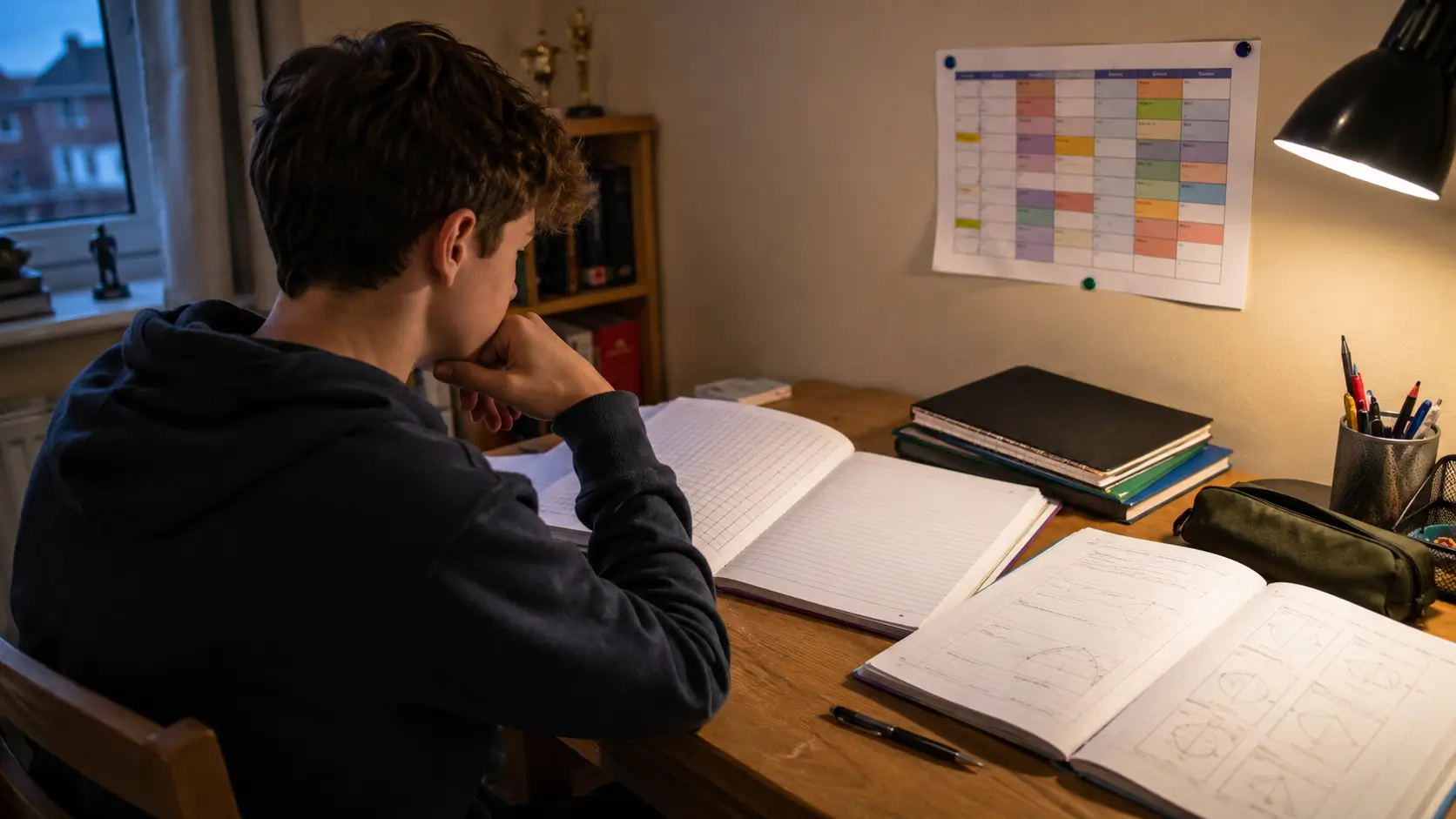
Year 10 started badly: the short answer
- One bad half-term at the start of a new course is weak evidence. New teachers, new subjects and a new pace produce marks that are about the transition rather than the child.
- What is not weak evidence: gaps carried up from Key Stage 3 into a subject that builds on them, and a subject that was fine last year and is not now.
- GCSEs in England are linear — every exam sits at the end of Year 11 — so autumn Year 10 content is examined up to twenty months later, and nothing on the course is re-taught before then.
- Tier decisions are confirmed in Year 11 but built out of Year 10 evidence, and the tier sets the ceiling: Foundation maths stops at grade 5, Foundation combined science at 5-5.
- The useful move this term is not a tutor, it is a diagnosis: which topics, and whether the marks are being lost on the new content or on what it assumes.
Every year, a set of reports lands in October and a set of parents ask the same question: it is six weeks in, everything is suddenly harder, and is it too early to do something about it? The honest answer is that it depends on what kind of bad start it is — and that Year 10 is the first year where the cost of guessing wrong goes up.
What actually changes in Year 10
Year 10 is not Year 9 with harder questions. Four things change at once, which is why a child who was comfortable in July can look lost in October.
- Everything counts, and nothing is re-taught. Reformed GCSEs are linear: in the government's own words on the reform, they are "no longer divided into different modules and students will take all their exams in one period at the end of their course". Autumn of Year 10 is examined in the summer of Year 11 — up to twenty months later — and the course only adds to itself in between.
- The subject count goes up and the depth goes up with it. Nine or ten GCSEs running at once, each with its own homework, assessment cycle and specification. The workload problem in Year 10 is usually scheduling before it is ability.
- Non-exam assessment starts appearing. Practical work in science, spoken language in English, coursework in art and design and technology. Assessment is mainly by exam, with other types used only where an essential skill needs testing — but the parts that are not exams tend to land in Year 10 and are easy to under-rate at the time.
- Sets and tiers stop being administrative. In Year 9 a set was where a child sat. In Year 10 it starts to shape what they can be entered for, which is the section below.
Why a bad start in Year 10 is different from a bad start in Year 8
At Key Stage 3 the argument for acting early is that gaps compound. At Year 10 there is a second argument on top of it, and it is arithmetic rather than opinion: a topic taught in October of Year 10 is sat in an exam in May or June of Year 11. Nothing in the timetable revisits it in between. Whatever is not understood now becomes revision-from-scratch later, at the point in the course when there is least room for it.
That is the whole case for not waiting, and it is also the reason the honest version of this article is not "book a tutor". A gap you can name in October is a few hours of work. The same gap found in the spring of Year 11 is competing with nine other subjects and a revision timetable. It is the same argument that makes Year 9 the cheap point to act rather than Year 11 — one year further on, with the meter now running.
The trap is the opposite mistake: reacting to the first assessment of a new course as though it measured the child. It largely measures the transition. Six weeks in, a mark is a prompt to look at the paper — not a verdict.
Is it too early for a tutor? Six situations
What a bad start in Year 10 usually is, and what it actually needs
Marks down across every subject, including ones they enjoy
- What it usually is
- Not a subject problem — attendance, the workload jump, or something outside school
- What it needs now
- The form tutor before any subject teacher. Tutoring a term-shaped problem does not work
One new subject is hard and the rest are fine
- What it usually is
- Settling. New teacher, new content, unfamiliar assessment style
- What it needs now
- A half-term of patience, then look again after the next assessment
Maths or science slipping, and it was shaky at KS3 too
- What it usually is
- Carried gaps meeting content that assumes them
- What it needs now
- Act now. This is the case where six weeks of targeted work changes the year
A subject that was strong last year and is not now
- What it usually is
- Something specific and findable — a missed unit, a method never secured, a set change
- What it needs now
- Get the paper and name the topic before deciding anything
Fine in class, poor in assessments
- What it usually is
- Recall, not understanding. The book had the example on the page above
- What it needs now
- Retrieval practice, not re-teaching
They have decided they are bad at the subject
- What it usually is
- Confidence, and it hardens fast at this age
- What it needs now
- Worth an outside voice sooner rather than later, tutor or not
What a bad start in Year 10 usually is, and what it actually needs
| What you are seeing | What it usually is | What it needs now |
|---|---|---|
| Marks down across every subject, including ones they enjoy | Not a subject problem — attendance, the workload jump, or something outside school | The form tutor before any subject teacher. Tutoring a term-shaped problem does not work |
| One new subject is hard and the rest are fine | Settling. New teacher, new content, unfamiliar assessment style | A half-term of patience, then look again after the next assessment |
| Maths or science slipping, and it was shaky at KS3 too | Carried gaps meeting content that assumes them | Act now. This is the case where six weeks of targeted work changes the year |
| A subject that was strong last year and is not now | Something specific and findable — a missed unit, a method never secured, a set change | Get the paper and name the topic before deciding anything |
| Fine in class, poor in assessments | Recall, not understanding. The book had the example on the page above | Retrieval practice, not re-teaching |
| They have decided they are bad at the subject | Confidence, and it hardens fast at this age | Worth an outside voice sooner rather than later, tutor or not |
Two of those six are not tutoring questions at all, and one of them — the whole-report dip — is covered properly in why a child falls behind, and whether it is one subject or all of them. A tutor is the right answer to a subject-shaped problem. It is an expensive answer to a timetable-shaped or a sleep-shaped one.
The tier decision is already being formed
This is the part of Year 10 that parents most often discover a year too late. Some GCSEs are split into a Foundation and a Higher tier, which is allowed where one paper cannot give every student a fair chance to show what they know. In practice it is maths and the sciences that most families meet. The entry is confirmed in Year 11, but it is decided out of evidence collected in Year 10.
What each tier can be awarded
GCSE maths
- Foundation
- Grades 1 to 5
- Higher
- Grades 4 to 9
GCSE combined science (double award)
- Foundation
- 1-1 to 5-5
- Higher
- 4-4 to 9-9, with a 4-3 safety net just below
What each tier can be awarded
| Subject | Foundation | Higher |
|---|---|---|
| GCSE maths | Grades 1 to 5 | Grades 4 to 9 |
| GCSE combined science (double award) | 1-1 to 5-5 | 4-4 to 9-9, with a 4-3 safety net just below |
A ceiling is not a failure — for many students Foundation is the right paper and produces a better grade than Higher would. What matters is that the decision is made deliberately rather than by drift, and that it is made knowing a grade 5 is the most a Foundation maths paper can award. If a grade 6 or above matters for a sixth-form course, the tier conversation is a Year 10 conversation, not a Year 11 one.
The other structural decision sitting in the same window is Combined versus Triple Science, which we set out in combined vs triple science, and the grade thresholds that tend to matter afterwards are in grade 4 vs grade 5.
Can we still change an option?
Sometimes, and only for a short while. Option changes are a school decision rather than an exam-board one, so there is no national deadline to quote — what there is instead is a timetable, a set of class sizes and a teacher already six weeks into a specification. In practice the window is the first few weeks of Year 10, and it narrows every week after that.
If it is genuinely the wrong subject rather than a hard start, ask the school these before the half-term:
- 1Is a change still possible on the timetable, and until when?
- 2How much of the specification has the other class already covered, and how would that be caught up?
- 3Is the concern the subject itself, or the teacher, the set, or the friendship group in the room?
- 4Would this change close off a sixth-form course or a career route they have mentioned?
- 5If we stay, what would need to be true by Christmas for this to be working?
Changing a subject to escape difficulty rarely helps if the difficulty travels — a student who finds the writing hard in history will find it hard in geography. Change the subject when the subject is wrong, not when the term has been hard.
What Year 10 looks like from here
- Aut
New content, first assessments
The first unit tests of the course, and the first marks that are about the course rather than the transition. This is the term to name topics rather than to panic about grades.
- Spr
Non-exam assessment and the first mocks
Practicals, coursework and spoken language start landing, and many schools run a first mock on the Year 10 content taught so far. It is the first honest read on whether autumn stuck.
- Sum
End-of-year exams, and the tier conversation
Most schools examine the whole year's content, and use the result to inform sets and the Foundation-or-Higher recommendation that gets confirmed in Year 11. This is the paper worth asking to see.
What to do in the first half-term
- 1Email one subject teacher one specific question: which topics are the marks coming off, and is it this year's content or what it assumes?
- 2Ask to see the assessment paper rather than the mark, and sort the lost marks into didn't know, knew it and slipped, and ran out of time
- 3Check which tier and which set your child is in for maths and science, and what that set is being prepared for
- 4Count the homework hours honestly for one week — nine subjects at 30 minutes each is a workload problem, not an ability problem
- 5Wait for the second assessment before drawing conclusions about a brand-new subject
- 6If the same topic is still costing marks after half-term, act on it then rather than at Christmas
If it does turn out to need help, the case for starting in Year 10 rather than Year 11 is that the work is diagnostic instead of remedial: finding four topics now costs a few hours, and finding the same four in March of Year 11 costs a term. Our GCSE tutoring starts with a free demo class that includes a short assessment of where your child actually is — in maths, English or science — and honest feedback afterwards, including when the answer is that nothing is wrong that a term will not fix.
GCSE lessons are 1 hour, one-to-one on Google Meet with nothing to install, and start from £20. There is no sign-up fee and no contract, so a half-term of support to close a specific gap is a perfectly reasonable thing to buy and then stop. Full rates are on the pricing page, and if you are weighing the spend itself, is private tutoring worth it is the honest version.
Ready to find out where your child stands?
Sources
- GOV.UK — Get the facts: GCSE reform. Reformed GCSEs are linear: "no longer divided into different modules and students will take all their exams in one period at the end of their course"; tiering is permitted only where one paper cannot give all students the opportunity to show their knowledge; assessment is mainly by exam
- AQA — How the 9 to 1 grading scale is applied to GCSE Combined Science: Foundation tier 1-1 to 5-5, Higher tier 4-4 to 9-9, with an allowed 4-3 for students narrowly below the 4-4 boundary
- TutorMint founder's teaching experience — 10+ years across home, academy and online teaching (the six situations, the first-half-term checklist and the option-change questions)
Written by TutorMint Founder
10+ years of classroom and one-to-one teaching experience. Facts checked 31 August 2026.
Found this useful?
Add Tutormint as a preferred source and our guides show up higher when you search Google.