Online vs in-person tutoring: the short answer
- The evidence does not crown a winner. The EEF rates one to one tuition at five additional months' progress and notes that studies involving digital technology show broadly similar effects.
- Its review of 60 remote-learning reviews put it plainly: teaching quality is more important than how lessons are delivered.
- Online wins on cost, travel time, scheduling and the size of the tutor pool — but five of the eleven rows in the comparison below go the other way.
- Choose in-person for children around Year 3 and younger, for needs where physical presence does the regulating, for handwriting, instruments and practical work, or where there is no quiet space or reliable connection.
- In the two EEF studies where online tuition disappointed, the tutor could not see the child working and the child had nowhere quiet to sit. Both are conditions you can check for before you book.
Does the research say online or in-person tutoring works better?
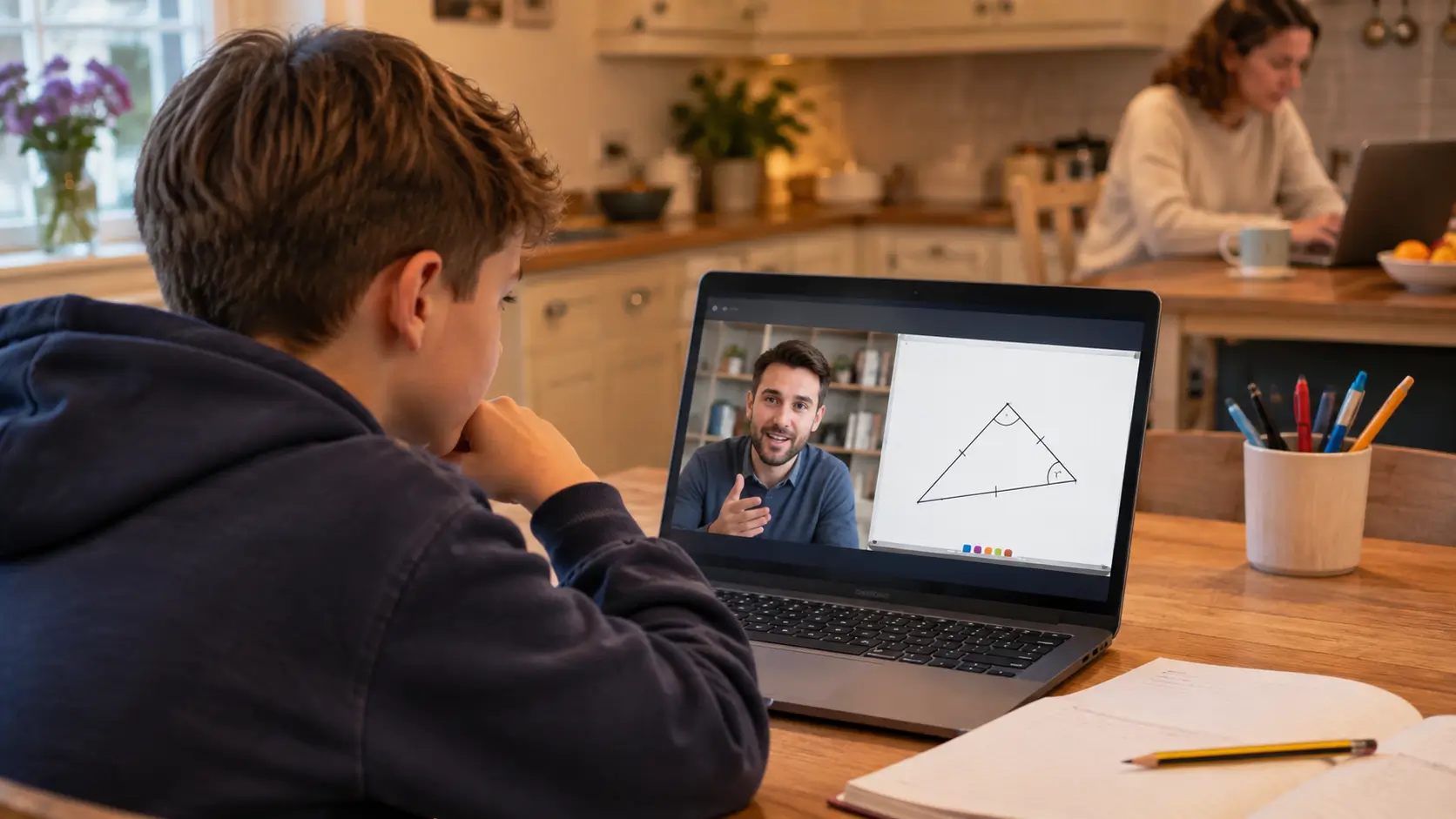
The honest answer on online tutoring vs in person is that the evidence does not pick a winner. What it does say, consistently, is that one-to-one tuition works, and that the ingredients making it work — a capable tutor, regular sessions, one child at a time — matter far more than whether that tutor is sitting in your kitchen or on your screen. The decision in front of you is not which method is better in the abstract. It is which one fits your child, your home and your budget.
The Education Endowment Foundation's Teaching and Learning Toolkit rates one to one tuition at five additional months' progress on average, drawn from 123 studies. Buried in the same entry is the line that settles most of this argument: “Studies involving digital technology show broadly similar effects.” Same intervention, different delivery, comparable results.
+5 months
average additional progress from one to one tuition
Education Endowment Foundation, Teaching and Learning Toolkit
The EEF reached the same conclusion from a different direction when it reviewed 60 systematic reviews and meta-analyses on remote learning in 2020. The first of its five key findings was blunt.
“Teaching quality is more important than how lessons are delivered.”
Education Endowment Foundation, remote learning rapid evidence assessment
That is the sentence to keep in mind while any tutoring company, this one included, tells you why its format is superior. If a tutor is weak, being physically present does not fix it. If a tutor is strong, a video call does not undo it.
Two other Toolkit numbers are worth having. One to one tuition has a larger impact in primary schools (+6 months) than secondary (+4 months), and in literacy (+6 months) than maths (+2 months). Small group tuition comes in at +4 months, which tells you the ratio is doing real work: one child at a time beats two or three, whichever room they are in. Both distinctions matter more to your child's result than delivery mode does.
Where does online tutoring actually fall down?
It would be easy to stop there. But the same evidence base contains findings that are inconvenient for anyone selling online lessons, and you should see them.
The EEF's National Online Tuition Pilot ran during the 2020 school closures, reaching 1,425 learners across 65 schools through around 9,800 sessions. It concluded that online delivery was feasible and that learners enjoyed it. It also concluded that online tuition lacked some of the benefits of in-person delivery, that tutors found it harder to build rapport with learners online, and that face-to-face tuition was preferred by both tutors and learners. Access to equipment and a reliable internet connection were named as key barriers, particularly for children learning from home rather than at school.
Then there is the trial that found nothing. The EEF's randomised controlled trial of Affordable Maths Tuition put 600 Year 6 pupils across 64 schools through 27 weeks of online one-to-one maths tutoring. It found no evidence of an impact on Key Stage 2 maths results. The process evaluation offered a clue: some pupils were interrupted because the tutor could not see they were still working on a problem, which the evaluators linked to the lack of face-to-face contact. Sessions also ran once a week, and children were sometimes distracted by noise from other sessions in the same room.
Read that last finding carefully, because it is the one that should shape your questions. Online tutoring failed there in a model where the tutor could not properly see the child and the child had nowhere quiet to sit. Those are fixable conditions, not permanent features of online learning — but only if you check for them before you book.
Online tutoring vs in person: how do they compare, dimension by dimension?
Online one-to-one vs in-person one-to-one, dimension by dimension
Measured outcomes
- Online one-to-one
- +5 months average for one to one tuition; digital-technology studies show broadly similar effects
- In-person one-to-one
- +5 months average, same evidence base
- Honest verdict
- Tie
Cost per hour
- Online one-to-one
- No travel to price in. The EEF notes costs are lower for online delivery than in person
- In-person one-to-one
- The tutor's travel time is inside your hourly rate whether it is itemised or not
- Honest verdict
- Online
Travel time
- Online one-to-one
- None. Lesson starts and ends on the hour
- In-person one-to-one
- 20 to 60 minutes of round trip for someone, so a one-hour lesson can eat an entire evening
- Honest verdict
- Online
Tutor pool
- Online one-to-one
- The whole country. You can pick a specialist in your exam board or your area's 11+ format
- In-person one-to-one
- Whoever is qualified, available and willing to drive to your postcode
- Honest verdict
- Online
Building rapport
- Online one-to-one
- Harder. EEF tutors reported it as more challenging online
- In-person one-to-one
- Easier. Full body language, no lag, no muted microphone
- Honest verdict
- In-person
Parental oversight
- Online one-to-one
- You can sit in without becoming part of the furniture, and see written updates after each lesson
- In-person one-to-one
- You are in the house, but hovering in the doorway is conspicuous for everyone
- Honest verdict
- Online, marginally
Lesson recordings
- Online one-to-one
- Some online platforms can record sessions or export the shared whiteboard for revision. Check whether yours does
- In-person one-to-one
- Whatever is on the paper afterwards
- Honest verdict
- Online, where the platform offers it
Technical risk
- Online one-to-one
- Real. Broadband drops, cameras die, siblings arrive
- In-person one-to-one
- Effectively none once the tutor is through the door
- Honest verdict
- In-person
Young children (roughly under 8)
- Online one-to-one
- Attention is harder to hold through a screen and an adult usually needs to be nearby
- In-person one-to-one
- Physical presence does the attention management for you
- Honest verdict
- In-person
Practical and hands-on work
- Online one-to-one
- Limited. Fine motor work, handwriting, instruments and lab practicals do not travel down a video call
- In-person one-to-one
- The whole point
- Honest verdict
- In-person
Who is in your home
- Online one-to-one
- Nobody
- In-person one-to-one
- A stranger, weekly, which raises checks you must actually carry out
- Honest verdict
- Online
Online one-to-one vs in-person one-to-one, dimension by dimension
| Dimension | Online one-to-one | In-person one-to-one | Honest verdict |
|---|---|---|---|
| Measured outcomes | +5 months average for one to one tuition; digital-technology studies show broadly similar effects | +5 months average, same evidence base | Tie |
| Cost per hour | No travel to price in. The EEF notes costs are lower for online delivery than in person | The tutor's travel time is inside your hourly rate whether it is itemised or not | Online |
| Travel time | None. Lesson starts and ends on the hour | 20 to 60 minutes of round trip for someone, so a one-hour lesson can eat an entire evening | Online |
| Tutor pool | The whole country. You can pick a specialist in your exam board or your area's 11+ format | Whoever is qualified, available and willing to drive to your postcode | Online |
| Building rapport | Harder. EEF tutors reported it as more challenging online | Easier. Full body language, no lag, no muted microphone | In-person |
| Parental oversight | You can sit in without becoming part of the furniture, and see written updates after each lesson | You are in the house, but hovering in the doorway is conspicuous for everyone | Online, marginally |
| Lesson recordings | Some online platforms can record sessions or export the shared whiteboard for revision. Check whether yours does | Whatever is on the paper afterwards | Online, where the platform offers it |
| Technical risk | Real. Broadband drops, cameras die, siblings arrive | Effectively none once the tutor is through the door | In-person |
| Young children (roughly under 8) | Attention is harder to hold through a screen and an adult usually needs to be nearby | Physical presence does the attention management for you | In-person |
| Practical and hands-on work | Limited. Fine motor work, handwriting, instruments and lab practicals do not travel down a video call | The whole point | In-person |
| Who is in your home | Nobody | A stranger, weekly, which raises checks you must actually carry out | Online |
Five of those eleven rows do not favour online, and that is the accurate picture. What tips the balance for most families is that the online advantages are structural (cost, travel, tutor pool) while the in-person advantages apply to particular children and particular kinds of work.
When is in-person tutoring the better choice?
There are children for whom I would tell a parent not to book online lessons at all. If any of these describe your situation, choose in-person and do not let anyone talk you out of it.
- Your child is roughly Year 3 or younger and cannot yet sit at a task without an adult beside them.
- Your child has a special educational need where physical presence does the regulating — where an adult's proximity, a hand on the page or a physical prompt is what keeps them in the work.
- Your broadband is unreliable, or the only device in the house is a phone. The EEF pilot named this as a key barrier for a reason.
- There is no quiet space. A lesson competing with a television and two siblings will fail online in a way it would not fail with a tutor sitting at the table.
- The work is physical: handwriting and fine motor practice, a musical instrument, practical lab technique, art.
- Your child has genuinely tried online lessons and disengages on screen in a way they do not in person. That is data about your child, and it beats any table.
Age is a guide, not a rule. In 10+ years of teaching I have taught nine-year-olds who worked beautifully online and thirteen-year-olds who needed someone in the room. The free demo class exists precisely so you find out which yours is before any money changes hands.
When is online tutoring the better choice?
The case for online is not that it beats a good local tutor in a fair fight. It is that for most families, the fair fight is not the choice on offer.
- The tutor pool is the biggest one. A local search gets you whoever will drive to you. Online, you can insist on a tutor who knows your exam board, your child's tier, or the particular 11+ format your area uses. Matching the specialist to the need is worth more than the room is.
- Travel time is the quiet killer of consistency. Tuition works when it is regular, and regular is exactly what a 40-minute round trip on a wet Tuesday in January stops being.
- Price follows from both. Nobody is charging you for a car.
- Scheduling gets easier. A 7pm slot is trivial online and awkward in person.
- You can watch. Sitting in on a video lesson is genuinely unobtrusive in a way that standing in a doorway is not.
For the wider question of whether tuition is worth paying for in the first place, our guide on whether private tutoring is worth it covers the money side properly, and how much a tutor costs in the UK has the current market rates.
What should you check before you book either?
The same questions apply to both formats. Use them on us as readily as on anyone else, and see how to choose a tutor for the longer list.
- 1Is it genuinely one-to-one, or a small group described as personalised?
- 2Can we try before we pay?
- 3Will the same tutor teach every lesson?
- 4Can the tutor see my child working, not just hear them? (The Affordable Maths trial turned on exactly this.)
- 5What do I receive after each lesson?
- 6What happens if we want to stop?
What does one-to-one online tutoring cost at TutorMint?
Lessons are 1 hour, on Google Meet, in the browser with nothing to install. All you need is a laptop or tablet with a camera and an internet connection. Lessons start from £15 per lesson for the 11+, from £15 at KS3, from £20 at GCSE and from £25 at A-Level. Your first demo class is free, there is no sign-up fee and there is no contract, so you can pause or stop whenever you like. See our pricing for the full breakdown, or how it works for the process from first message to first lesson.
Parents are welcome to sit in on any lesson without notice, and after each lesson you get an update covering what was taught, what homework was set and what comes next. Message us and we reply within 2 hours, 9am–9pm UK time, seven days a week. If you want the detail on how the lessons themselves run, our online tutoring page walks through the shared screen and whiteboard setup.
If, after the demo, the honest answer for your child is a tutor in the room, we will tell you so. That is the point of a free trial lesson.
The only reliable way to answer the online versus in-person question for your child is to watch one lesson and see how they respond. Your first class is free, there is no payment detail required to book it, and if we think a tutor in the room would serve your child better, we will say so.
Ready to find out where your child stands?
Sources
- EEF — One to one tuition, Teaching and Learning Toolkit
- EEF — Small group tuition, Teaching and Learning Toolkit
- EEF — Best evidence on supporting students to learn remotely
- EEF — Online Tuition pilot, evaluated by NatCen
- EEF — Affordable Maths Tuition trial
- TutorMint founder's teaching experience — 10+ years across home, academy and online teaching (the age guidance and readiness observations)
Written by TutorMint Founder
10+ years of classroom and one-to-one teaching experience. Facts checked 31 August 2026.
Found this useful?
Add Tutormint as a preferred source and our guides show up higher when you search Google.