The dedication and teaching methods are truly appreciated
The dedication and teaching methods are truly appreciated. My child is learning with confidence and enjoying the process.
Samraiz Shakoor
GB ·
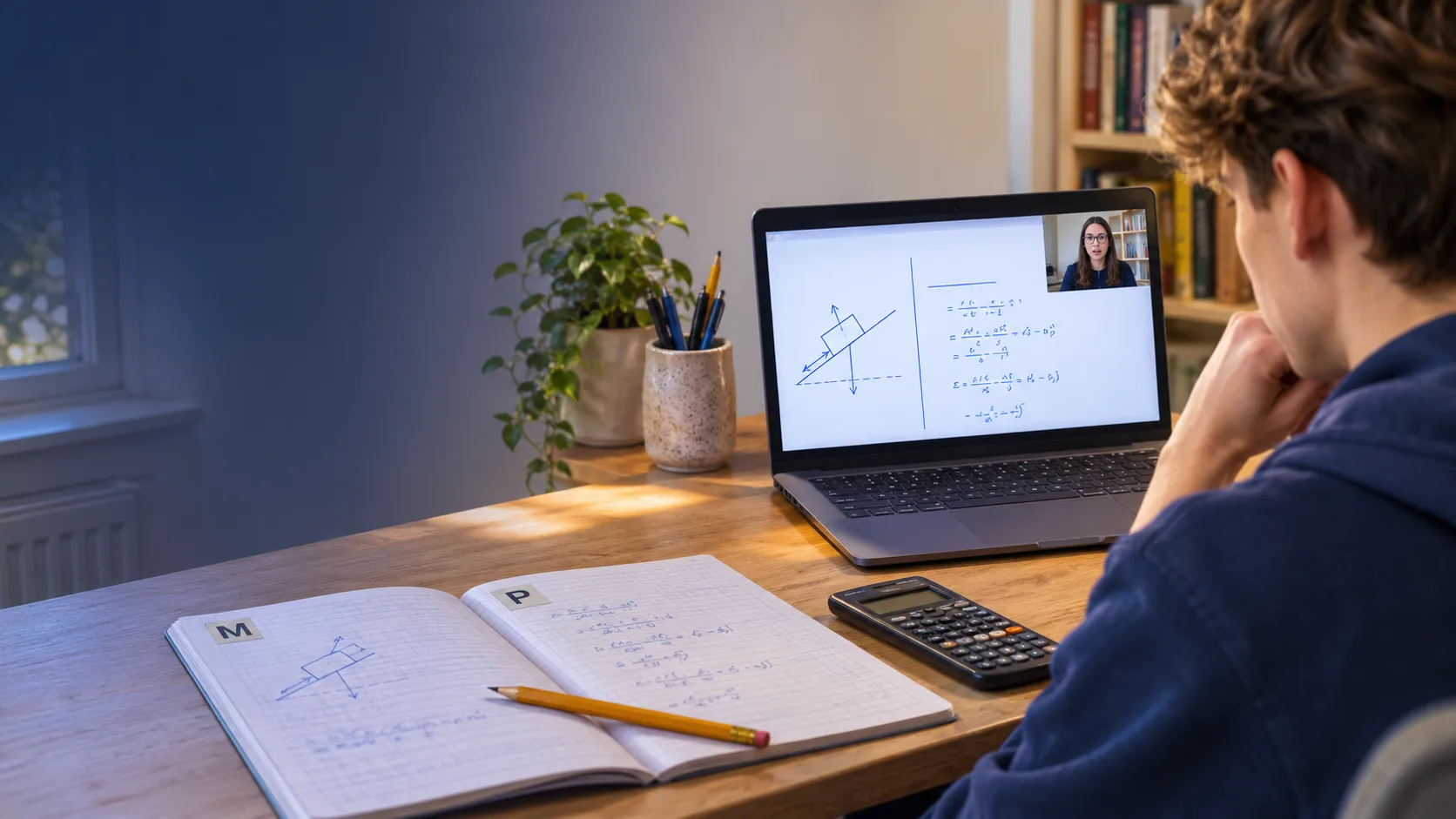
A tutor who teaches A-Level Maths and A-Level Physics as the pair they are: the mechanics taught once, the maths the physics course assumes taught before the physics needs it, and the sign conventions that differ between the two made explicit. One-hour lessons online, to AQA, Edexcel or OCR.
Two courses, one desk
A-Level Physics has to put at least 40% of its marks on maths skills, and A-Level Maths spends a sixth of its marks on mechanics. The two courses share constant acceleration, Newton's laws, moments, projectiles, logarithms and calculus. What they do not share is a timetable. Physics teaches projectiles and moments in Year 12; on Edexcel A-Level Maths they are Year 13 content, and on AQA and OCR they sit late in the course too.
So a Year 12 physics student is resolving forces on a slope months before their maths teacher gets to vectors. A single A Level maths and physics tutor fixes the order: the maths is brought forward to the week the physics needs it, and taught once.
| Topic | In A-Level Maths | In A-Level Physics | What goes wrong |
|---|---|---|---|
| Constant acceleration | Year 12 mechanics: the suvat equations in one dimension | Year 12 mechanics: the same equations, with g and real data | Physics takes g as 9.81 m s⁻²; Edexcel maths takes it as 9.8. Two marks a paper go to students who use the wrong one in the wrong room. |
| Vectors and projectiles | Year 13 on Edexcel; late in the course on AQA and OCR | Year 12, usually in the first term | Physics needs resolving and projectiles a year before the maths course teaches them, so the physics runs on vector work nobody has taught. |
| Moments and friction | Year 13 mechanics | Year 12 materials and mechanics | Same timing problem as projectiles. A joint tutor brings the maths forward instead of letting the physics teacher improvise it. |
| Exponentials and logs | Year 12 pure | Year 13: capacitor discharge, radioactive decay | Students who can differentiate eˣ still cannot read a decay constant off a ln graph, because the two were never put side by side. |
| Differentiation and integration | Year 12, then the chain rule and integration techniques in Year 13 | Everywhere: gradients of graphs, area under a force–extension or velocity–time graph | Maths marks the method; physics marks the meaning. “The gradient is 4.2” earns nothing until it is called an acceleration with a unit. |
| Trigonometry, radians and SHM | Radians and trig identities in Year 12 pure; differential equations in Year 13 | Circular motion and simple harmonic motion in Year 13 | x = A cos ωt is an identity to the maths student and a model to the physics student. The joint lesson makes it both. |
A joint lesson starts from whichever paper is losing more marks that week, and works the question in both languages. A projectile is solved as the maths course would set it, with i and j components and a stated modelling assumption, and then as the physics paper would mark it, with a free-body diagram, g as 9.81 and a unit on every line. The student sees that it is one problem, and stops learning it twice.
The maths the physics is waiting on is taught early. Resolving vectors, the chain rule, reading a decay constant off a ln graph: each arrives in the lesson the week the physics class reaches it, not the term after. The single-subject pages explain the rest of each course: our A-Level maths tutor page covers pure, statistics and the papers by board, and our A Level physics tutor page covers fields, SHM, practicals and uncertainties.
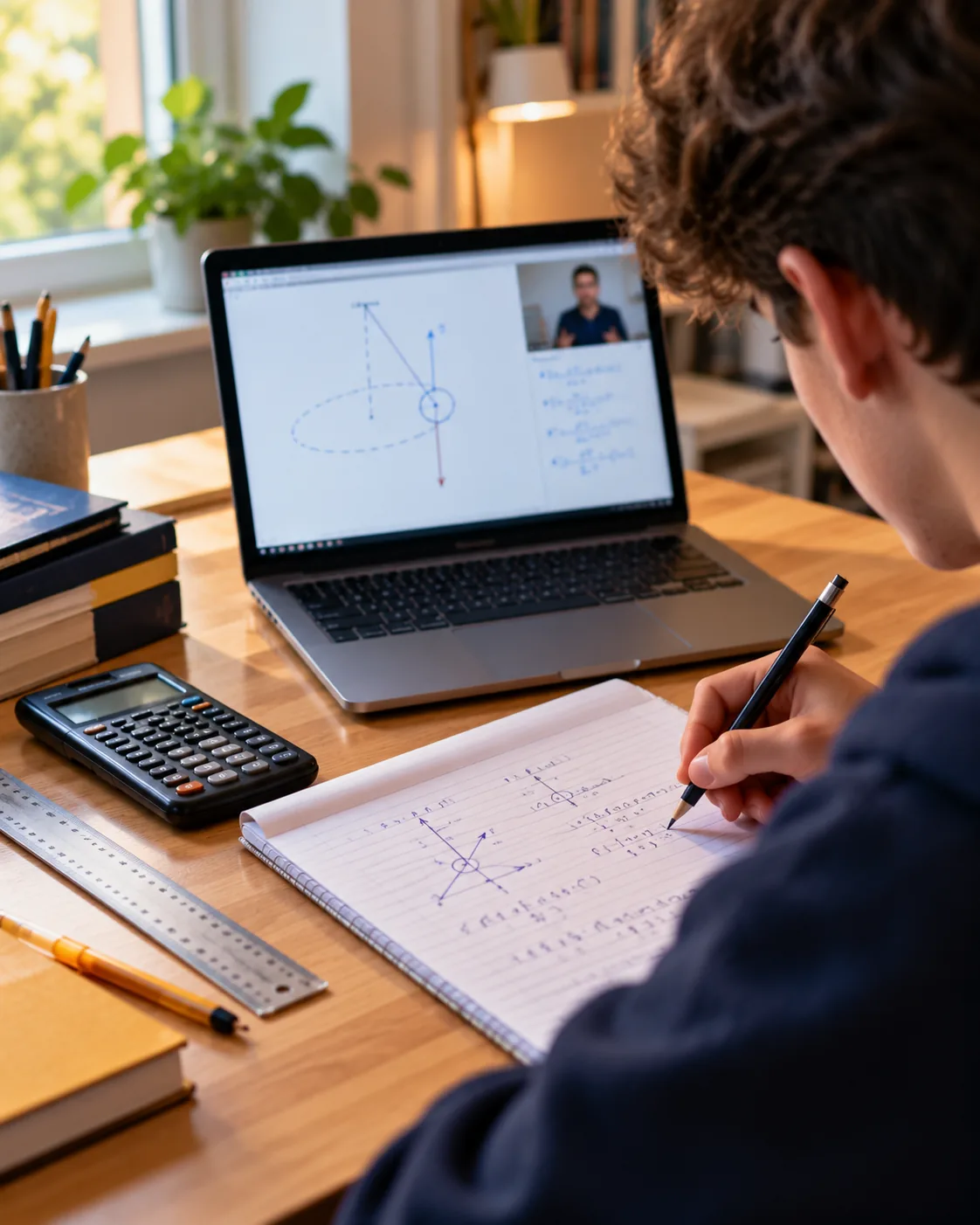
Lessons are one-to-one on Google Meet with a shared whiteboard, so the tutor sees every line as it is written. That matters more for this pair than for any other: the mark in both subjects is in the working, and the working is where the two courses disagree.
Book a free demo class
One hour with a tutor who teaches both. Tell us the two boards and we'll match the tutor.
from£25
First class free · No card details · No contract
| Convention | A-Level Maths | A-Level Physics |
|---|---|---|
| Value of g | 9.8 m s⁻² on Edexcel unless the question says otherwise | 9.81 m s⁻² on every board |
| Units | Rarely penalised; a bare number is usually fine | A missing or wrong unit loses the mark, every time |
| Significant figures | Three unless told otherwise; exact answers preferred | Match the data; four from two-sig-fig inputs is marked down |
| Modelling assumptions | State them for a mark: particle, light inextensible string, smooth plane | Usually implicit; the marks go to uncertainties and evaluation instead |
| Direction and sign | Choose a positive direction and keep it; i and j notation | Free-body diagram first, components second; signs follow the diagram |
Nearly every UK engineering degree, and physics itself, asks for A-Level Maths and A-Level Physics together, and the most competitive courses set high grades in both. For those students the joint lesson turns, in Year 13, into timed past papers in each subject, with mechanics given particular weight because it is what the degree builds on first.
Boards can be mixed freely: an Edexcel maths student on AQA physics, or OCR for both. Each board splits its content across its papers differently, and Edexcel maths puts all of its statistics and mechanics on one paper, so the tutor plans around the two specifications your child is actually sitting, confirmed from their own notes in the first lesson. If the first term of Year 12 has already gone badly in either subject, our guides to struggling with A-Level maths and struggling in Year 12 set out what is normal and when to act. Every A-Level subject we cover is on our A-Level tutoring page.
4.3
TrustScore
Excellent
Based on 9 reviews onTrustpilot
Trustpilot weights the TrustScore by review age, so it is not the plain average of the reviews shown here.
89% of the 9 published reviews are 5-star
How the 9 published reviews score
The dedication and teaching methods are truly appreciated. My child is learning with confidence and enjoying the process.
Samraiz Shakoor
GB ·
Very satisfied with the teaching quality and dedication. I can see a positive difference in my child’s learning and confidence.
Hadiqa Fatima
CA ·
Excellent teaching and great results! My child is improving day by day and feels much more confident in English and math. Highly recommended!
Maryam Tehseen
CA ·
Nice experience.
Kashi
GB ·
Tutor Mint have been fantastic for my 13 year old home educated daughter with weekly maths tutoring. My daughter is autistic so sometimes struggles with communication & the tutor has been able to support her so her communication & confidence with them improves every week.
I believe Tutor Mint is outstanding value for money & I highly recommend their services.
Laura Hines
GB ·
Excellent support was provided and my child managed to achieve much higher than predicted by their school in mathematics! Highly recommend!!!
Customer
GB ·
Amazing experience!
I studied triple sciences from this platform. I got 6 and 2, 7's in bio, chem and physics.
Highly recommended.
Almira Adeel
GB ·
I really appreciate your efforts, my daughter is now good in maths. Thank you so much.
Wajeeha Asjad
GB ·
I really appreciate your effort. Must recommended. My child is confident in his English and maths skills.
Asma Nageen
GB ·
Lessons are 1 hour. Your first demo class is completely free, there are no sign-up fees, and there's no contract — you can pause or stop at any time.
from £25/lesson
1-hour lesson
A free demo class with an A-Level maths and physics tutor, built around a question from whichever paper is going worse. No payment, no contract, and a straight answer about whether it is the maths, the physics or the step between them.
A-Level Maths and Physics is one of the things we teach. The same tutors cover every level and subject below, one-to-one on Google Meet, and each page explains exactly what a lesson covers.
Maths, English, verbal and non-verbal reasoning for the grammar-school test your child is actually sitting. From £15 a lesson.
Years 7 to 9, where the gaps that show up at GCSE usually start. From £15 a lesson.
Taught to the board and tier your child's school has entered them for, with past papers from the first month. From £20 a lesson.
Maths, the three sciences and English, to the AQA, Edexcel or OCR specification. From £25 a lesson.
Past papers, mark-scheme technique and timed practice for GCSE, A-Level and the 11+.
A tutor who works through the set work with your child and teaches the method, never the answer.
Every rate on one page. One-hour lessons, no sign-up fee, no contract.
One full lesson with a diagnostic of where your child stands. No card details.
Number to calculus, in the method your child's school uses, for 11+, KS3, GCSE and A-Level.
Reading, writing and the exam-style questions, from the 11+ paper to GCSE Language.
Set texts from memory, closed-book essays and unseen poetry, to the board's mark scheme.
KS3 and GCSE Combined Science: biology, chemistry and physics with one tutor.
GCSE Triple and A-Level, with required practicals and six-markers taught as a skill.
GCSE Triple and A-Level, from moles and equations to the long-answer questions.
GCSE Triple and A-Level: the equations, the units and the calculation questions that cost marks.
All 21 GL-style question types for the 11+, taught in the order they move scores fastest.
Rotations, matrices, cube nets and spatial reasoning, practised family by family.