The dedication and teaching methods are truly appreciated
The dedication and teaching methods are truly appreciated. My child is learning with confidence and enjoying the process.
Samraiz Shakoor
GB ·
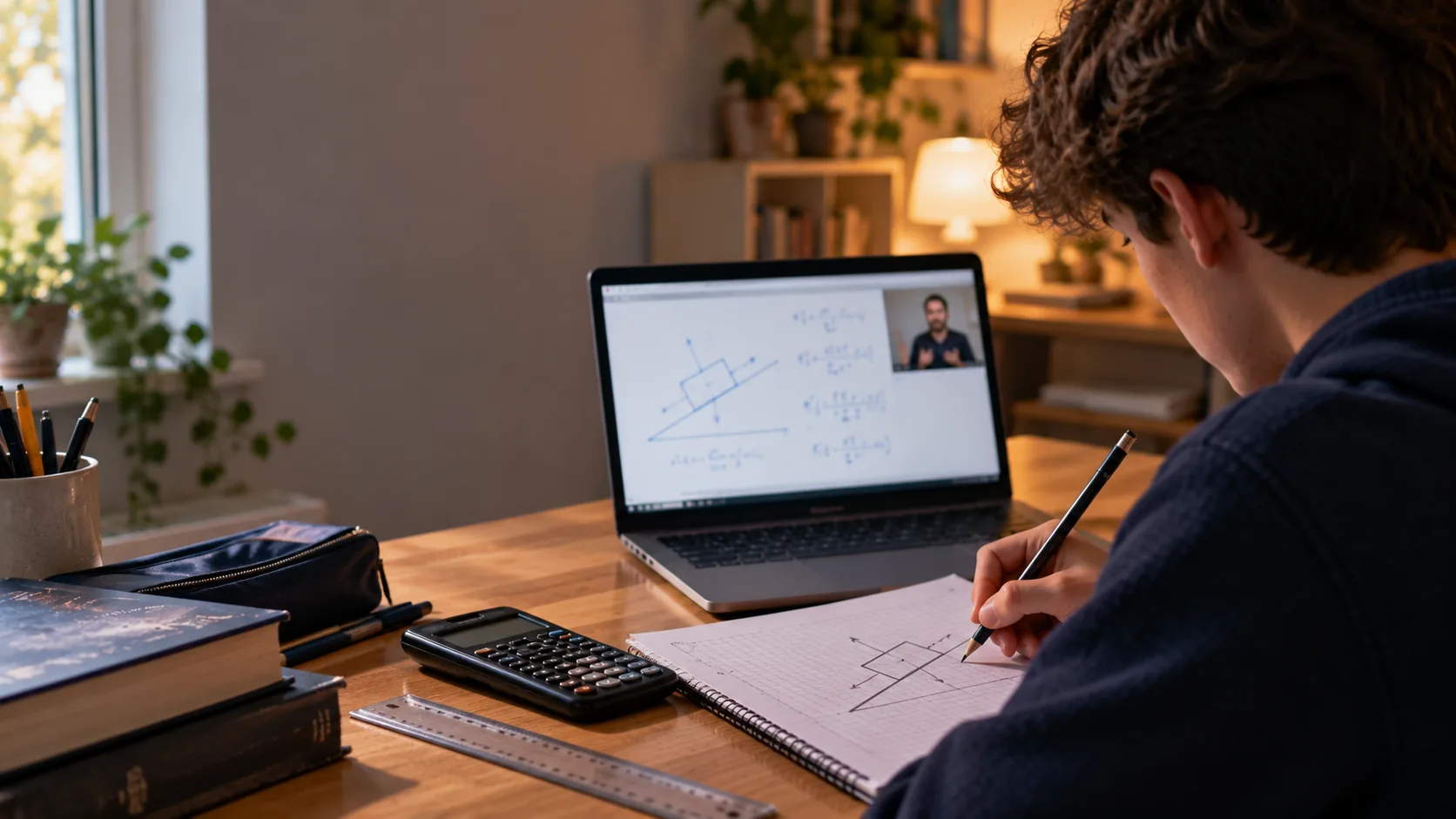
An A Level physics tutor who works on the part most students actually lose marks on: the maths underneath the physics. Mechanics, fields, SHM and the practical questions, taught to your child's AQA, OCR or Edexcel specification in one-hour lessons from home.
Every unit reduces to base units
Every A-Level physics specification has to assess maths skills in at least 40% of its marks. Chemistry's figure is 20% and biology's 10%. That single fact explains most of the Year 12 surprise: a student can understand the physics perfectly and still drop a grade on rearranging, logarithms and units.
The formula booklet is supplied in the exam, so knowing the equations is not the hard part. Choosing the right two and combining them is. Students taking A-Level maths alongside have an advantage, and one A-Level maths and physics tutor can teach the shared mechanics once. Students who are not get the maths taught inside the physics, at the point each skill is needed.
| Board | Papers and weighting | What to know |
|---|---|---|
| AQA | Paper 1 (34%) · Paper 2 (34%) · Paper 3 (32%) | Papers 1 and 2 each open with 25 multiple-choice questions. Paper 3 is practical skills and data analysis plus one optional topic: astrophysics, medical physics, engineering physics, turning points or electronics. Twelve required practicals. |
| OCR Physics A | Modelling physics (37%) · Exploring physics (37%) · Unified physics (26%) | The third paper is synoptic, drawing questions from the whole course. Practical work runs through practical activity groups rather than a fixed list of twelve. |
| OCR Physics B | Fundamentals (41%) · Scientific literacy (37%) · Practical skills (22%) | Advancing Physics, taught through contexts. The scientific literacy paper is built partly around an advance notice article released before the exam, which students have to prepare from. |
| Edexcel | Advanced Physics I (30%) · Advanced Physics II (30%) · General and Practical Principles (40%) | The heaviest-weighted paper is the synoptic third, which carries the questions on the sixteen core practicals. An Edexcel A-Level physics tutor plans for that paper from the start, not in the last term. |
A-Level physics carries two separate practical outcomes, and parents are rarely told the difference. The Practical Endorsement is assessed by your child's teachers in the school lab against common criteria and reported as Pass or Not Classified. It sits outside the A*–E grade, though universities see it. No tutor can award it, online or in person.
The other outcome is in the written papers, and it is large. Questions on the required practicals ask for method, variables, uncertainties and evaluation, and they reward a kind of thinking that revising theory does not build. Absolute and percentage uncertainty, error bars, and the uncertainty in a gradient from best and worst fit lines are taught as skills, with real data, until they stop costing marks.
The demo is a real lesson with a physics specialist, built around a past-paper question your child found hard. By the end you know whether the problem is the physics, the maths or the exam technique, and what a term of A Level physics tuition would target.
Whether you are looking for a Year 12 physics tutor after a difficult first half-term or an A Level physics private tutor for the run-in to Year 13, the lessons are the same price and the same tutor every week.
Book a free demo class
One hour with an A-Level physics specialist. Tell us the board and we'll match the tutor.
from£25
First class free · No card details · No contract
| Symptom | Cause | Fix |
|---|---|---|
| Right method, wrong number | Prefixes and powers of ten: mA, μF, nm and MeV slipped through unconverted. | Every answer gets a unit check against base units before it is written down. |
| Blank on “show that” questions | The answer is given, so the marks are all for the working, and the working is not shown. | Practise laying out a derivation line by line, with each substitution visible. |
| Fields feel like three topics | Gravitational and electric fields learned separately, so the parallel between them is never used. | Teach them side by side as one pattern: field strength, potential, inverse-square law. |
| SHM graphs misread | Displacement, velocity and acceleration graphs confused, or read a quarter-cycle out. | Sketch all three from one starting point until the phase relationship is automatic. |
| Uncertainty marks dropped | Absolute, percentage and gradient uncertainties treated as the same calculation. | One worked example of each, then mixed past-paper practice on real data sets. |
| Long answers score low | Correct facts in the wrong order, with no link from cause to effect. | Plan extended responses as a chain, each step leading to the next. |
In Year 12 the work is mostly repair: the algebra, vectors and units that GCSE never stretched. If the first term has gone badly, our guide to struggling in Year 12 sets out what is normal and when to act, and is A-Level physics hard? shows where the marks actually go. In Year 13 the work turns synoptic: fields, SHM and thermal physics lean on Year 12 mechanics, and the final papers mix both years freely.
A-Level physics is required or strongly preferred for nearly every UK engineering degree, and for physics itself, usually alongside maths. Mechanics is the area those courses build on most directly, so it gets particular attention. For how the step up works across every subject, see our A-Level tutoring page; for physics from GCSE triple science upwards, our online physics tutor page.
4.3
TrustScore
Excellent
Based on 9 reviews onTrustpilot
Trustpilot weights the TrustScore by review age, so it is not the plain average of the reviews shown here.
89% of the 9 published reviews are 5-star
How the 9 published reviews score
The dedication and teaching methods are truly appreciated. My child is learning with confidence and enjoying the process.
Samraiz Shakoor
GB ·
Very satisfied with the teaching quality and dedication. I can see a positive difference in my child’s learning and confidence.
Hadiqa Fatima
CA ·
Excellent teaching and great results! My child is improving day by day and feels much more confident in English and math. Highly recommended!
Maryam Tehseen
CA ·
Nice experience.
Kashi
GB ·
Tutor Mint have been fantastic for my 13 year old home educated daughter with weekly maths tutoring. My daughter is autistic so sometimes struggles with communication & the tutor has been able to support her so her communication & confidence with them improves every week.
I believe Tutor Mint is outstanding value for money & I highly recommend their services.
Laura Hines
GB ·
Excellent support was provided and my child managed to achieve much higher than predicted by their school in mathematics! Highly recommend!!!
Customer
GB ·
Amazing experience!
I studied triple sciences from this platform. I got 6 and 2, 7's in bio, chem and physics.
Highly recommended.
Almira Adeel
GB ·
I really appreciate your efforts, my daughter is now good in maths. Thank you so much.
Wajeeha Asjad
GB ·
I really appreciate your effort. Must recommended. My child is confident in his English and maths skills.
Asma Nageen
GB ·
Lessons are 1 hour. Your first demo class is completely free, there are no sign-up fees, and there's no contract — you can pause or stop at any time.
from £25/lesson
1-hour lesson
One free lesson with an A-Level physics tutor, built around a past-paper question your child found hard. No payment, no obligation, and a straight answer about where the marks are going.
A-Level Physics is one of the things we teach. The same tutors cover every level and subject below, one-to-one on Google Meet, and each page explains exactly what a lesson covers.
Maths, English, verbal and non-verbal reasoning for the grammar-school test your child is actually sitting. From £15 a lesson.
Years 7 to 9, where the gaps that show up at GCSE usually start. From £15 a lesson.
Taught to the board and tier your child's school has entered them for, with past papers from the first month. From £20 a lesson.
Maths, the three sciences and English, to the AQA, Edexcel or OCR specification. From £25 a lesson.
Past papers, mark-scheme technique and timed practice for GCSE, A-Level and the 11+.
A tutor who works through the set work with your child and teaches the method, never the answer.
Every rate on one page. One-hour lessons, no sign-up fee, no contract.
One full lesson with a diagnostic of where your child stands. No card details.
Number to calculus, in the method your child's school uses, for 11+, KS3, GCSE and A-Level.
Reading, writing and the exam-style questions, from the 11+ paper to GCSE Language.
Set texts from memory, closed-book essays and unseen poetry, to the board's mark scheme.
KS3 and GCSE Combined Science: biology, chemistry and physics with one tutor.
GCSE Triple and A-Level, with required practicals and six-markers taught as a skill.
GCSE Triple and A-Level, from moles and equations to the long-answer questions.
GCSE Triple and A-Level: the equations, the units and the calculation questions that cost marks.
All 21 GL-style question types for the 11+, taught in the order they move scores fastest.
Rotations, matrices, cube nets and spatial reasoning, practised family by family.