One-to-One Online GCSE Chemistry Tutoring
Two decisions shape the grade before a paper is sat — tier and triple science — and one idea, the mole, decides most of what happens afterwards. Lessons work on all three.
- Year 10
- Year 11
- Combined
- Triple
- Foundation
- Higher
The Decisions That Shape the Grade
Parents are rarely walked through either of the first two, and the third is usually described as a content gap when it is really a consequence of them.
Combined or triple
Combined Science awards two GCSEs across all three sciences; triple awards three and goes further in each. In chemistry the extra ground is mostly quantitative — more moles work, more calculation, more analysis — which is also the ground A-Level opens by assuming.
Foundation or Higher
Foundation papers are graded 1–5 and Higher 4–9. An over-cautious entry caps a result before the exam is sat; an over-ambitious one leaves a student facing questions they cannot start. We read tier from actual past-paper performance and say so plainly when the honest read is not the hoped-for one.
Where the moles live
The heaviest calculation content sits on the Higher tier, so the tier decision and the calculation problem are the same problem. A student who is shaky on moles in Year 10 is often being quietly steered toward Foundation by a gap that a term of lessons would close.
The triple-versus-combined trade-off is worked through in full in our post on combined versus triple science, and the same two decisions apply across all three sciences.
Most of the Calculations Are One Idea
Mass, moles and formula mass are a single relationship used in whichever direction a question needs. Taught as three formula triangles, it produces students who can answer any question shaped like the worked example and freeze on one that is not — which is exactly what an exam sets. Rebuilding it as one idea is usually a few lessons of work, and it unlocks yields, concentrations, titrations and gas volumes at the same time.
This is also the ground where GCSE decides how A-Level feels. The quantitative content that triple science adds is what A-Level Chemistry assumes from the first week, and the students who find Year 12 brutal are very often the ones who got through GCSE calculations by pattern-matching.
The Paper Hands You a Periodic Table and Nothing Else Useful
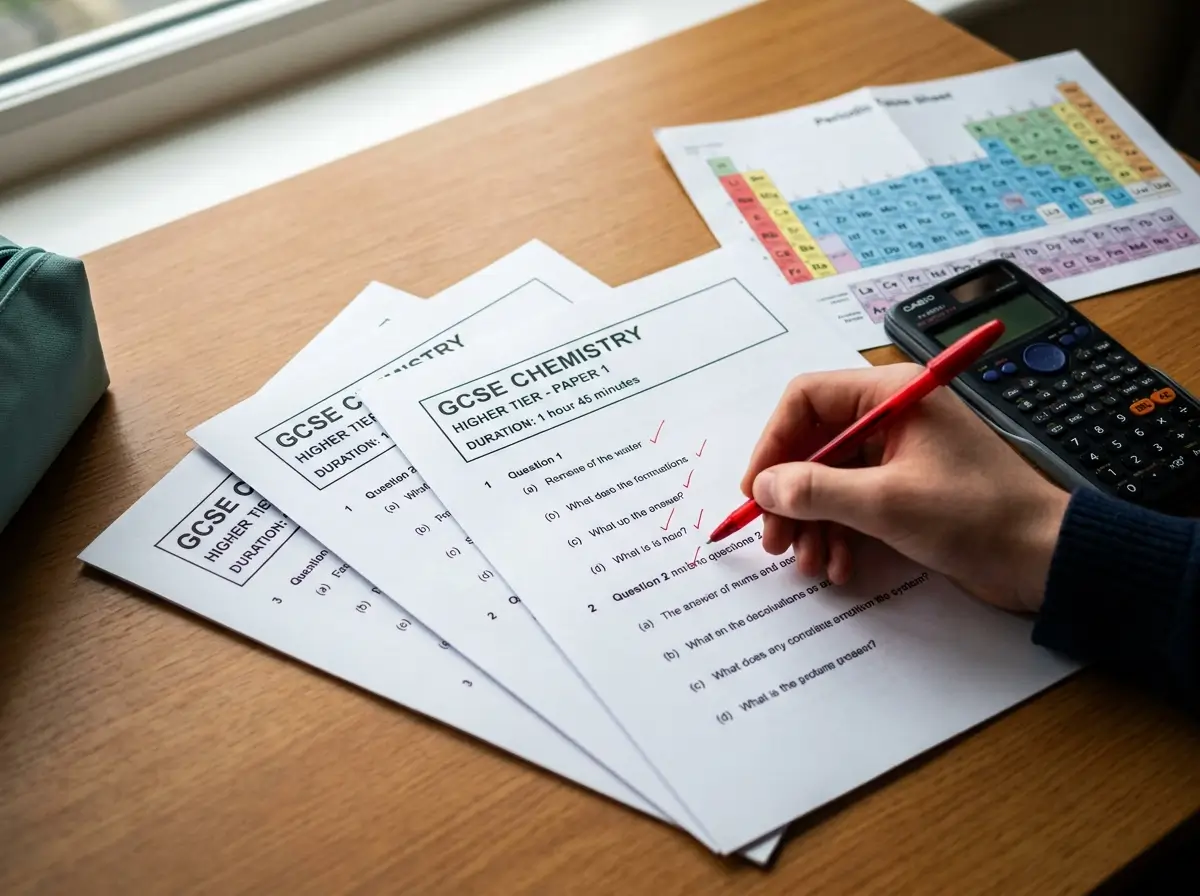
Students see the periodic table on the front of the paper and assume the rest will be there too. It will not. The charges on common ions, the formulae of the compounds those ions make, the reactivity series, the tests for gases and the state symbols all have to be carried in — and every one of them sits underneath a question about something else, so forgetting one costs marks on a question that was not testing it.
That is why lessons treat a small core as non-negotiable and drill it until it is automatic, rather than revising it as another topic. It is perhaps twenty facts. They appear on every paper, in both tiers, and a student who has them can spend their thinking on the chemistry the question is actually about.
When a Chemistry Gap Is Cheapest to Fix
Chemistry is the most hierarchical of the three sciences, so when a gap opens matters as much as how big it is.
Atoms and bonding
Almost everything later is bonding wearing a different hat: structure and properties, electrolysis, why one substance conducts and another does not. A student who never quite got bonding does not fail one topic — they find every later topic slightly impossible for reasons nobody names.
The mole arrives
The single biggest step in the course, and the point at which chemistry starts feeling like maths to students who were coping. This is also when tier conversations start, which is why a gap here has consequences well beyond the topic.
Consolidation, and less room
Rates, equilibrium, organic and analysis, on top of revision for everything else. A gap that would have taken a term in Year 10 now competes with ten other subjects, which is the real reason early is cheaper.
Where GCSE Chemistry Marks Are Actually Lost
Five patterns, none of which is a gap in knowing what a reaction does.
Moles as a formula rather than an idea
Nearly every calculation on the paper is the same relationship used in a different direction. A student who has learned three separate triangles will manage the questions that look like the examples and stall on the one that does not.
Equations that do not balance
Balancing, state symbols, and ionic equations with spectator ions removed. These are marks awarded for care rather than understanding, and they are lost in volume every series.
Required practicals revised as theory
The practicals are examined in the written papers rather than assessed separately. Questions ask about method, variables, error and how the results should be read — a different kind of thinking from recalling a reaction, and one that responds very well to being taught deliberately.
Six-mark answers written as a list
Extended response is marked by level, not by point: a coherent argument that links its steps outscores a longer list of correct facts. Students are rarely shown this difference, and it is worth several grades' worth of marks across a paper.
Data and graph questions
Chemistry carries more maths than biology at GCSE — rates from a tangent, percentage yield and atom economy, unit conversions. Lost marks here are almost never chemistry marks.
Chemistry across every level, including the topic list and the exam boards, is on our online chemistry tutor page.
Get an Honest Read on Tier
One free demo class with an experienced GCSE Chemistry tutor. No payment, no obligation — and a straight answer about tier, based on how your child actually performs on a past paper rather than on optimism.
GCSE Tutoring Starts From £20 Per Lesson
Lessons are 1 hour. Your first demo class is completely free, there are no sign-up fees, and there's no contract — you can pause or stop at any time.
GCSE
from £20/lesson
1-hour lesson