The dedication and teaching methods are truly appreciated
The dedication and teaching methods are truly appreciated. My child is learning with confidence and enjoying the process.
Samraiz Shakoor
GB ·
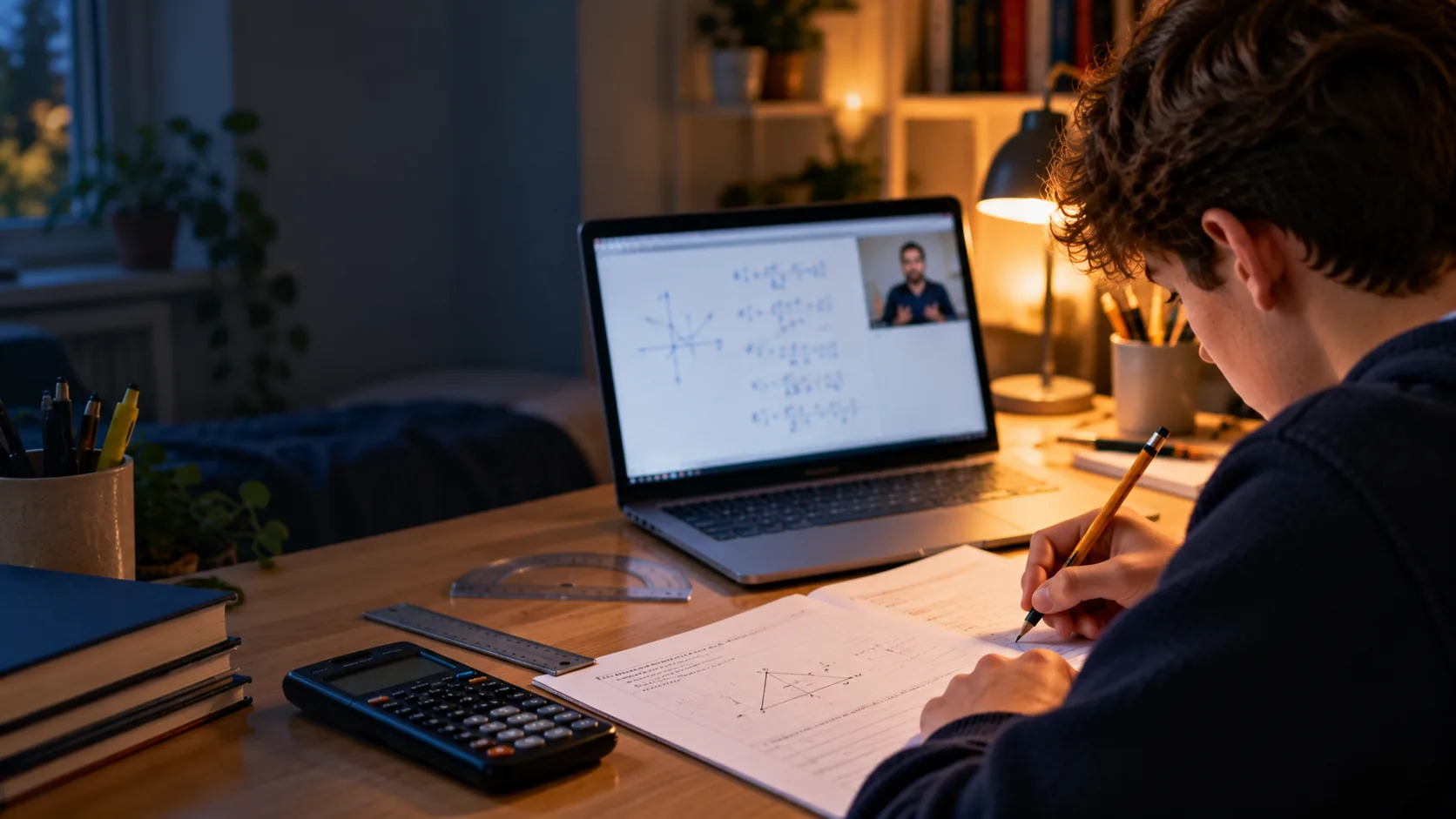
Your child is on a grade 4 and the sixth form wants a 6. Or they understand it in class and lose it in the exam. A GCSE maths tutor works on the reason, not just the topic: the non-calculator paper, the tier, and the method marks that go every time an answer is written without its working.
Book a free demo class
One full lesson with a diagnostic of where your child's marks are going.
from£20
First class free · No card details · No contract
We test number work without a calculator in the first lesson rather than finding out in the mocks. A student who reaches for the calculator to halve 0.36 is losing marks across the whole of Paper 1, and it is usually a few weeks of work to fix.
Foundation papers award grades 1 to 5 and Higher papers 4 to 9. A student entered for Foundation cannot get above a 5 however well they do on the day. Put a student on Higher who cannot start the harder questions, though, and they can drop below a 4 and lose their confidence along the way.
That matters for what comes next. Sixth forms set their own maths grade for A-Level Maths, and it is usually a 6 or a 7, higher at the most selective. A Foundation entry rules that out. If your child has been moved down, our guide to being moved to Foundation maths explains what to ask the school. The tutor will give you an honest view on tier from real past-paper work, even when it is not the answer you were hoping for.
Grades 4 and 5 sit on both papers. That overlap is where most tier decisions are made.
£4000 is invested for 5 years at 3% compound interest per year. Work out the value of the investment after 5 years. (3 marks)
Answer only, typed in wrong0 / 3
No working on the page means nothing for the examiner to credit. One slip on the calculator and every mark goes.
Simple interest instead: £46000 / 3
Wrong method from the first line. This is a concept gap, not carelessness, and it is the kind a tutor spots in one question.
In Year 10 the work is mostly gaps. Algebra and number problems from Key Stage 3 are fixed before the Higher topics that depend on them, such as quadratics, simultaneous equations and trigonometry, arrive in class. A gap that takes a few weeks in Year 10 is much harder to fit into Year 11, when ten other subjects want the same evenings.
In Year 11 the lessons turn to past papers. Your child sits timed questions from their own board, then goes through the mark scheme line by line with the tutor, so they learn what earns a method mark, not just what the answer is. Mocks then show exactly what still needs fixing.
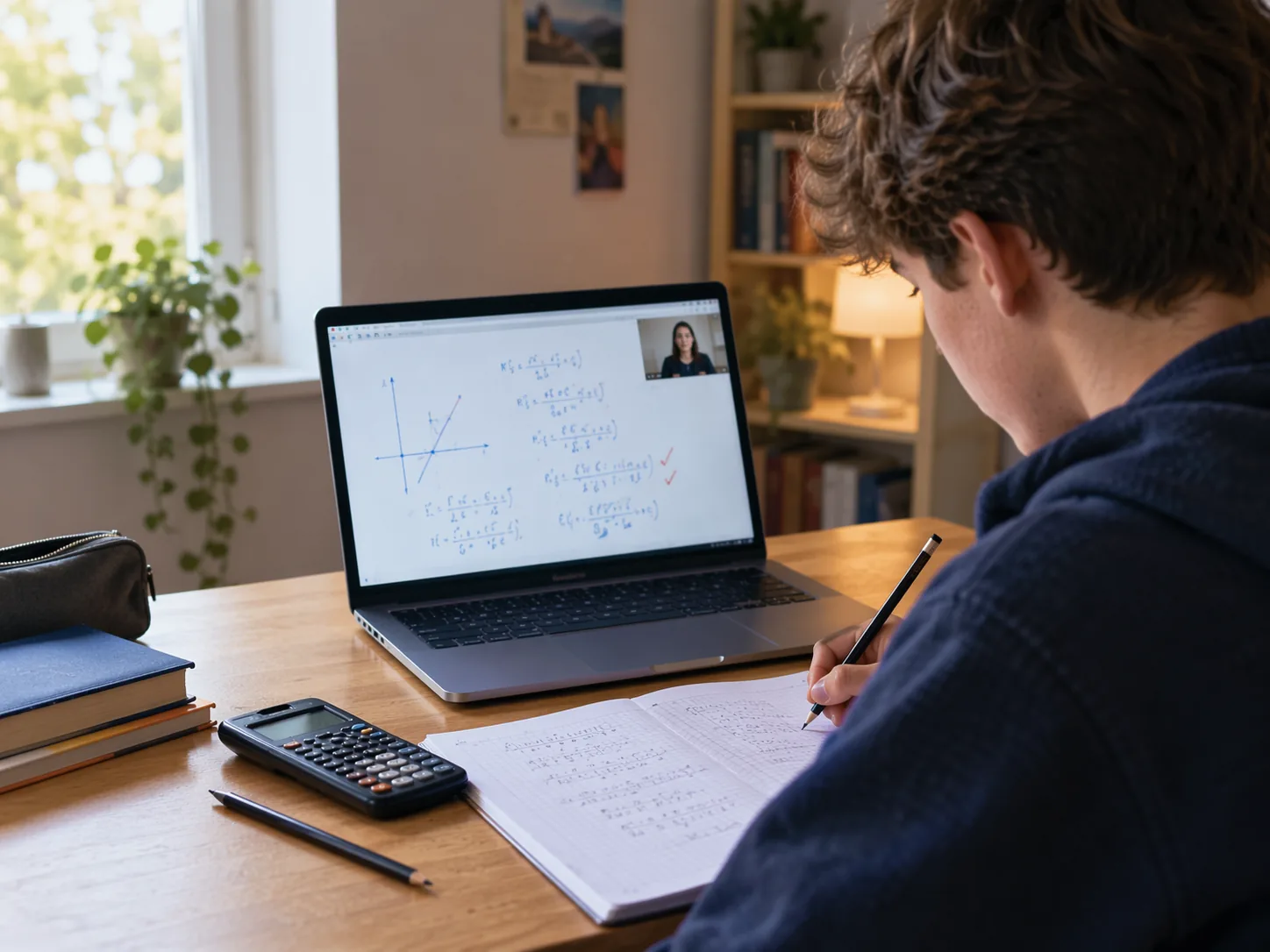
Each lesson is one-to-one on Google Meet with a shared whiteboard, so the tutor watches the working as it is written. You get the same help with GCSE maths as from a private tutor for GCSE maths at your kitchen table, without the travel. For students aiming at A-Level maths tutoring next, Year 11 is also when the algebra that Year 12 assumes gets made secure.
4.3
TrustScore
Excellent
Based on 9 reviews onTrustpilot
Trustpilot weights the TrustScore by review age, so it is not the plain average of the reviews shown here.
89% of the 9 published reviews are 5-star
How the 9 published reviews score
The dedication and teaching methods are truly appreciated. My child is learning with confidence and enjoying the process.
Samraiz Shakoor
GB ·
Very satisfied with the teaching quality and dedication. I can see a positive difference in my child’s learning and confidence.
Hadiqa Fatima
CA ·
Excellent teaching and great results! My child is improving day by day and feels much more confident in English and math. Highly recommended!
Maryam Tehseen
CA ·
Nice experience.
Kashi
GB ·
Tutor Mint have been fantastic for my 13 year old home educated daughter with weekly maths tutoring. My daughter is autistic so sometimes struggles with communication & the tutor has been able to support her so her communication & confidence with them improves every week.
I believe Tutor Mint is outstanding value for money & I highly recommend their services.
Laura Hines
GB ·
Excellent support was provided and my child managed to achieve much higher than predicted by their school in mathematics! Highly recommend!!!
Customer
GB ·
Amazing experience!
I studied triple sciences from this platform. I got 6 and 2, 7's in bio, chem and physics.
Highly recommended.
Almira Adeel
GB ·
I really appreciate your efforts, my daughter is now good in maths. Thank you so much.
Wajeeha Asjad
GB ·
I really appreciate your effort. Must recommended. My child is confident in his English and maths skills.
Asma Nageen
GB ·
Lessons are 1 hour. Your first demo class is completely free, there are no sign-up fees, and there's no contract — you can pause or stop at any time.
from £20/lesson
1-hour lesson
One free lesson with a GCSE maths tutor, with a recent mock or test to work from. Maths at every level is on our online maths tutor page, and if English is the other subject holding the grades back, our GCSE English tutor page covers it in the same detail.
GCSE Maths is one of the things we teach. The same tutors cover every level and subject below, one-to-one on Google Meet, and each page explains exactly what a lesson covers.
Maths, English, verbal and non-verbal reasoning for the grammar-school test your child is actually sitting. From £15 a lesson.
Years 7 to 9, where the gaps that show up at GCSE usually start. From £15 a lesson.
Taught to the board and tier your child's school has entered them for, with past papers from the first month. From £20 a lesson.
Maths, the three sciences and English, to the AQA, Edexcel or OCR specification. From £25 a lesson.
Past papers, mark-scheme technique and timed practice for GCSE, A-Level and the 11+.
A tutor who works through the set work with your child and teaches the method, never the answer.
Every rate on one page. One-hour lessons, no sign-up fee, no contract.
One full lesson with a diagnostic of where your child stands. No card details.
Number to calculus, in the method your child's school uses, for 11+, KS3, GCSE and A-Level.
Reading, writing and the exam-style questions, from the 11+ paper to GCSE Language.
Set texts from memory, closed-book essays and unseen poetry, to the board's mark scheme.
KS3 and GCSE Combined Science: biology, chemistry and physics with one tutor.
GCSE Triple and A-Level, with required practicals and six-markers taught as a skill.
GCSE Triple and A-Level, from moles and equations to the long-answer questions.
GCSE Triple and A-Level: the equations, the units and the calculation questions that cost marks.
All 21 GL-style question types for the 11+, taught in the order they move scores fastest.
Rotations, matrices, cube nets and spatial reasoning, practised family by family.