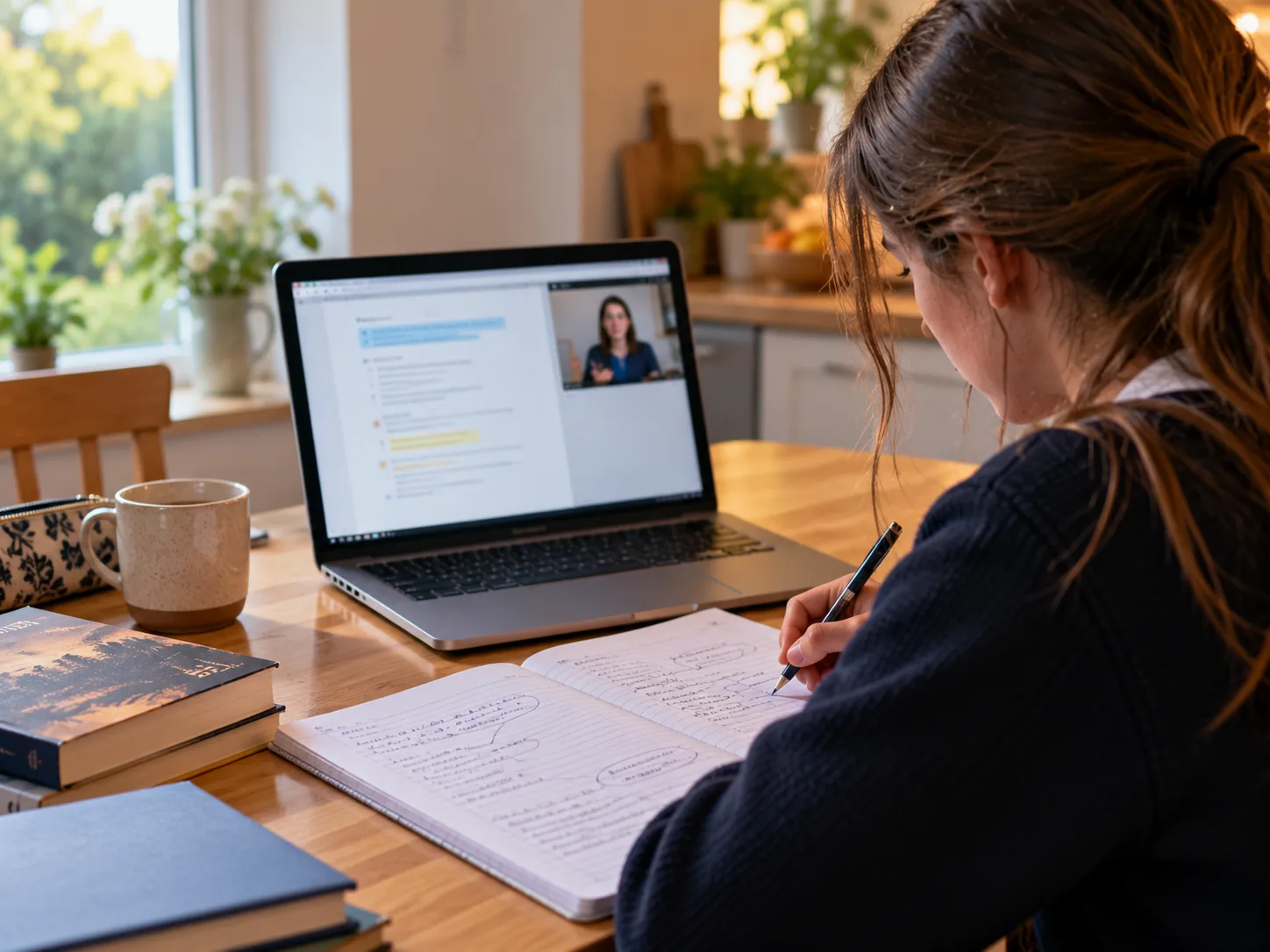
A GCSE student annotating an unseen prose extract with a highlighter during an online English lesson
GCSE English Tutoring

A GCSE English Tutor Online, for English Language

A GCSE English tutor for the student who reads well enough and still comes back with a 4. As a GCSE English Language tutor, the job is the thing in the box below: finding the method in an unseen extract, writing it down in the shape the mark scheme rewards, then writing something of their own that holds together for forty minutes.

  • AQA or Edexcel
  • Year 10 and Year 11
  • Language and Literature
  • 1-hour lessons on Google Meet

Book a free demo class

Tell us the board and the year group. We'll match a tutor and send a time on WhatsApp.

from£20

First class free · No card details · No contract

Paper 1 · Unseen Extract

An Unseen Extract, Annotated in a Lesson

Paper 1 · Unseen extract
The tide had gone out further than anyone in the village could remember. Boats lay on their sides like tired dogs1, and the harbour wall, usually half drowned, stood up out of the mud as if it had been waiting years to be seen2. Mara walked to the very end of it.3 Behind her the houses kept their curtains closed. Ahead there was only the long grey shine of the sand and, far out, something that should not have been there4.
  1. 1Language: simileQ2 · AO2

    Not just stranded: the boats seem worn out, which makes the whole village feel tired.

  2. 2Language: personificationQ2 · AO2

    The wall is given patience, so the scene feels like it has been holding a secret.

  3. 3Structure: shift in focusQ3 · AO2

    A short sentence narrows the wide shot of the village down to one character.

  4. 4Structure: withheld detailQ3 · Q4

    The paragraph ends on something unnamed. The reader is made to wait, and that is the tension.

Anatomy of the Two Papers

Two Papers, the Same Shape, and Half the Marks Are Writing

GCSE English Language has no set texts. Both papers hand over unseen material and ask four reading questions, then a writing task worth as much as all four together. This is the AQA layout most schools enter; Edexcel splits the same skills into nineteenth-century fiction with imaginative writing, and contemporary non-fiction with transactional writing. Your child's tutor teaches to whichever board they sit.
Paper 1

Creative reading and writing

One unseen extract from a novel or short story

Section A · Reading

  • Q1List four things from a set part of the extract4
  • Q2How the writer uses language8
  • Q3How the whole extract is structured8
  • Q4Evaluate a reader's view of the extract20

Section B · Writing

Q5 · 40 marks: a description or a story, often from a picture prompt

Paper 2

Writers' viewpoints and perspectives

Two unseen non-fiction sources, one from the nineteenth century

Section A · Reading

  • Q1Choose four true statements4
  • Q2Summarise differences across both sources8
  • Q3How one writer uses language12
  • Q4Compare the two writers' attitudes16

Section B · Writing

Q5 · 40 marks: an article, letter, speech or essay giving a point of view

Read the right-hand column of each paper. Question 4 on Paper 1 is worth more than the first three questions on that paper combined, and it is the one students leave short because they ran out of time on question 2. Paper 2 question 4 asks for a comparison of attitudes, not techniques; students who answer it like a language question write a lot and score little. Much of GCSE English tuition is simply spending the minutes where the marks are.

The reading questions also climb in a way students are rarely told. Q1 wants retrieval and nothing else. Q2 and Q3 want named methods with their effect. Q4 wants a judgement, with the methods as evidence for it. A student who writes the same kind of paragraph for all four has guessed the mark scheme, and lessons replace the guess with the scheme itself.

Question 5, Twice

Creative Writing and Viewpoint Writing Are Taught, Not Hoped For

24

marks for content and organisation

16

marks for spelling, punctuation, grammar and sentence range

On Paper 1 the student writes a description or a story; on Paper 2 an article, letter or speech arguing a point. Both are marked out of forty, and sixteen of those marks are technical accuracy. That is the closest thing in English to free marks, and it is rarely taught after primary school. We work on it through the student's own writing, one habit at a time, so the improvement turns up in the exam rather than in a worksheet.

Creative writing loses marks for the opposite reason to the one parents expect. It is rarely dull. It is usually a plot that runs out of time. A strong Paper 1 answer is a single moment, shaped on purpose: a wide opening, a close-up, a shift, an ending that echoes the start. That is structure the student has just been analysing in question 3, and lessons make the link explicit. Viewpoint writing on Paper 2 needs a planned line of argument and a voice suited to the audience, and a ten-minute plan usually separates a 5 from a 7 more than vocabulary does.

She understands everything she reads. Her answers just tell me what happens.

The sentence we hear most from parents

Retelling is the single most common reason a capable reader stalls at a 4 or 5. Each sentence explains what the extract says when the question asked how the writer made it work. The fix is mechanical before it is clever: quote a few words, name the method, say what it does to the reader, then say why the writer wanted that. Practised every lesson on fresh unseen material, it becomes the student's default.

Doing it one to one and online helps here more than people expect. On a shared screen the tutor sees a paragraph being written and stops it at the sentence that slides into summary, rather than marking the whole answer a week later. A GCSE English tutor online can do that every week for an hour, which a class of thirty cannot.

Year 10, Year 11 and After

The English Language Grade Opens or Closes Sixth-Form Doors

Most sixth forms and colleges ask for a 4 or 5 in English Language as a condition of entry, and essay-based A-Levels such as history, English or law often ask for a 6. Our guide to the difference between a grade 4 and a grade 5 explains why both numbers get quoted, and what each one unlocks.

A year 10 English tutor has the easier job: the question types are new, so they can be learned correctly the first time. A year 11 English tutor spends more time on timed papers and on undoing a habit, usually the retelling one. Either way, lessons follow your child's school scheme rather than running a separate course beside it.

A Year 11 student planning a piece of GCSE English writing with an online tutor on a shared document

Spoken language is separate. Every student gives a short presentation in school, assessed by their teacher and reported as Pass, Merit or Distinction. It is endorsed alongside the grade and does not change the 9 to 1 result, so lessons spend little time on it unless the student is anxious about speaking.

Literature is a different exam. English Literature is closed book: quotations from Macbeth, A Christmas Carol, An Inspector Calls and the poetry anthology have to be remembered, not looked up. Set texts, quotation learning and the comparison essay are covered on our online English Literature tutor page, and most students we teach take lessons in both.

For English at every level, from KS3 reading to the 11+, see our online English tutor page. If it is maths that is holding the grades back, our GCSE maths tutor page covers tiers and papers the same way. Everything else at this stage is on our GCSE online tutoring page, and what comes next is on A-Level tutoring.

The First Lesson

What the Free Demo Class Actually Does

  1. 1

    One unseen extract

    Your child answers a language question on something they have never seen, and the tutor watches how they approach it.
  2. 2

    One paragraph rebuilt

    The weakest sentence is rewritten together, method and effect, so your child leaves with one thing they can do differently.
  3. 3

    A straight read for you

    Where the marks are going on reading and writing, which board's questions to drill, and whether weekly private tuition is worth it. Sometimes it is not.

Families looking for private tutors for GCSE English usually want the same tutor every week. That is how it works here: one tutor, one hour, on Google Meet from home, with no contract, and an AQA GCSE English tutor or Edexcel specialist matched to the board. GCSE English Language tuition and Literature lessons are the same price.

What Parents Say About Tutormint

4.3

TrustScore

Excellent

Based on 9 reviews onTrustpilot

Trustpilot weights the TrustScore by review age, so it is not the plain average of the reviews shown here.

89% of the 9 published reviews are 5-star

The dedication and teaching methods are truly appreciated

The dedication and teaching methods are truly appreciated. My child is learning with confidence and enjoying the process.

Samraiz Shakoor

GB ·

Very satisfied with the teaching quality

Very satisfied with the teaching quality and dedication. I can see a positive difference in my child’s learning and confidence.

Hadiqa Fatima

CA ·

Excellent teaching and great results

Excellent teaching and great results! My child is improving day by day and feels much more confident in English and math. Highly recommended!

Maryam Tehseen

CA ·

Nice experience

Nice experience.

Kashi

GB ·

Tutor Mint have been fantastic

Tutor Mint have been fantastic for my 13 year old home educated daughter with weekly maths tutoring. My daughter is autistic so sometimes struggles with communication & the tutor has been able to support her so her communication & confidence with them improves every week.

I believe Tutor Mint is outstanding value for money & I highly recommend their services.

Laura Hines

GB ·

Excellent support was provided

Excellent support was provided and my child managed to achieve much higher than predicted by their school in mathematics! Highly recommend!!!

Customer

GB ·

Amazing experience

Amazing experience!

I studied triple sciences from this platform. I got 6 and 2, 7's in bio, chem and physics.

Highly recommended.

Almira Adeel

GB ·

I really appreciate your efforts

I really appreciate your efforts, my daughter is now good in maths. Thank you so much.

Wajeeha Asjad

GB ·

I really appreciate your effort.

I really appreciate your effort. Must recommended. My child is confident in his English and maths skills.

Asma Nageen

GB ·

Pricing

GCSE Tutoring Starts From £20 Per Lesson

Lessons are 1 hour. Your first demo class is completely free, there are no sign-up fees, and there's no contract — you can pause or stop at any time.

GCSE

from £20/lesson

1-hour lesson

Start Here

One Unseen Extract, One Free Lesson

A free demo class with a GCSE English tutor, and a straight answer about where the reading and writing marks are going.

See Pricing
Common Questions

GCSE English Tutor FAQs

GCSE English lessons are one hour, one to one and online, and start from £20 per lesson. The first demo class is free, there is no sign-up fee and no contract, so you can pause or stop at any time.

Yes, both. They are two separate GCSEs that reward different skills: Language tests unseen reading and your child's own writing, Literature tests closed-book essays on the set texts. The free demo looks at both, and lessons go where the marks are being lost.

Yes. Your child's tutor teaches to the board their school has entered them for, AQA or Edexcel for most students, using that board's question types, mark schemes and past papers. The two boards set different texts and question wording, so this matters from the first lesson.

Yes. Lessons run on Google Meet with a shared document, so the tutor watches a paragraph being written, stops it at the sentence that drifts into retelling and rebuilds it there. That is harder to do on a marked script handed back a week later.

No. Year 10 is when the reading questions and the writing task are first taught to the exam format, and habits set then tend to stick. Starting in Year 10 leaves Year 11 for timed practice rather than repair.
Everything we teach

Every subject and level we tutor online

GCSE English is one of the things we teach. The same tutors cover every level and subject below, one-to-one on Google Meet, and each page explains exactly what a lesson covers.

By level

  • 11+

    Maths, English, verbal and non-verbal reasoning for the grammar-school test your child is actually sitting. From £15 a lesson.

  • KS3

    Years 7 to 9, where the gaps that show up at GCSE usually start. From £15 a lesson.

  • GCSE

    Taught to the board and tier your child's school has entered them for, with past papers from the first month. From £20 a lesson.

  • A-Level

    Maths, the three sciences and English, to the AQA, Edexcel or OCR specification. From £25 a lesson.

Also

  • Exam preparation

    Past papers, mark-scheme technique and timed practice for GCSE, A-Level and the 11+.

  • Homework help

    A tutor who works through the set work with your child and teaches the method, never the answer.

  • Pricing

    Every rate on one page. One-hour lessons, no sign-up fee, no contract.

  • Free demo class

    One full lesson with a diagnostic of where your child stands. No card details.

By subject

  • Maths

    Number to calculus, in the method your child's school uses, for 11+, KS3, GCSE and A-Level.

  • English

    Reading, writing and the exam-style questions, from the 11+ paper to GCSE Language.

  • English Literature

    Set texts from memory, closed-book essays and unseen poetry, to the board's mark scheme.

  • Science

    KS3 and GCSE Combined Science: biology, chemistry and physics with one tutor.

  • Biology

    GCSE Triple and A-Level, with required practicals and six-markers taught as a skill.

  • Chemistry

    GCSE Triple and A-Level, from moles and equations to the long-answer questions.

  • Physics

    GCSE Triple and A-Level: the equations, the units and the calculation questions that cost marks.

  • Verbal Reasoning

    All 21 GL-style question types for the 11+, taught in the order they move scores fastest.

  • Non-Verbal Reasoning

    Rotations, matrices, cube nets and spatial reasoning, practised family by family.

WhatsApp Us