One-to-One Online KS3 Science Tutoring for Years 7 to 9
One subject on the timetable, three at GCSE, and no exam board in between. Lessons work on the models, the maths and the method that GCSE science assumes were built in Years 7 to 9.
- Year 7
- Year 8
- Year 9
- Biology
- Chemistry
- Physics
One Subject on the Timetable, Three in the Curriculum
Science is the only KS3 subject that is really three subjects wearing one name. The national curriculum names biology, chemistry and physics separately from Year 7, but almost every school teaches them on a single line of the timetable, often with one teacher whose own degree covered one of the three. Physics is most commonly the strand taught out of specialism, and it is also the strand where the maths arrives first.
On top of that, KS3 science has no exam board, no specification and no test at the end — the same structural absence that shapes KS3 English, with a different consequence. Schools do not just choose their own order for science; many choose their own length for KS3, compressing it into two years and starting GCSE science in Year 9. Two children in the same year group can therefore be two years apart in what they have been taught, and neither school report will say so.
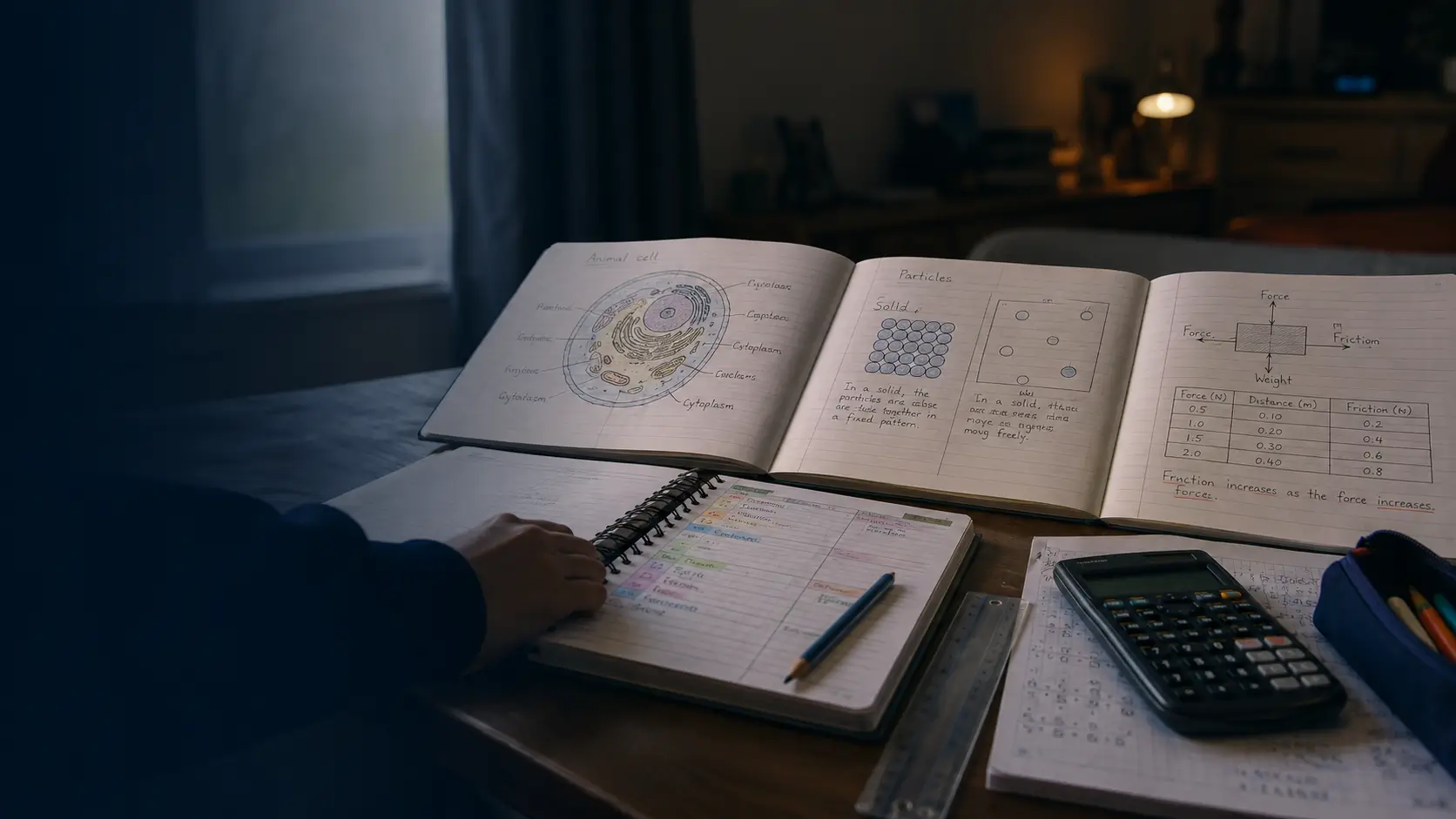
So the first lesson is diagnosis rather than delivery. The tutor works from your child's own exercise book — what has been covered, in what order, and where the explanations stop being explanations and start being descriptions.
Three Strands and the One That Runs Through Them
These are the four parts the national curriculum sets for Years 7 to 9. The fourth is the one parents rarely hear about and the one GCSE examiners rely on most.
Biology
Cells and organisation, the human body, reproduction, photosynthesis and respiration, ecosystems and inheritance. The strand students usually find most approachable, which is why a weak grasp of it hides for the longest.
Chemistry
The particle model, atoms and elements, the periodic table, reactions and the conservation of mass. Almost everything here is a model of something invisible, so a student can draw the diagram correctly and still not be using it to think.
Physics
Forces, energy, electricity, waves, space and matter. The strand where the maths bites first, and the one most likely to be taught by a teacher whose own degree was in one of the other two.
Working scientifically
Variables, fair tests, accuracy, anomalies, graphs and conclusions. It is not a topic with its own lessons, it is assessed inside all three strands, and it is the single most transferable thing a KS3 student can be taught.
Most KS3 Science Problems Are Maths Problems
A KS3 science lesson quietly assumes a set of maths skills it does not teach: proportion, converting units, reading a scale, plotting and reading a graph, and rearranging a formula to make a different quantity the subject. Those are taught in maths, in a different room, sometimes a year later than science first needs them.
This is why a student can be genuinely interested in science, strong on the biology, and still sinking in Year 8 physics. It also explains a pattern parents see and misread: the child who “understands it when the teacher explains it” but cannot do the questions. Understanding was never the failure — a numerical step inside the question was, and a lesson that only re-explains the science will not find it.
Assumed, not taught
The maths a KS3 science lesson expects a student to already have:
- Proportion
- Unit conversion
- Reading a scale
- Plotting a graph
- Reading a graph
- Rearranging a formula
- Significant figures
- Standard form
A first lesson checks these before it checks any science, because a gap here looks exactly like a gap in the subject and is fixed somewhere else entirely.
What Changes in Each KS3 Science Year
The three years fail in different ways, which is why Year 9 is the point most families act.
Familiar enough to switch off in
Much of Year 7 revisits primary content — the body, materials, forces — with new vocabulary attached. Students who conclude they already know this stop listening at exactly the point the naming, the units and the reasoning are being installed underneath.
Where science becomes abstract
Particles, energy transfer, chemical change and electric current all arrive here, and none of them can be seen. This is the year a student moves from describing science to modelling it, and the year a gap is most likely to open with nothing on a report to show it.
Often not KS3 at all any more
Many schools run a two-year KS3 and begin GCSE science in Year 9, at the same time as options are chosen and the combined-or-triple decision is made. Check which your child's school does — it changes what this year is for.
Year 9 is also when the combined-or-triple question is settled, and it is settled largely on how KS3 went — what combined and triple science actually mean is worth reading before the options form comes home.
Where GCSE Science Gaps Are Actually Formed
None of these appears on a report as a failed topic, because none of them is a topic. They are habits of thinking, and Years 7 to 9 are when they set.
The maths that arrives wearing a lab coat
Proportion, unit conversion, rearranging a formula, significant figures. All of it is maths, taught in a different room, and quietly assumed to be there in a science lesson. A student who is fine on the biology and lost on the calculation usually has a maths gap with a science label on it.
A model held as a picture
The particle diagram is drawn correctly and then never used. Asked why a gas can be compressed and a liquid cannot, the student describes the picture again rather than reasoning from it. GCSE chemistry and physics pay almost entirely for the second thing.
Everyday words doing scientific work
Energy is not used up, weight is not mass, and a strong acid is not a concentrated one. These collisions between ordinary and scientific meaning are formed at KS3 and are still costing marks in Year 11, because nobody ever flagged them as errors.
Method without variables
An experiment written up as a story of what happened, with no independent variable named and nothing held constant. The habit of asking what is being changed, what is being measured and what must stay the same is worth more at GCSE than any single topic.
All four are what GCSE science tutoring spends its time rebuilding once there is a specification, a tier decision and a set of required practicals competing for the same hours. Rebuilding them at KS3 is the cheapest version of this work that exists.
Bring the Science Exercise Book
One free demo class with an experienced science tutor. No payment, no obligation — and a straight answer about whether what you are seeing is a science gap, a maths gap wearing a science label, or nothing to worry about.
KS3 Tutoring Starts From £15 Per Lesson
Lessons are 1 hour. Your first demo class is completely free, there are no sign-up fees, and there's no contract — you can pause or stop at any time.
KS3
from £15/lesson
1-hour lesson