
The short version
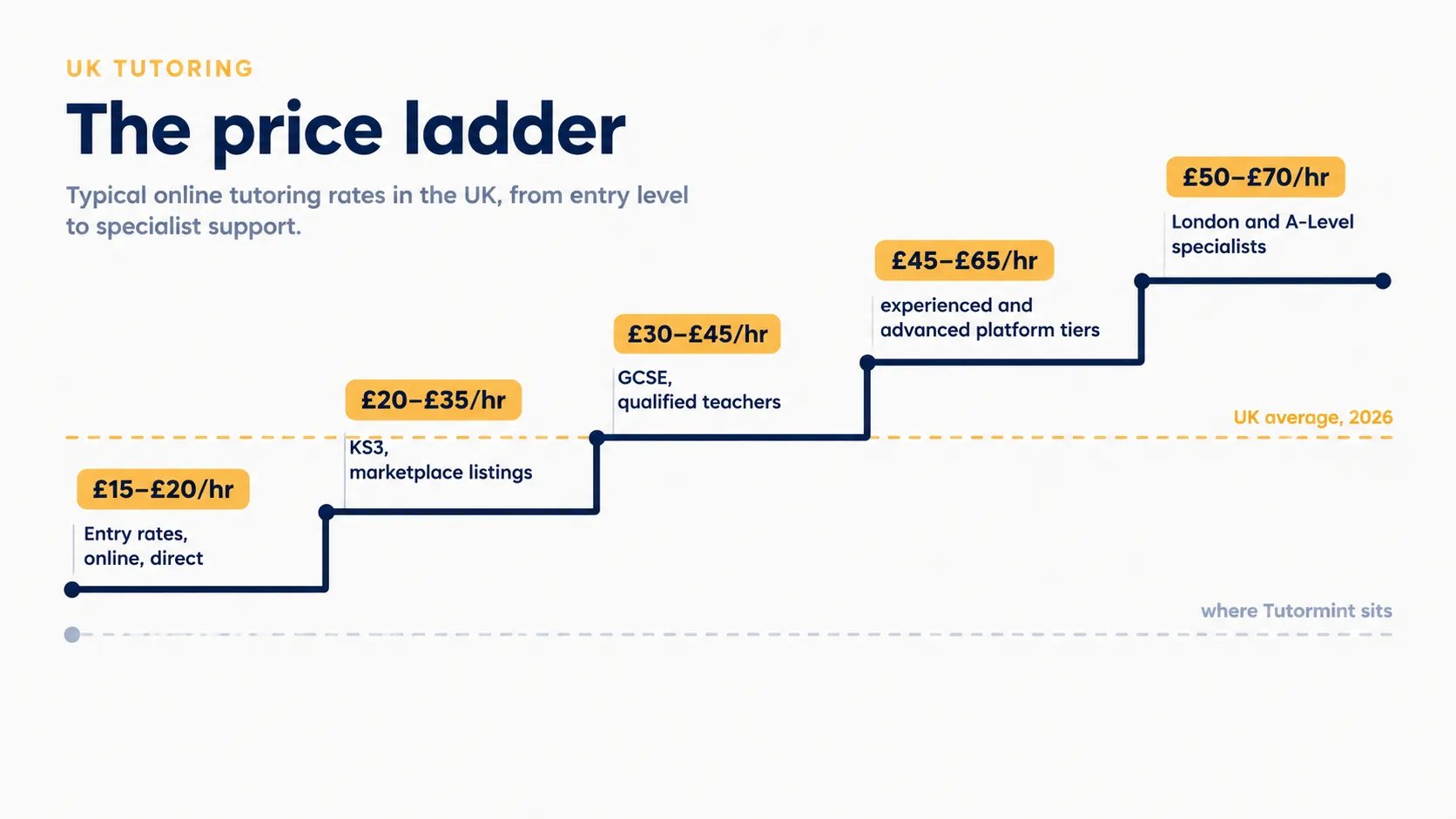
- Advertised UK tutoring rates in 2026 run from about £20 to £70 an hour. A 2026 industry survey puts the national average at £35–£40, and London at £50–£65.
- On the largest platforms, experience is priced explicitly: an experienced tutor is listed from £45 an hour, an advanced one from £65.
- Tutoring is now normal rather than exceptional. 29% of secondary pupils in England and Wales have had it — but 45% in London against 19% in rural areas, and 30% in the best-off households against 23% in the worst-off.
- That gap is about what families can pay, not about which children need help.
- Tutormint starts at £15 an hour for the 11+ and KS3, £20 at GCSE and £25 at A-Level, with the first lesson free. Same experienced teaching, priced against a household budget rather than a London hourly rate.
Every tutoring website will tell you what it charges. Almost none will tell you what the market charges, which is the number you actually need if you are deciding whether this is affordable for your family. So here is the whole ladder, sourced and dated, followed by the part of the story the price lists leave out.
What tutoring costs in the UK in 2026
Two things drive the headline rate: the level your child is working at, and who is doing the teaching. Subject matters far less than most parents expect. Below are the advertised ranges across UK agencies, marketplaces and independent tutors this year, set against a full school year of one lesson a week — because per-hour pricing hides how quickly a weekly commitment adds up.
Advertised UK rates, 2026. A school year here is 36 teaching weeks, one 1-hour lesson a week, one subject.
KS3 (Years 7–9)
- Typical advertised rate
- £20–£35/hr
- One subject, one school year
- £720–£1,260
- Tutormint
- from £15/hr (£540)
GCSE
- Typical advertised rate
- £20–£45/hr (qualified teachers £30+)
- One subject, one school year
- £720–£1,620
- Tutormint
- from £20/hr (£720)
11+ / entrance exams
- Typical advertised rate
- £25–£60/hr
- One subject, one school year
- £900–£2,160
- Tutormint
- from £15/hr (£540)
A-Level
- Typical advertised rate
- £25–£70/hr
- One subject, one school year
- £900–£2,520
- Tutormint
- from £25/hr (£900)
Advertised UK rates, 2026. A school year here is 36 teaching weeks, one 1-hour lesson a week, one subject.
| Level | Typical advertised rate | One subject, one school year | Tutormint |
|---|---|---|---|
| KS3 (Years 7–9) | £20–£35/hr | £720–£1,260 | from £15/hr (£540) |
| GCSE | £20–£45/hr (qualified teachers £30+) | £720–£1,620 | from £20/hr (£720) |
| 11+ / entrance exams | £25–£60/hr | £900–£2,160 | from £15/hr (£540) |
| A-Level | £25–£70/hr | £900–£2,520 | from £25/hr (£900) |
You will find higher averages quoted elsewhere, and they are not wrong. TutorCruncher's 2026 rate survey puts GCSE tuition at £30–£55 an hour and A-Level at £35–£70, with a national average of £35–£40. The lower ends of our table come from marketplace listings where new and student tutors set their own entry prices; the survey figures describe what established tutors and agencies actually bill. Both are real. Which one applies to you depends mostly on where you live: that same survey has London at £50–£65 an hour and the North East at £28–£40.
The clearest illustration of what you are paying for sits on MyTutor's own pricing page, which sorts tutors into three bands: emerging tutors from £25 an hour, experienced tutors from £45, and advanced tutors from £65. That is the market being honest. Experience is the product, and on the big platforms experience roughly doubles the price.
£1,620
One GCSE subject, one lesson a week, one school year, at £45 an hour
36 weeks × 1 hour. Two subjects doubles it. Most families need two.
The number the price lists do not show
The Sutton Trust has tracked private tuition in England and Wales for twenty years. Its February 2026 report found that 29% of secondary school pupils have had a private tutor at some point, up from 18% two decades ago. Tutoring stopped being a luxury purchase somewhere in that period and became something close to a default.
But the same report shows exactly who is taking part:
- 45% in London, 19% in rural areas. The same national curriculum, the same exams, a gap of more than two to one in who gets extra help with them.
- 30% in the best-off households, 23% in the worst-off. Roughly where the gap sat in 2019, so the last few years have not narrowed it.
- 33% in urban areas against 19% outside them, and 20% of pupils now get tutoring through school, down from 22% in 2023 as school programmes are cut back.
Read those numbers next to the table above and the mechanism is not subtle. A weekly GCSE lesson at the London rate costs more across a school year than most households have spare, for one subject. Interest in tutoring is not what varies between a family in Kensington and a family in County Durham. Price is.
This is the whole reason Tutormint prices the way it does. Not as a discount offer with an end date, and not as an entry rate that climbs once you are committed, but because a market where the average hour costs more than a weekly food shop leaves out most of the children who would benefit from it.
If you are new to the UK, the pricing is even harder to read
Families who have recently moved here face the same price ladder with none of the context. You are learning what KS3, GCSE and A-Level mean, which of AQA, Edexcel, OCR and WJEC your child's school actually uses, whether the 11+ applies where you live, and how far behind or ahead your child is against a curriculum they have never been taught. Then somebody quotes you £55 an hour with a confident explanation, and you have no way to judge whether that is the going rate or an opportunistic one.
It is also the point where the avoidable costs appear. Registration and matching fees. Compulsory blocks of ten lessons paid upfront. Cancellation terms that charge full price when a child is ill. Platform commission sitting quietly inside the hourly rate. None of these are illegal and none of them are rare, and all of them are easier to sell to a parent who has just arrived.
Five questions that price any UK tutor accurately, wherever you are from:
- 1Which exam board does my child's school use, and will you teach to that specification?
- 2Is the hour I pay for teaching time, or does it include admin, marking or setup?
- 3Is there a registration fee, a minimum block, or a notice period?
- 4What happens to my money if my child is ill on lesson day?
- 5Can I see a real lesson before I pay anything?
Any tutor worth hiring will answer all five in a sentence each. Hesitation on the last two is the useful signal — a service confident in its teaching has no reason to refuse a trial lesson, and a service that keeps your money when your child has a temperature has told you how it thinks about families.
Cheap and affordable are not the same thing
This is the fair objection to everything above, and it deserves a straight answer. A low rate can mean a business has found a way to charge less for the same work, or it can mean the work itself has been cut down. The difference is visible in what the lesson contains, not in the price.
Affordable tutoring still includes
- A tutor with real teaching experience at that level, not someone one year ahead of your child
- A planned lesson built on a diagnosed gap, not an hour of checking homework
- Teaching to your child's actual exam specification, with that board's past papers
- Written notes after each lesson and honest progress updates to you
- One rate per level whatever the subject, and no charge for rescheduling illness
Genuinely cheap tutoring cuts
- Preparation — the tutor arrives without a plan and improvises from the textbook
- Group sizes — a 'one-to-one' rate that turns out to be one-to-four
- Specification accuracy — generic maths teaching that ignores which board sets the paper
- Feedback — no notes, no updates, and no honest answer when it is not working
- The trial — payment upfront, before you have seen anyone teach
Ask a low-priced tutor to walk you through that first column. If the answers are solid, the low rate is a business decision. If they are vague, the low rate is the product.
Where we chose to sit on that ladder
Tutormint starts at £15 an hour for the 11+ and KS3, £20 at GCSE and £25 at A-Level. Across a 12-week term of weekly lessons that is £180, £240 and £300 per subject, all in. There is no registration fee, no compulsory upfront block and no contract, and rates do not rise in exam season — the price you agree in September is the price you pay in May.
Three structural reasons that number can be lower without the teaching being thinner:
- Everything runs online. No travel time is priced into your bill, no fuel, no dead half-hour between houses. That alone removes a large slice of what an in-person tutor has to charge.
- It is not a marketplace. There is no platform commission sitting between you and your tutor, and no advertising spend to recover on every lesson you book.
- Level sets the rate, not subject. GCSE maths and GCSE English cost the same. You never pay a premium because a subject sounds harder or happens to be in demand this year.
We say this plainly on the pricing page too: these rates sit at or below the bottom of the UK range while Tutormint is still a growing business, and they will be reviewed as it grows. What will not change is the intention behind them, or the rate you have already agreed.
What you get for it is a tutor with genuine classroom and one-to-one experience, teaching live to your child's specification. The first lesson is free, deliberately, because the only honest way to settle an argument about quality is to let a parent watch one hour of teaching and judge it. If it is not right, you have lost nothing but the hour.
What to expect at any price
Whoever you end up hiring, ours included, these are reasonable things to insist on:
- A diagnosis before a plan. A tutor who has not established what is actually wrong is guessing expensively.
- Movement in confidence within three or four weeks, and measurable change by the next assessment cycle.
- A tutor who tells you when tutoring is not the answer — when the gap is organisation, sleep or a subject choice rather than teaching.
- The freedom to change tutor without penalty if the match is wrong. Personality fit is not a luxury at this age.
- A clear answer to what happens if you need to pause. Life happens mid-term.
None of that costs more to provide. It is simply what a tutoring service should be, whether it charges £15 an hour or £65.
Ready to find out where your child stands?
Sources
Written by TutorMint Founder
10+ years of classroom and one-to-one teaching experience. Facts checked 6 September 2026.
Found this useful?
Add Tutormint as a preferred source and our guides show up higher when you search Google.