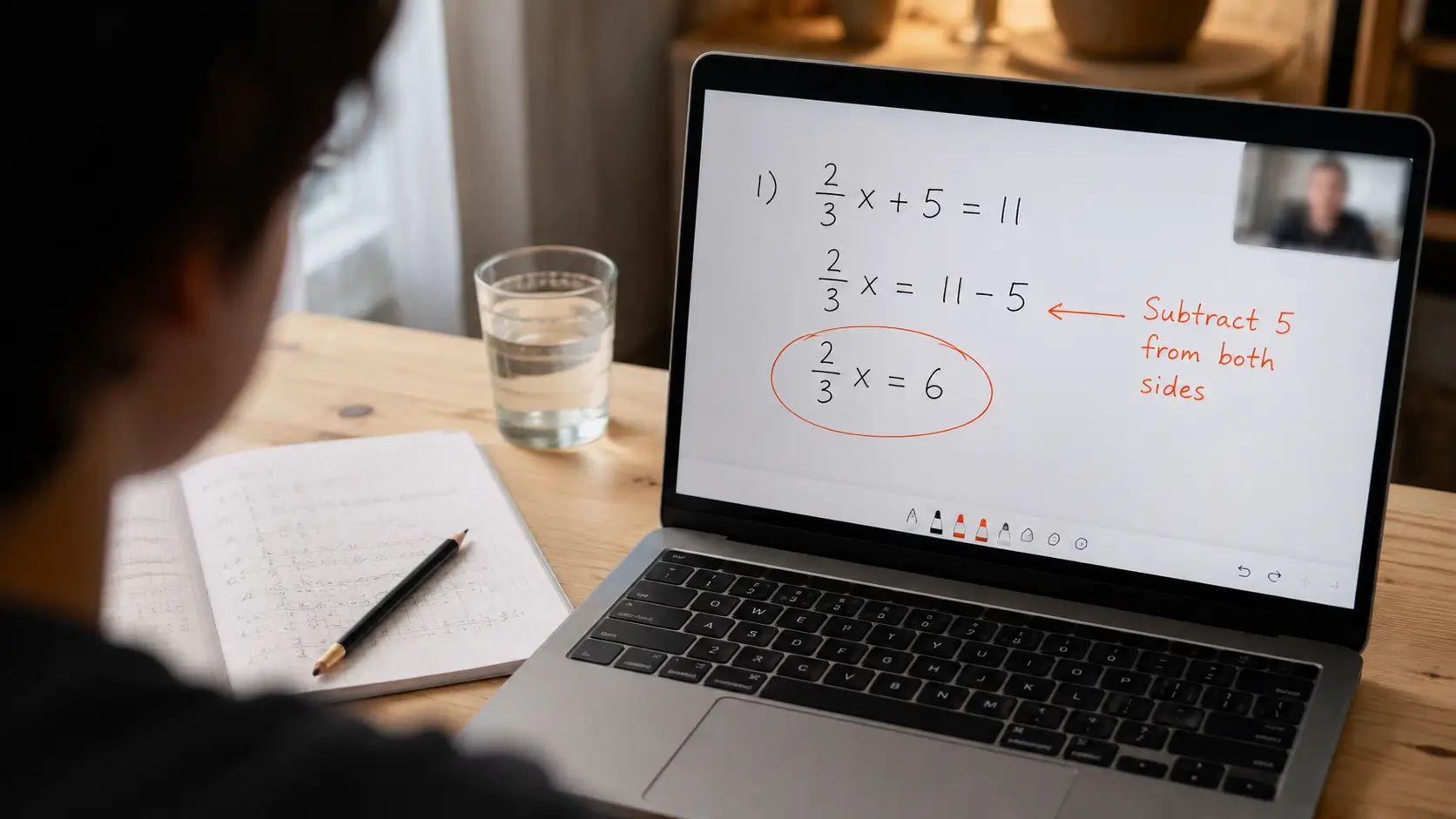
A one-to-one online lesson is not a video call with a teacher talking at your child. It is two people writing on the same page at the same time. That is the whole mechanic, and once you have seen it described minute by minute, most of the worry about whether online "works" answers itself.
Before the first lesson: the demo and the match
Nothing starts with a payment. It starts with a message.
You fill in the short demo form or message on WhatsApp with your child's year group, subject and what has been difficult. A recent test or school report helps but isn't required. Tutormint replies within two hours, 9am to 9pm UK time, seven days a week, to arrange the demo.
The demo class is a real lesson, not a sales call. It runs about 40 minutes with a tutor matched to your child's subject and level, and woven into it is a short assessment: the tutor works through questions to find not just what your child gets wrong, but why. There is no charge and no obligation at any point.
Afterwards you get feedback — strengths, gaps, and a recommended plan covering lesson frequency and what the first month would cover. If the tutor was the right fit, they continue. If not, a different tutor is matched and the second demo is free too.
That sequence exists because the wrong tutor is the most common reason tutoring fails, and it is much cheaper to discover that before any money changes hands. If you are comparing providers, the questions to ask before you pay anyone are worth having in front of you.
The tools: what your child actually needs
Less than most parents expect.
- A laptop or tablet, a headset if you have one, and a quiet spot.
- Lessons run in the browser through Google Meet. Nothing to install, no software to manage, no account for your child to set up.
- A shared screen or whiteboard, which is where the actual teaching happens.
- Their own exercise book and the school's worksheet, if the lesson is about specific homework — one advantage of learning at their own desk is that the real material is right there.
If anything doesn't work before a lesson, you message on WhatsApp and it gets sorted live rather than eating into the lesson.
A typical lesson, in sequence
Every tutor works slightly differently and every child needs something different, so treat this as the shape of an hour rather than a script.
Minutes 0–5 · Landing. Camera on, quick check on the week: what came up in class, what the last homework felt like, whether a test has been announced. This is not small talk — it's how the tutor decides whether today's plan survives contact with reality.
Minutes 5–15 · Retrieval of last week. Two or three questions on what was covered last time, done cold. Not because it's a test, but because it's the only way to know whether last week stuck. This is where a good online lesson beats a passive one: there is nowhere to hide in a one-to-one, and no way to nod along.
Minutes 15–40 · The topic, worked together on the whiteboard. The tutor and your child write on the same board at the same time — solutions written out step by step, texts annotated, diagrams sketched. Typically it moves: worked example by the tutor, then a similar question with prompts, then one your child does alone while the tutor watches the working appear. The reason working is written out rather than answers spoken is that most lost marks are method errors, and a method error is invisible until you can see the steps.
Minutes 40–52 · Independent practice with the tutor watching. Exam-style questions where possible, at your child's board and exam board. The tutor stays quiet and intervenes at the point of hesitation — the most informative moment in the lesson.
Minutes 52–60 · Consolidation and next steps. What was covered, what's still shaky, and short practice set for the week. Lessons follow the UK national curriculum and your child's exam board specification, and each one builds directly on the last, because it's the same tutor every week — no time lost re-explaining where your child is to a new face. The full sequence is also set out on how it works, step by step.
How tutors keep younger children focused on a screen
The honest answer is structure, not entertainment.
One-to-one lessons hold attention better than classrooms or group calls simply because your child is being asked a question every minute or two. There is nothing passive to hide behind. For younger students and 11+ preparation, shorter and more frequent sessions sometimes work better than a single longer one, and the tutor will say so if that's what suits your child.
Parents are welcome to sit in on any lesson, without notice. Many do for the first few sessions. Nothing about the lesson changes when you're in the room, which is itself worth knowing.
Between lessons: homework and support
Each lesson ends with short practice so progress continues between sessions. It is deliberately short — the point is retrieval, not volume.
If homework is the specific problem, that is its own service: homework help sessions are built around the work your child has actually been set, at their own desk with their own book, where the tutor teaches the method rather than handing over answers. There's a reason we draw that line hard. An answer app can produce a correct answer while concealing the one thing you need to know — which step your child couldn't do.
How parents actually see progress
Three mechanisms, none of which require you to ask:
- An update after lessons — topics covered, homework set, how your child is doing and what's next.
- Adjustment around school assessments. When mock or test results come in, the tutor changes the plan to match what the results show rather than continuing a pre-written scheme.
- Sitting in whenever you want. The most direct evidence available, and it costs nothing.
What you should not expect is a promised grade. Nobody can honestly offer that, and anyone who does is selling something other than teaching.
Is online actually as good as someone in your kitchen?
The fair answer is that for one-to-one teaching, the delivery method appears to matter far less than the teaching.
The Education Endowment Foundation's Teaching and Learning Toolkit puts one-to-one tuition at around five months' additional progress on average, drawing on more than 120 studies, and notes that studies involving digital technology show broadly similar effects — while online delivery costs less than in-person. Its wider review of remote learning reached the same conclusion in plainer terms: teaching quality matters more than how lessons are delivered. Those are averages across many programmes, not a prediction for one child. The longer version is in what the evidence says about online vs in-person.
Where online genuinely wins is mundane: no travel either side, a much larger pool of specialist tutors than your postcode contains, and your child working at their own desk with their own materials. Where in-person can win is with children who need physical presence to stay regulated and engaged — and an evaluation of one large online tuition pilot found that face-to-face tuition was preferred by both tutors and learners, so this is a real consideration rather than a marketing weakness to hide.
The demo class exists precisely so you can find out which camp your child is in without paying to guess — and one-to-one online tutoring sets out what the ongoing arrangement looks like after it.
What it costs, and what you're committing to
Lessons are one hour. They start from £15 for 11+ and KS3, from £20 at GCSE and from £25 at A-Level. The first demo class is free, there are no sign-up fees, and there is no contract — you can pause or stop at any time.
Rescheduling is free with at least 24 hours' notice. If your child is unwell, message before the lesson and it's rescheduled free of charge. If a tutor ever has to cancel, the lesson is never charged.
Ready to find out where your child stands?
Sources
- Education Endowment Foundation — One to one tuition: around five months' additional progress from more than 120 studies; digital-technology studies show broadly similar effects; online delivery costs less than in person
- Education Endowment Foundation — Remote learning: rapid evidence assessment (teaching quality matters more than how lessons are delivered)
- Education Endowment Foundation / NatCen — Online Tuition pilot evaluation: face-to-face tuition was preferred by both tutors and learners
Written by TutorMint Founder
10+ years of classroom and one-to-one teaching experience. Facts checked 13 August 2026.
Found this useful?
Add Tutormint as a preferred source and our guides show up higher when you search Google.