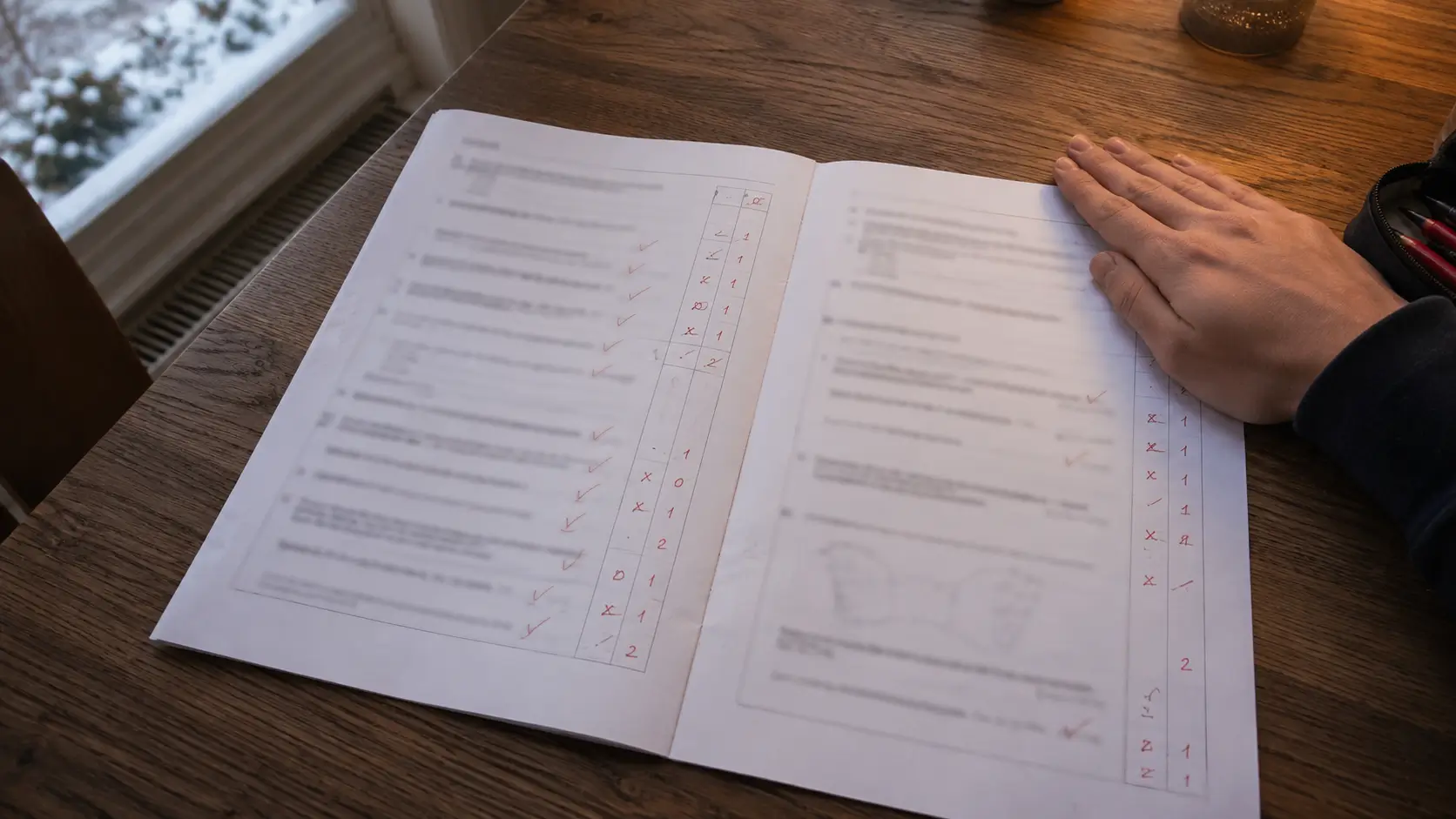
Bad mock results: the short answer
- A mock grade is not a GCSE grade. Boundaries are set after each real series, against that year's papers, so a mock marked to last year's boundaries is measuring against a standard that no longer exactly applies.
- The course is not finished. A November or January mock covers content that is missing the last two terms, which is why the same student's grade usually moves between the mock and the summer.
- The mark breakdown is the valuable part and the grade is the noise. Which questions, which topics, and whether the marks were lost to not knowing, to slipping, or to the clock.
- A bad mock in Year 11 is early enough to act on and late enough to take seriously — there are two terms left, and they are the two that decide the grade.
- One thing a bad mock does affect immediately: predicted grades, tier decisions and sixth-form conversations. That is the practical reason not to shrug it off.
Mock results arrive in December or January carrying their own particular dread, and they produce two equally wrong reactions in the same week: this is a disaster, and mocks do not count. Neither is true. Here is what a mock is actually measuring, and what to do with it.
Why a mock grade is not a GCSE grade
Grade boundaries are not fixed in advance. Exam boards set them after each series has been marked, by looking at marked papers from that year and previous years, so that the standard stays the same even when the paper does not. If this year's paper turns out slightly harder, the boundaries come down; slightly easier, and they go up. Whatever boundary a school applies to a mock therefore comes from somewhere else — a previous series, or an indicative figure supplied with a practice paper — rather than from an award made against the papers this year group actually sat.
So when a school converts a mock mark into a grade, it is applying a boundary borrowed from a previous series to a paper that was never awarded against it. That is a reasonable working estimate. It is not the same measurement as a GCSE grade, in either direction — mocks are often marked harshly on purpose, and sometimes flatter.
Add the second thing, which is bigger: the course is not finished. A mock sat in November of Year 11 covers a syllabus with two terms still to teach, and it is usually written to include only what has been taught. Every year, students conclude from a mock that they cannot do a subject they have not yet been taught the whole of.
What a bad mock does tell you
All of the value is underneath the grade, and it is worth more than any other single piece of information you will get in Year 11. Get the paper, not the number.
Reading a mock paper: what each pattern means and what it needs
Marks lost across the last two questions of every paper
- What it is
- Timing, not knowledge
- What it needs
- Timed sections rather than more content revision
Method marks missing where the answer is right
- What it is
- Exam technique — working not shown
- What it needs
- One rule: write the line before the answer, every time
One topic wrong wherever it appears
- What it is
- A genuine gap, and a findable one
- What it needs
- Two hours on that topic, then a past paper to confirm
Strong on recall questions, weak on applied ones
- What it is
- The content is learned but not usable
- What it needs
- Past-paper questions by topic, not more notes
Blank space rather than wrong answers
- What it is
- Either the clock or avoidance
- What it needs
- Ask which — the child knows, and will usually say
Down in every subject at once
- What it is
- Not subject knowledge — revision method, or something outside school
- What it needs
- Fix the method before buying any subject help
Reading a mock paper: what each pattern means and what it needs
| What the paper shows | What it is | What it needs |
|---|---|---|
| Marks lost across the last two questions of every paper | Timing, not knowledge | Timed sections rather than more content revision |
| Method marks missing where the answer is right | Exam technique — working not shown | One rule: write the line before the answer, every time |
| One topic wrong wherever it appears | A genuine gap, and a findable one | Two hours on that topic, then a past paper to confirm |
| Strong on recall questions, weak on applied ones | The content is learned but not usable | Past-paper questions by topic, not more notes |
| Blank space rather than wrong answers | Either the clock or avoidance | Ask which — the child knows, and will usually say |
| Down in every subject at once | Not subject knowledge — revision method, or something outside school | Fix the method before buying any subject help |
The single most useful thing you can do with a mock paper takes twenty minutes: sit down with your child and put every lost mark into one of three piles — did not know it, knew it and got it wrong, ran out of time. Three different problems with three different fixes, and mixing them up is the most common reason a term of revision changes nothing. It is the same sorting exercise that works on a disappointing result at any point.
The part that does count immediately
Mocks are not the qualification, but they are used for real decisions in the weeks after they are marked:
- Predicted grades. Sixth forms and colleges ask for them, and a mock sat in December is often the most recent evidence a school has when it writes them.
- Tier entry. In maths and the sciences, the Foundation-or-Higher decision is confirmed in Year 11 and mock performance is a large part of the evidence behind it. Foundation maths is capped at grade 5, so this decision sets the ceiling.
- Intervention groups. Schools use mocks to allocate their own after-school and revision resources. A mock result is often the thing that gets a child into that support, which makes it worth understanding rather than hiding.
This is the reason not to file a bad mock under "it does not count". It does not count towards the GCSE. It does count towards the decisions being made about your child in January.
What to do in the fortnight after
- 1Get every paper home, including the subjects that went well — the contrast is informative
- 2Sort the lost marks into the three piles before anyone plans any revision
- 3Pick two topics per subject, not a syllabus. A term has room for depth or for coverage, not both
- 4Ask each teacher one question: what is the biggest single thing between this mark and the next grade?
- 5Check the tier entry for maths and science, and ask what would need to change for a different decision
- 6Rebuild the revision method before adding hours to it — self-testing beats rereading, and it is the cheapest change available
- 7Book the next full past paper for four to six weeks' time, under timed conditions, as the actual test of whether any of this worked
On method rather than hours: the two techniques with the best evidence behind them are active recall and spaced repetition, and most students who "revised hard and it did not work" were rereading. If the honest problem is how much time is going in, how many hours to revise for GCSEs has realistic numbers rather than heroic ones.
Is it too late to recover?
From a December mock, no — two terms is a long time, and the marks between a grade 3 and a grade 4 in maths are typically a few per paper rather than a rewrite of the subject. What is true is that the recovery has to be specific. Students who move a grade between the mock and the summer are almost never the ones who simply revised more; they are the ones who knew exactly which topics and which habits were costing them, because somebody read the paper properly in January.
If that is the help you want, it is the narrow kind: our GCSE tutoring starts with a free demo class that includes going through a real paper and naming the gaps, in maths, English or science. Lessons are 1 hour, one-to-one on Google Meet, from £20, with no sign-up fee and no contract — so a targeted half-term between the mock and the exams is a normal thing to buy and then stop. Rates are on the pricing page.
Ready to find out where your child stands?
Sources
- AQA — Grade boundaries: boundaries are set by senior examiners only once all papers have been marked, because it is not until then that it is possible to see how difficult students found the paper compared with previous years
- GOV.UK — Get the facts: GCSE reform (reformed GCSEs are linear, with all exams at the end of the course)
- TutorMint founder's teaching experience — 10+ years across home, academy and online teaching (the paper-reading table and the fortnight-after checklist)
Written by TutorMint Founder
10+ years of classroom and one-to-one teaching experience. Facts checked 31 August 2026.
Found this useful?
Add Tutormint as a preferred source and our guides show up higher when you search Google.