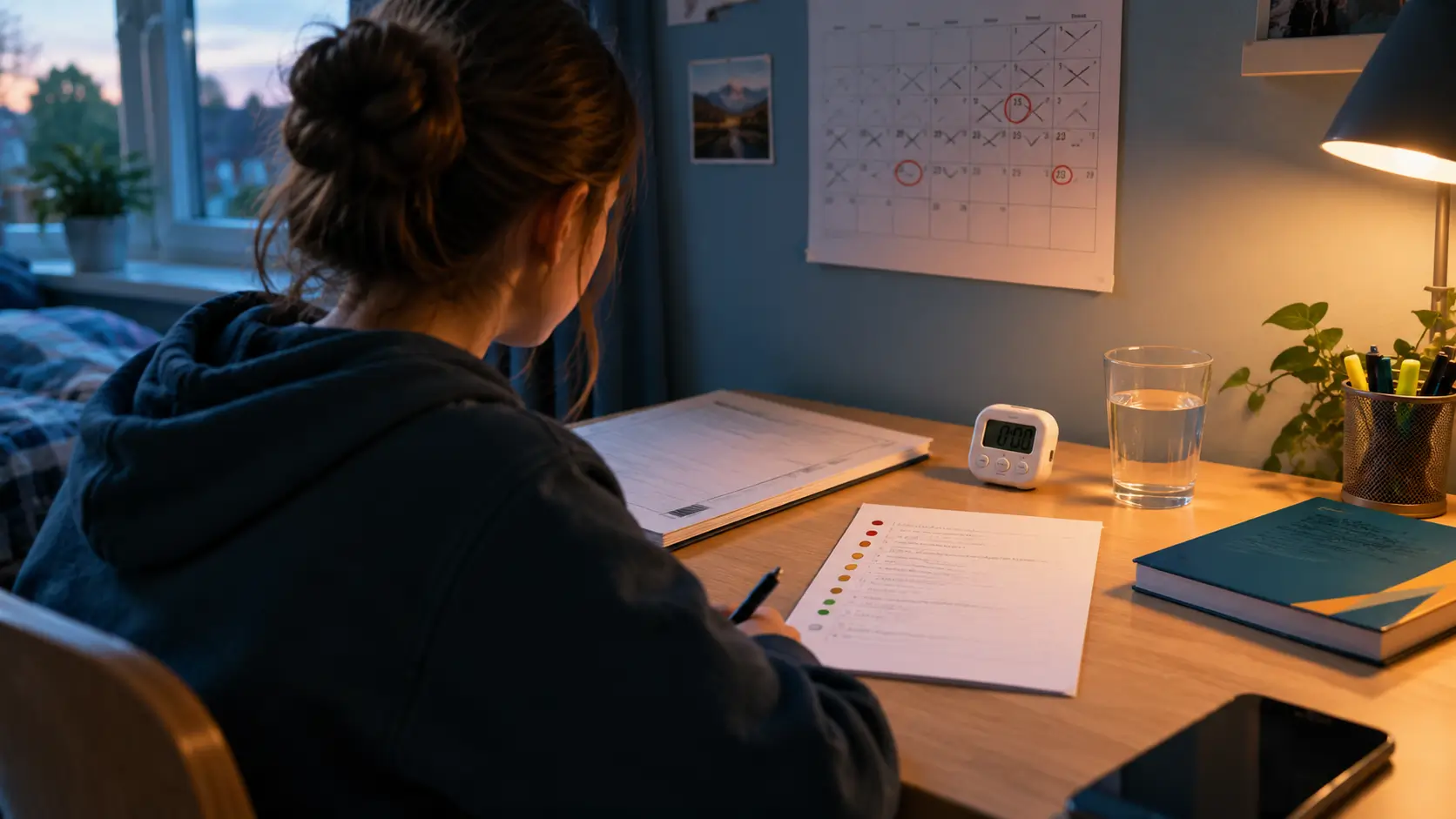
The short version
- Find out exactly what is being sat: which subjects, which exam board, which tier and which topics. Schools set mocks themselves, so this varies more than parents expect.
- Plan by topic, not by hours. List every topic, mark the weak ones, and spend the first four weeks on those.
- Swap rereading and highlighting for recall: closing the book and writing down what you remember, then checking.
- Do at least one timed paper per subject in the last fortnight, and mark it properly so you know why each mark was lost.
- Protect sleep in the final week. Teenagers need 8 to 10 hours, and their body clock naturally runs late.
Mocks don't count towards the final GCSE. But they are not nothing either. Schools use them to set predicted grades for sixth form and college applications, to decide which tier your child is entered for in maths and science, and to choose who gets extra support for the rest of Year 11.
That makes the six weeks before them unusually valuable. There is time to fix real gaps, not just cram. The five steps below are in the order they should happen.
Mock dates are set by your child's school, not by the exam boards. Many schools sit Year 11 mocks between November and January, and some run a second set in the spring. Check the school calendar or ask your child's tutor group teacher for the exact dates.
1. Find out exactly what is being sat
This sounds obvious, but it is the step most families skip, and it decides everything after it. Some schools set a full past paper. Others set a shortened paper covering only the topics taught so far. A child revising the whole course for a mock that covers half of it has wasted three weeks.
These questions fit in one email to the school, or a quick word with each subject teacher:
- 1Which subjects are being sat, and on which dates?
- 2Which exam board does each subject use? (AQA, Pearson Edexcel, OCR and WJEC Eduqas papers look different.)
- 3Is my child sitting Foundation or Higher in maths, science and languages?
- 4Is it a full paper, or only the topics taught so far? Which topics are in?
- 5How will the results be used: predicted grades, tier entry, or set changes?
The tier question matters most in maths, because Foundation tops out at a grade 5. If you are not sure what tiers mean or why the school chose one, our guide to being moved to Foundation maths explains it in plain English.
2. Plan by topic, not by hours
A revision timetable that says "Monday: maths, 1 hour" doesn't tell your child what to do when they sit down. A list of topics does. Get the topic list for each subject from the school, or from the exam board's specification, and have your child mark each one red (can't do it), amber (shaky) or green (confident). Be honest: green means they could answer an exam question on it now, without notes.
Then the plan writes itself. Red topics come first, because that is where the marks are. Green topics get almost no time until the last week. Our free revision timetable template has a topic tracker and a weekly planner built for exactly this.
- Weeks 1–2
List the topics and fix the reds
Red-amber-green every subject. Spend most sessions on the red topics in the two or three subjects that matter most for your child's next step.
- Weeks 3–4
Ambers, and a first timed paper
Move on to amber topics. Sit one timed paper in the subject your child is most worried about, so there is still time to act on what it shows.
- Week 5
Timed papers and marking
One timed paper per main subject, each marked with the mark scheme. Each lost mark points to a topic or habit to fix this week.
- Week 6
Light, short and early nights
Quick recall of every topic, especially the greens. No new topics. Pack the kit, check the timetable, and go to bed at a normal time.
For how much revision is realistic on a school night, and how it should build towards the summer, see our guide to how many hours to revise for GCSEs.
3. Swap rereading for recall
Rereading notes and highlighting feel productive, because the material looks familiar. But familiar is not the same as remembered. In the exam hall there are no notes to recognise, only a blank space to fill. Revision should practise exactly that.
Revision that works
- Closing the book and writing down everything they remember, then checking what they missed
- Answering exam questions on a topic before rereading it
- Flashcards they test themselves on, not ones they just read
- Coming back to a topic a few days later instead of finishing it in one go
Revision that only feels like it works
- Rereading the textbook or class notes
- Highlighting, or copying notes out neatly
- Watching revision videos without answering anything afterwards
- Spending a whole evening on one topic and never returning to it
There is good evidence behind this. Our guide to active recall and spaced repetition explains why it works and how to use it at home.
If your child doesn't know where to start, a free one-hour demo lesson is a quick way to find out. A tutor works through recent tests or homework with them and tells you which topics are actually red. It costs nothing and there is no obligation.
Ready to find out where your child stands?
4. Do timed papers, then mark them properly
A child who can answer a question at the kitchen table with no time limit may not manage it in 90 minutes in an exam hall. The only way to find out is to sit a paper in real conditions: timed, no notes, no phone, in one sitting.
Don't worry about using up the paper the school might set. Exam boards hold the newest papers back for schools. Pearson, for example, gives only teachers the most recent papers, so that at least one stays unseen for mocks. The papers your child can download are older ones, and they are free to use as practice.
Then mark the paper with the board's mark scheme. The score matters less than the reason behind each lost mark, because each reason has a different fix.
Why marks were lost, and what to do about it
They didn't know the content
- What it usually means
- A red or amber topic
- The fix
- Back to step 2 and step 3 for that topic
They misread what the question asked
- What it usually means
- Command words such as "explain", "evaluate" or "show that"
- The fix
- Practise reading questions and underlining the command word before answering
They ran out of time
- What it usually means
- Too long on early questions, or no plan
- The fix
- Set a rough time per mark, and move on when it runs out
A careless slip
- What it usually means
- A copying error, missing units or a sign mistake
- The fix
- Leave five minutes to check, and check the slips they usually make
No working shown
- What it usually means
- Right answer in their head, but no method marks
- The fix
- Write every step down, even when it feels obvious
Why marks were lost, and what to do about it
| The mark was lost because | What it usually means | The fix |
|---|---|---|
| They didn't know the content | A red or amber topic | Back to step 2 and step 3 for that topic |
| They misread what the question asked | Command words such as "explain", "evaluate" or "show that" | Practise reading questions and underlining the command word before answering |
| They ran out of time | Too long on early questions, or no plan | Set a rough time per mark, and move on when it runs out |
| A careless slip | A copying error, missing units or a sign mistake | Leave five minutes to check, and check the slips they usually make |
| No working shown | Right answer in their head, but no method marks | Write every step down, even when it feels obvious |
5. Protect sleep and the week itself
Teenagers aged 13 to 18 need around 8 to 10 hours of sleep. Their body clock also shifts later during adolescence, so many naturally don't feel sleepy until 11pm or midnight. A late-night revision session in mock week takes from the sleep that makes the next morning's paper go well.
In the last week:
- Keep the same bedtime. Including the weekend before. An early night once doesn't make up for a week of late ones.
- Phones out of the bedroom. Just for mock fortnight, if every night is too much to ask.
- No new topics. The last few days are for recall of what they already know, not cramming something new.
- Pack the kit the night before. A clear pencil case, black pens, a ruler, a protractor, and a calculator with working batteries.
- Eat breakfast. A morning paper on an empty stomach is a harder paper.
When the results come back
Whatever the grades, the most useful thing about a mock is the marked paper. It shows exactly which topics and habits cost marks, months before the real exams. Ask to see the papers, not just the grades.
A disappointing mock is common, and it is not a prediction. Our guide to bad mock results explains how to read the paper and what to do next. Tier decisions are not usually final after the mocks either: the national deadline for summer exam entries is 21 February 2027.
Where a tutor fits in six weeks
Six weeks is six weekly lessons. That is not enough to reteach a whole GCSE, and we would never promise it. It is enough to find the topics that are costing the most marks, fix the biggest of them, and sit a timed paper with someone who can explain every lost mark.
What six weekly one-to-one lessons can cover before the mocks
1
- What happens
- Diagnosis. The tutor works through recent tests, homework or a short set of exam questions to find the red topics.
2–4
- What happens
- The red topics, in order of how many marks they carry, matched to your child's exam board and tier.
5
- What happens
- A timed paper, or part of one, done before the lesson and marked together. Every lost mark gets a reason and a fix.
6
- What happens
- Exam technique: command words, timing, and checking for your child's usual careless slips.
What six weekly one-to-one lessons can cover before the mocks
| Lesson | What happens |
|---|---|
| 1 | Diagnosis. The tutor works through recent tests, homework or a short set of exam questions to find the red topics. |
| 2–4 | The red topics, in order of how many marks they carry, matched to your child's exam board and tier. |
| 5 | A timed paper, or part of one, done before the lesson and marked together. Every lost mark gets a reason and a fix. |
| 6 | Exam technique: command words, timing, and checking for your child's usual careless slips. |
Our GCSE online tutoring is one-to-one, matched to your child's exam board, and covers maths, English and science. Lessons are one hour and start from £20 at GCSE, with no contract and no sign-up fee. Full rates are on our pricing page.
Timing matters here. Starting this week means up to six lessons before a mid-November mock. Starting in three weeks means three. If the mocks are close, tell us when you book the demo and the tutor will start with the highest-mark topics.
Ready to find out where your child stands?
Sources
- Pearson — Past papers information for students: "Only teachers at Pearson-approved schools and colleges have access to the most recent exam papers. This is to ensure that there is at least one exam paper that can be used for a mock exam." Students can access papers more than nine months old for most qualifications
- Newcastle upon Tyne Hospitals NHS Foundation Trust — Sleep in older children: age 13–18 years, 8–10 hours; teenagers have a natural tendency to fall asleep later, closer to 11pm or midnight
- Joint Council for Qualifications — Key dates, June 2027 examination series: deadline for GCSE and GCE entries 21 February 2027
Written by TutorMint Founder
10+ years of classroom and one-to-one teaching experience. Facts checked 8 October 2026.
Found this useful?
Add Tutormint as a preferred source and our guides show up higher when you search Google.