The short version
- Download the free template below: a start page for mock dates, a red-amber-green topic tracker, a weekly planner and a filled-in example week.
- Plan topics, not subjects. "Maths, 40 minutes" gives a teenager nothing to start on. "Simultaneous equations, six exam questions" does.
- Red topics go in first, and each one goes in twice a week. Coming back to a topic a few days later is what makes it stick.
- Every slot needs a method that tests your child, such as recall or exam questions, not rereading.
- Plan a rest evening and one empty slot. A timetable with no slack falls apart the first time a week goes wrong.
- If the same topics are still red after three weeks, that is a teaching gap, not a planning one. A timetable can't fix it on its own.
Most teenagers make a revision timetable at some point. Few are still using it a fortnight later. Usually the timetable is the problem, not the teenager. A grid of colour-coded subjects and hours looks organised, but when your child sits down at 7pm on a Tuesday it doesn't tell them what to actually do.
The template below is built around topics instead. It takes about half an hour to set up the first time and ten minutes each Sunday after that. It works for mocks and for the summer exams, and it is free to print and share.
Free GCSE revision timetable template
Four A4 pages: a start page for mock dates, a red-amber-green topic tracker, a weekly planner and a filled-in example week. No sign-up. Print as many copies as you need.
What's in the template
- Page 1: start here. A table for every mock (subject, exam board, tier, paper and date), the five steps below in short, and what a week that lasts looks like.
- Page 2: the topic tracker. One sheet per subject. List every topic, mark it red, amber or green, write the date each time it is revised again, and mark it again at week four. This is the page that tells you what goes in the planner.
- Page 3: the weekly planner. Seven days, two sessions on weekdays and a third at weekends, a column for what to come back to, and space for the week's red topics and hours. Print one a week.
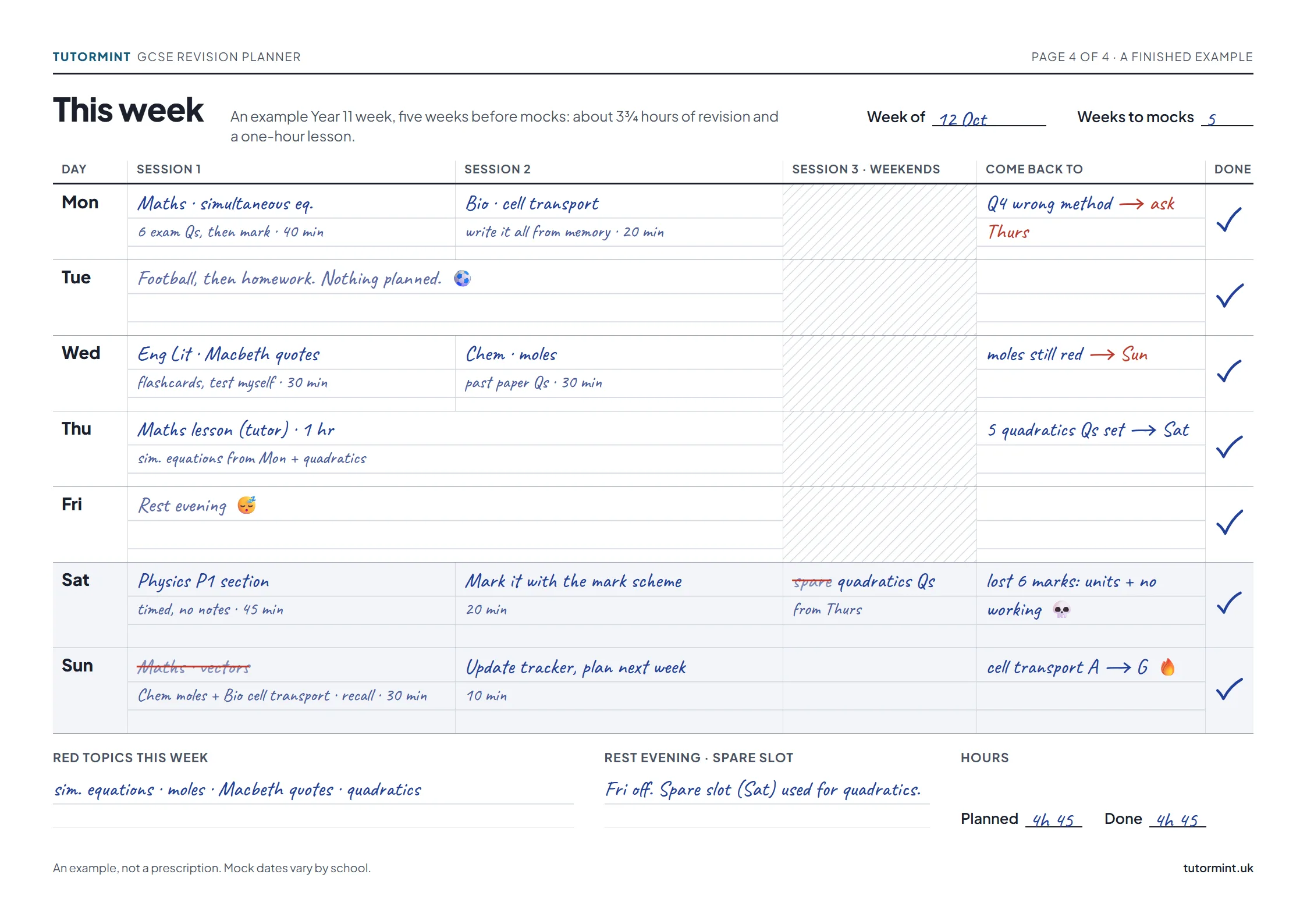
- Page 4: a filled-in example. A Year 11 week five weeks before mocks, written by hand, crossings-out included, so your child can see what a good slot looks like.
How to fill it in, step by step
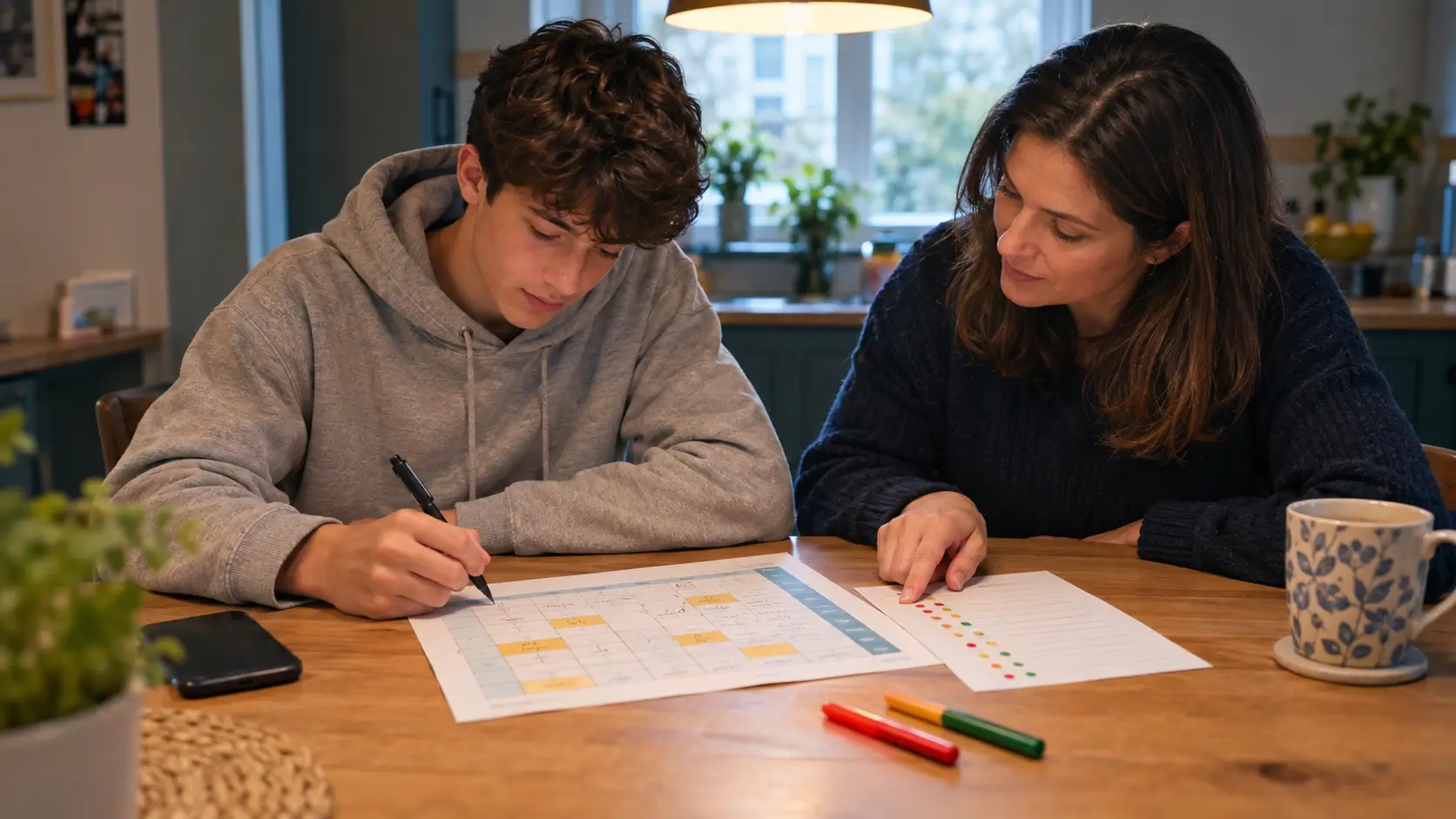
Do the first one together. It goes faster with two people, and your child is far more likely to stick to a plan they helped make than one handed to them.
1. Get the topic list for each subject
Ask each subject teacher which topics the mock covers. Some mocks are a full paper, others only cover what has been taught so far. If the school can't say, use the exam board's specification, which lists every topic.
2. Mark every topic red, amber or green
On the topic tracker. Red means they can't do it yet. Amber means they can, but only with notes. Green means they could answer an exam question on it now, without notes. Be strict about green.
3. Block out the fixed things first
School, homework, clubs, work and family evenings. Whatever is left is the real revision time. Most Year 11s have room for one or two sessions on most school nights, not three.
4. Fill the slots with red topics, each one twice
Write a subject, a topic and a method in every slot. Red topics in the subjects that matter most for your child's next step go in first, and each red topic goes in a second time later in the week.
5. Leave a rest evening and one empty slot
The empty slot is for whatever slipped. On Sunday, spend ten minutes updating the tracker and writing the next week's sheet from it.
How much to put in it
Less than most families expect, at least at the start. A timetable that asks for three hours every night is abandoned within days. One that asks for an hour on most school nights is still running in December. These weekly totals sit on top of homework:
A realistic weekly revision load
Year 10
- Revision per week
- 1–2 hours
- What the timetable is for
- Building the habit: end-of-topic self-testing and flashcards
Year 11, September to November
- Revision per week
- 4–6 hours
- What the timetable is for
- Mock preparation: red topics first, first timed paper sections
Year 11, December to February
- Revision per week
- 5–8 hours
- What the timetable is for
- Fixing what the mock papers showed, subject by subject
Year 11, March to Easter
- Revision per week
- 8–12 hours
- What the timetable is for
- Timed papers in every subject, and marking them properly
Final weeks before the summer exams
- Revision per week
- 12–18 hours
- What the timetable is for
- Recall of every topic, falling as the exams begin
A realistic weekly revision load
| When | Revision per week | What the timetable is for |
|---|---|---|
| Year 10 | 1–2 hours | Building the habit: end-of-topic self-testing and flashcards |
| Year 11, September to November | 4–6 hours | Mock preparation: red topics first, first timed paper sections |
| Year 11, December to February | 5–8 hours | Fixing what the mock papers showed, subject by subject |
| Year 11, March to Easter | 8–12 hours | Timed papers in every subject, and marking them properly |
| Final weeks before the summer exams | 12–18 hours | Recall of every topic, falling as the exams begin |
The example week comes to about three and three-quarter hours of revision plus a one-hour lesson, which sits inside the autumn range. For the full term-by-term picture, see our guide to how many hours to revise for GCSEs.
What goes in a slot
The method matters as much as the topic. A large review of study techniques by John Dunlosky and colleagues found that practice testing and spreading study out over time were of high utility. Rereading and underlining were of surprisingly low utility, even though they are what most students do by default. So every slot on the timetable should make your child produce an answer, not just look at one.
Good slots
- Maths: simultaneous equations, six exam questions, then mark them
- Biology: cell transport, write down everything from memory, then check
- English Literature: Macbeth key quotes, flashcards, test yourself
- Physics: Paper 1 section, timed, no notes, then mark it with the mark scheme
Slots that won't get done well
- Maths, 1 hour
- Read over biology notes
- Make English flashcards (making them isn't revising)
- Physics revision
Past papers belong in the timetable from the autumn, not just in May. The papers your child can download are older ones, because exam boards keep the newest papers back for schools to use as mocks. Our guide to active recall and spaced repetition explains how to make recall sessions work at home.
Not sure which topics are really red? Teenagers tend to mark topics green because they recognise them, not because they can do them. A free one-hour demo lesson is a quick way to check. A tutor works through recent tests or homework with your child and tells you which topics should go on the timetable first.
Ready to find out where your child stands?
Why revision timetables fall apart, and the fix
The usual reasons, and what to change
They sit down and don't know where to start
- Why
- The slot says a subject, not a topic
- The fix
- Write the topic and the method in every slot
It's abandoned after one bad week
- Why
- No slack. One missed night and the plan is already wrong
- The fix
- One rest evening and one empty slot every week
Hours go in, but the marks don't move
- Why
- Rereading and highlighting instead of testing
- The fix
- Every slot ends with an answer your child wrote
The favourite subject gets all the time
- Why
- Green topics feel good to revise
- The fix
- Plan from the tracker, red topics first
The same topics stay red week after week
- Why
- They were never properly understood in the first place
- The fix
- Revision can't fix this alone. It needs reteaching
The usual reasons, and what to change
| What happens | Why | The fix |
|---|---|---|
| They sit down and don't know where to start | The slot says a subject, not a topic | Write the topic and the method in every slot |
| It's abandoned after one bad week | No slack. One missed night and the plan is already wrong | One rest evening and one empty slot every week |
| Hours go in, but the marks don't move | Rereading and highlighting instead of testing | Every slot ends with an answer your child wrote |
| The favourite subject gets all the time | Green topics feel good to revise | Plan from the tracker, red topics first |
| The same topics stay red week after week | They were never properly understood in the first place | Revision can't fix this alone. It needs reteaching |
That last row is the one to watch. A timetable is very good at showing where the problem is. It can't explain simultaneous equations to a child who didn't follow them in class. If the topic tracker shows the same reds in week four as in week one, more revision time won't help. Someone needs to teach the topic again, in a different way.
Your part as a parent
- Help make it, then step back. Help with the first week's sheet. After that it is your child's plan. Checking every slot turns it into a battle.
- Ten minutes on Sunday. Ask what went red to green this week and what is still red. That one question tells you more than any amount of checking.
- Ask for the topic lists. Teachers usually respond to a parent's email faster than to a student's question. You can get the mock topics and the exam board for every subject in one message.
- Protect the rest evening. It is part of the plan, not a failure of it. So is sleep: teenagers need around 8 to 10 hours, and a late-night session costs the next day.
- Phones in another room during slots. Just for the length of each session, if every evening is too much to ask.
If revision has already become an argument at home, our guide to homework battles covers how to help without taking over. For what to do with the weeks before mocks beyond the timetable, see five things to do in the six weeks before GCSE mocks.
Where a weekly lesson fits in the timetable
Look at Thursday in the example week. Monday's maths mistake is written in the notes column, and it goes straight into Thursday's lesson. The tutor then sets questions for Saturday's spare slot. That is what a weekly lesson adds to a timetable: the red topics that won't move get reteaching, and the rest of the week gets work set from it.
What one lesson a week does for the timetable
Your child decides alone which topics are red
- With a weekly lesson
- The first lesson checks the tracker against real exam questions
A stuck topic stays red
- With a weekly lesson
- A stuck topic gets taught again, a different way
Timed papers get marked, or don't
- With a weekly lesson
- Lost marks are explained, one by one
The plan relies on willpower
- With a weekly lesson
- There is a fixed hour each week that the rest of the week builds around
What one lesson a week does for the timetable
| Without a lesson | With a weekly lesson |
|---|---|
| Your child decides alone which topics are red | The first lesson checks the tracker against real exam questions |
| A stuck topic stays red | A stuck topic gets taught again, a different way |
| Timed papers get marked, or don't | Lost marks are explained, one by one |
| The plan relies on willpower | There is a fixed hour each week that the rest of the week builds around |
Our GCSE online tutoring is one-to-one and matched to your child's exam board, with tutors for maths, English and science. Lessons are one hour, start from £20 at GCSE, and come with no contract and no sign-up fee. Full rates are on our pricing page.
If the mocks are in mid-November, a lesson a week starting now means about five lessons before them. Starting after half-term means two or three. When you book the free demo, tell us the mock dates and bring the topic tracker. The tutor will start with the red topics worth the most marks.
Ready to find out where your child stands?
Sources
- Association for Psychological Science — summary of Dunlosky et al. (2013), Improving Students' Learning With Effective Learning Techniques: practice tests and distributed practice "were found to be of high utility"; underlining and rereading "were found to be of surprisingly low utility"
- Pearson — Past papers information for students: the most recent papers are kept for teachers so that at least one can be used for a mock exam
- Newcastle upon Tyne Hospitals NHS Foundation Trust — Sleep in older children: age 13–18 years, 8–10 hours
- Weekly revision totals by stage — Tutormint, How Many Hours Should You Revise for GCSEs? (10+ years of GCSE teaching)
Written by TutorMint Founder
10+ years of classroom and one-to-one teaching experience. Facts checked 8 October 2026.
Found this useful?
Add Tutormint as a preferred source and our guides show up higher when you search Google.