One-to-One Online KS3 Maths Tutoring for Years 7 to 9
Maths is the KS3 subject set earliest and the one where a gap compounds fastest. Lessons rebuild the steps GCSE maths assumes were secure by Year 9 — before the set, and then the tier, are decided.
- Year 7
- Year 8
- Year 9
- Number
- Algebra
- Geometry
The Subject That Is Sorted First
Most secondary schools teach maths in sets grouped by attainment, and many set from the first term of Year 7 — earlier than any other subject. The set is usually drawn from the Year 6 SATs and a school's own baseline test, and it decides how fast your child moves through the next three years and how much of the harder content they meet.
Meanwhile there is nothing at the end of KS3 to check the result. The national tests sat at fourteen were abolished in 2008 and national curriculum levels were withdrawn in 2014, so each school now reports progress on a scale of its own — the same structural absence that shapes KS3 English and KS3 Science. In maths it matters more, because maths is hierarchical: a gap left in Year 7 is not one missing topic but a weak step inside everything built on it.
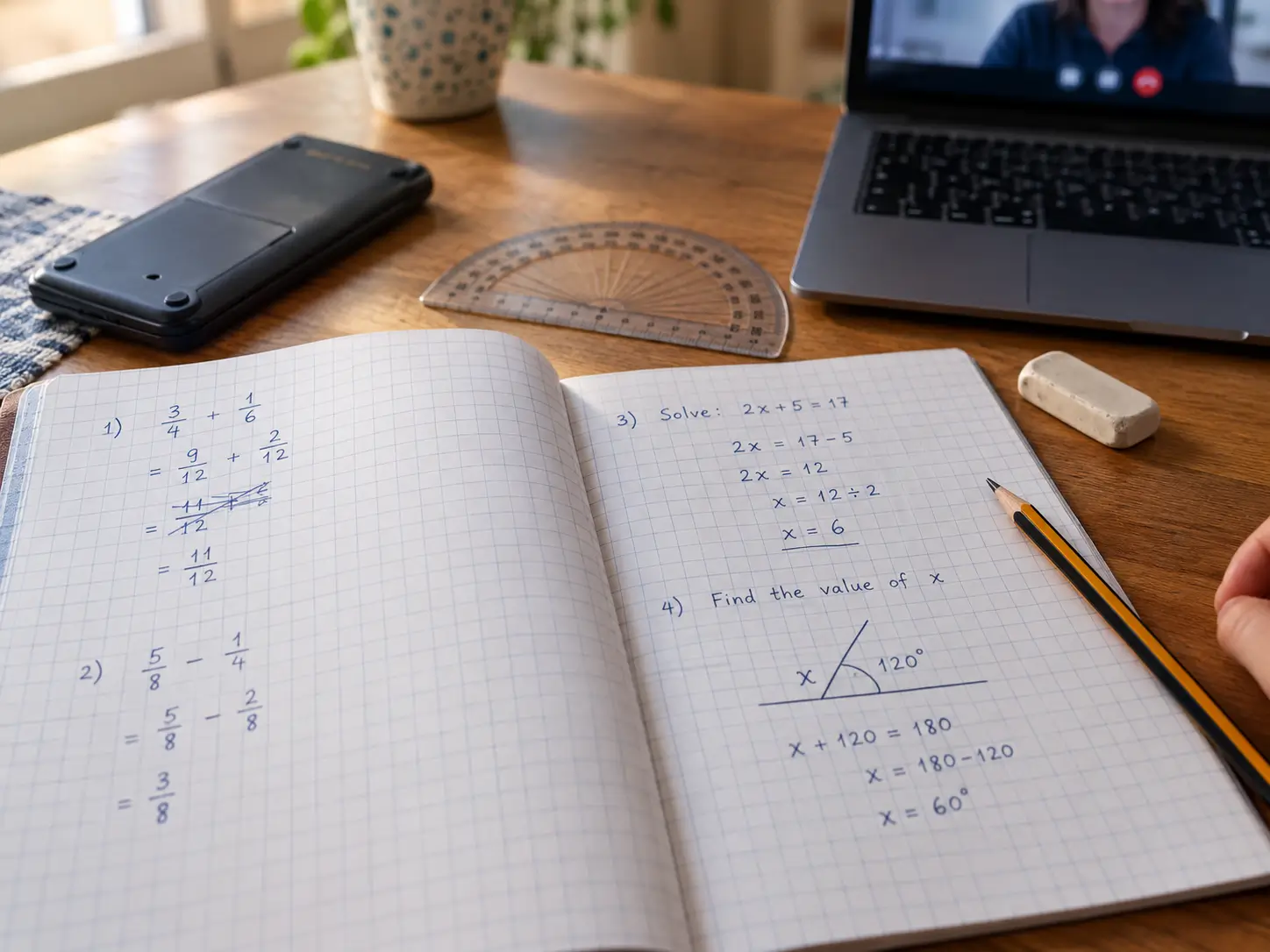
So the first lesson is diagnosis rather than delivery. The tutor works from your child's exercise book and watches how they answer, not just whether the answer is right, and traces each error back to the step that actually failed.
Six Strands, and Where Each One Goes Next
The national curriculum sets six areas of content for Years 7 to 9. Schools choose the order; GCSE examines all six.
Number
Place value, negatives, fractions, decimals and percentages as one system, powers and roots, and estimation. The strand everything else is built from.
At GCSE: Examined directly, and as a step inside almost every other question.
Algebra
Letters standing for numbers, expressions, equations, sequences and graphs. The strand where a student either learns that algebra is arithmetic written generally, or decides it is a separate subject they are bad at.
At GCSE: The largest share of Higher tier, and the gate to A-Level maths.
Ratio, proportion and rates of change
Scaling, sharing in a ratio, direct and inverse proportion, percentage change, speed and density. The strand the other subjects lean on most — science above all.
At GCSE: The strand most often hidden inside a wordy problem.
Geometry and measures
Angles, constructions, area and volume, transformations, Pythagoras and the start of trigonometry. The most visual strand, and the one where a missing formula is most often a missing understanding.
At GCSE: Formulae that KS3 is expected to have made memorable rather than looked up.
Probability
Outcomes, sample spaces, the 0-to-1 scale and combined events. Short on the timetable, so a gap here is easy to carry unnoticed into Year 10.
At GCSE: Tree diagrams and Venn diagrams build directly on it.
Statistics
Averages and spread, charts and tables, and choosing which one answers the question. Also taught in science and geography, often with different conventions.
At GCSE: Usually reasoning marks — interpreting, not just drawing.
The KS3 Set Quietly Shapes the GCSE Tier
GCSE maths is sat at one of two tiers, and the tier caps the grade. The entry decision is usually confirmed in Year 10 or Year 11 — but by then a student taught in a lower set since Year 7 may simply not have met the Higher content, and the decision is made for them by what was never taught.
That is why set reviews in Years 7 to 9 matter more than they look. Most schools move students between sets at fixed points after an assessment, and a student who has closed a specific gap before that point has a case to make. If your child has already been moved down, our guide on what being moved to Foundation maths means covers when it is the right call and when it is worth questioning.
Foundation
Grades 1–5
A grade 5 is the highest available.
Higher
Grades 4–9
Includes the algebra A-Level maths builds on.
Both tiers sit three papers, and one of the three is non-calculator — which is where a KS3 habit of reaching for the calculator first costs the most.
What Changes in Each KS3 Maths Year
Each year goes wrong differently, which is why Year 9 is the point most families act.
From SATs to sets
A Year 6 SATs result is the starting point most schools set from, sometimes alongside their own baseline test in the first weeks. The content then moves quickly — standard form and significant figures now appear in Year 7 papers — and the set your child lands in shapes what they are taught next.
Algebra becomes the language
Year 8 is where algebra stops being a topic and starts being how other topics are written: sequences become rules, area becomes a formula, a graph becomes an equation. A shaky Number strand shows up here first, as a student who cannot simplify an expression because the fractions inside it beat them.
Often GCSE already
Many schools start GCSE maths content in Year 9, and set changes made now tend to stick. It is the last year a gap can be closed without competing for time against a specification, which is why it is the year most families act.
If Year 7 maths looks nothing like what you remember, that is not your memory — we read 255 questions to check whether Year 7 maths is harder, and some of what used to be tested at fourteen is now taught at eleven. For the first term specifically, how to tell whether your child is behind in Year 7 separates ordinary adjustment from a real gap.
Where GCSE Maths Gaps Are Actually Formed
None of these appears on a report as a failed topic. They are habits and misreadings, and Years 7 to 9 are when they set.
Fractions and negatives that only fail as steps
Nothing on a report names the gap, because it never appears as a topic. A student who is shaky on fractions, negatives or rearranging does not fail one lesson — they lose marks wherever those operations turn up inside ratio, algebra, trigonometry or probability.
The equals sign read as “the answer goes here”
Primary arithmetic teaches that the equals sign comes before the answer. Algebra needs it to mean the two sides balance. A student who never makes that switch can solve one-step equations by guessing and stalls on anything with unknowns on both sides.
The calculator arrives without a method
Every Year 6 SATs maths paper is non-calculator; two of the three GCSE papers allow one. KS3 is where calculator use is supposed to be learned, and where it often replaces mental methods instead of supporting them — which the non-calculator GCSE paper then finds.
Right answers with no working
A strong KS3 student can carry a lot in their head, and is often praised for it. GCSE awards method marks on most longer questions and asks students to explain and justify. The habit of writing the steps down is far cheaper to build at twelve than at fifteen.
All four are what GCSE maths tutoring spends its time rebuilding once there is a specification, a tier decision and a non-calculator paper competing for the same hours. For every level from KS3 to A-Level, see our online maths tutor page.
Bring the Maths Exercise Book
One free demo class with an experienced maths tutor. No payment, no obligation — and a straight answer about which step is actually failing, whether the set is right, or whether there is nothing to worry about.
KS3 Tutoring Starts From £15 Per Lesson
Lessons are 1 hour. Your first demo class is completely free, there are no sign-up fees, and there's no contract — you can pause or stop at any time.
KS3
from £15/lesson
1-hour lesson